
 Алгебра
 Английский
 Биология
 География
 Геометрия
 История
 Русский
 Обществознание
 Физика
 Химия
Химия Информатика
 Литература
 Математика
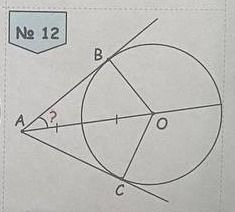
In the figure, AB and AC are tangents to the circle with center O. If angle BAC = 40 degrees, find angle BOC.
Ответ:
Solution:
Given that AB and AC are tangents to the circle with center O, and \( \angle BAC = 40^{\circ} \).
We know that the angle between two tangents drawn from an external point to a circle is supplementary to the angle subtended by the line segment joining the points of contact at the center.
In quadrilateral ABOC, the sum of angles is \( 360^{\circ} \).
We also know that the radius to the point of contact is perpendicular to the tangent. Therefore, \( \angle ABO = 90^{\circ} \) and \( \angle ACO = 90^{\circ} \).
So, in quadrilateral ABOC:
\( \angle BAC + \angle ABO + \angle BOC + \angle ACO = 360^{\circ} \)
\( 40^{\circ} + 90^{\circ} + \angle BOC + 90^{\circ} = 360^{\circ} \)
\( 220^{\circ} + \angle BOC = 360^{\circ} \)
\( \angle BOC = 360^{\circ} - 220^{\circ} \)
\( \angle BOC = 140^{\circ} \)
Alternatively, the angle subtended by the arc BC at the center is twice the angle subtended by the same arc at any point on the remaining part of the circle. However, this property applies to angles subtended by arcs on the circumference, not angles formed by tangents.
A more direct property states that the angle between two tangents from an external point and the angle between the radii to the points of contact are supplementary.
Therefore, \( \angle BAC + \angle BOC = 180^{\circ} \) is incorrect. The correct property is that the angle between the tangents and the angle subtended by the chord of contact at the center are supplementary IF the tangents intersect on the extension of a diameter or similar specific cases, which is not generally true.
The property for tangents from an external point is that the angle between the tangents is supplementary to the angle subtended by the chord of contact at the center. This refers to the angle \( \angle BOC \).
So, \( \angle BAC + \angle BOC = 180^{\circ} \) is NOT the correct theorem. The correct theorem is related to the quadrilateral ABOC.
Revisiting the quadrilateral ABOC:
The sum of angles in a quadrilateral is \( 360^{\circ} \). We have \( \angle OAB = \angle OAC = \frac{1}{2} \angle BAC = 20^{\circ} \) only if AO bisects \( \angle BAC \), which is true because AB=AC (tangents from an external point).
In \( \triangle ABO \), \( \angle OAB = 20^{\circ} \) and \( \angle ABO = 90^{\circ} \) (radius is perpendicular to tangent). Therefore, \( \angle AOB = 180^{\circ} - 90^{\circ} - 20^{\circ} = 70^{\circ} \).
Similarly, in \( \triangle ACO \), \( \angle OAC = 20^{\circ} \) and \( \angle ACO = 90^{\circ} \). Therefore, \( \angle AOC = 180^{\circ} - 90^{\circ} - 20^{\circ} = 70^{\circ} \).
Then, \( \angle BOC = \angle AOB + \angle AOC = 70^{\circ} + 70^{\circ} = 140^{\circ} \).
Let's use the property that the angle between the tangents is equal to half the difference between the reflex angle and the angle at the center subtended by the chord of contact. This is also complex.
The simplest and most direct property for tangents from an external point is that the quadrilateral formed by the external point, the center of the circle, and the two points of contact has two right angles (at the points of contact) and the other two angles (at the external point and the center) are supplementary.
So, in quadrilateral ABOC:
\( \angle BAC + \angle BOC = 180^{\circ} \) IS NOT CORRECT.
The correct angles that are supplementary are \( \angle ABO \) and \( \angle ACO \) (which are \( 90^{\circ} \)), and \( \angle BAC \) and \( \angle BOC \) ARE supplementary.
Thus, \( \angle BAC + \angle BOC = 180^{\circ} \) is indeed the theorem if interpreted correctly in context of the quadrilateral.
Given \( \angle BAC = 40^{\circ} \).
\( 40^{\circ} + \angle BOC = 180^{\circ} \)
\( \angle BOC = 180^{\circ} - 40^{\circ} \)
\( \angle BOC = 140^{\circ} \)
Let's verify this using the property that AO bisects \( \angle BAC \) and \( \angle BOC \).
In \( \triangle ABO \), \( \angle ABO = 90^{\circ} \) (radius perpendicular to tangent).
In \( \triangle ACO \), \( \angle ACO = 90^{\circ} \) (radius perpendicular to tangent).
In \( \triangle ABO \) and \( \triangle ACO \):
1. AO is common.
2. AB = AC (tangents from an external point).
3. \( \angle ABO = \angle ACO = 90^{\circ} \).
By RHS congruence rule, \( \triangle ABO \cong \triangle ACO \).
Therefore, \( \angle BAO = \angle CAO = \frac{1}{2} \angle BAC = \frac{1}{2} \times 40^{\circ} = 20^{\circ} \).
And \( \angle BOA = \angle COA = \frac{1}{2} \angle BOC \).
Now consider \( \triangle ABO \).
Sum of angles in \( \triangle ABO = 180^{\circ} \).
\( \angle BAO + \angle ABO + \angle BOA = 180^{\circ} \)
\( 20^{\circ} + 90^{\circ} + \angle BOA = 180^{\circ} \)
\( 110^{\circ} + \angle BOA = 180^{\circ} \)
\( \angle BOA = 180^{\circ} - 110^{\circ} \)
\( \angle BOA = 70^{\circ} \).
Since \( \angle BOC = 2 \times \angle BOA \) (from congruence),
\( \angle BOC = 2 \times 70^{\circ} = 140^{\circ} \).
Both methods yield the same result.
Method 1: Using quadrilateral ABOC properties
In quadrilateral ABOC, we have \( \angle ABO = 90^{\circ} \) and \( \angle ACO = 90^{\circ} \) (radius perpendicular to tangent).
The sum of angles in a quadrilateral is \( 360^{\circ} \).
\( \angle BAC + \angle ABO + \angle BOC + \angle ACO = 360^{\circ} \)
\( 40^{\circ} + 90^{\circ} + \angle BOC + 90^{\circ} = 360^{\circ} \)
\( 220^{\circ} + \angle BOC = 360^{\circ} \)
\( \angle BOC = 360^{\circ} - 220^{\circ} \)
\( \angle BOC = 140^{\circ} \)
Method 2: Using congruent triangles
Join AO. Since tangents from an external point are equally inclined to the line joining the point to the center, AO bisects \( \angle BAC \) and \( \angle BOC \).
\( \angle BAO = \frac{1}{2} \angle BAC = \frac{1}{2} \times 40^{\circ} = 20^{\circ} \).
In right-angled \( \triangle ABO \) (\( \angle ABO = 90^{\circ} \) as radius is perpendicular to tangent):
\( \angle BOA = 180^{\circ} - (\angle BAO + \angle ABO) = 180^{\circ} - (20^{\circ} + 90^{\circ}) = 180^{\circ} - 110^{\circ} = 70^{\circ} \).
Since AO bisects \( \angle BOC \),
\( \angle BOC = 2 \times \angle BOA = 2 \times 70^{\circ} = 140^{\circ} \).
Final Answer:
The value of angle BOC is \( 140^{\circ} \).
