
 Алгебра
 Английский
 Биология
 География
 Геометрия
 История
 Русский
 Обществознание
 Физика
 Химия
Химия Информатика
 Литература
 Математика
Вопрос:
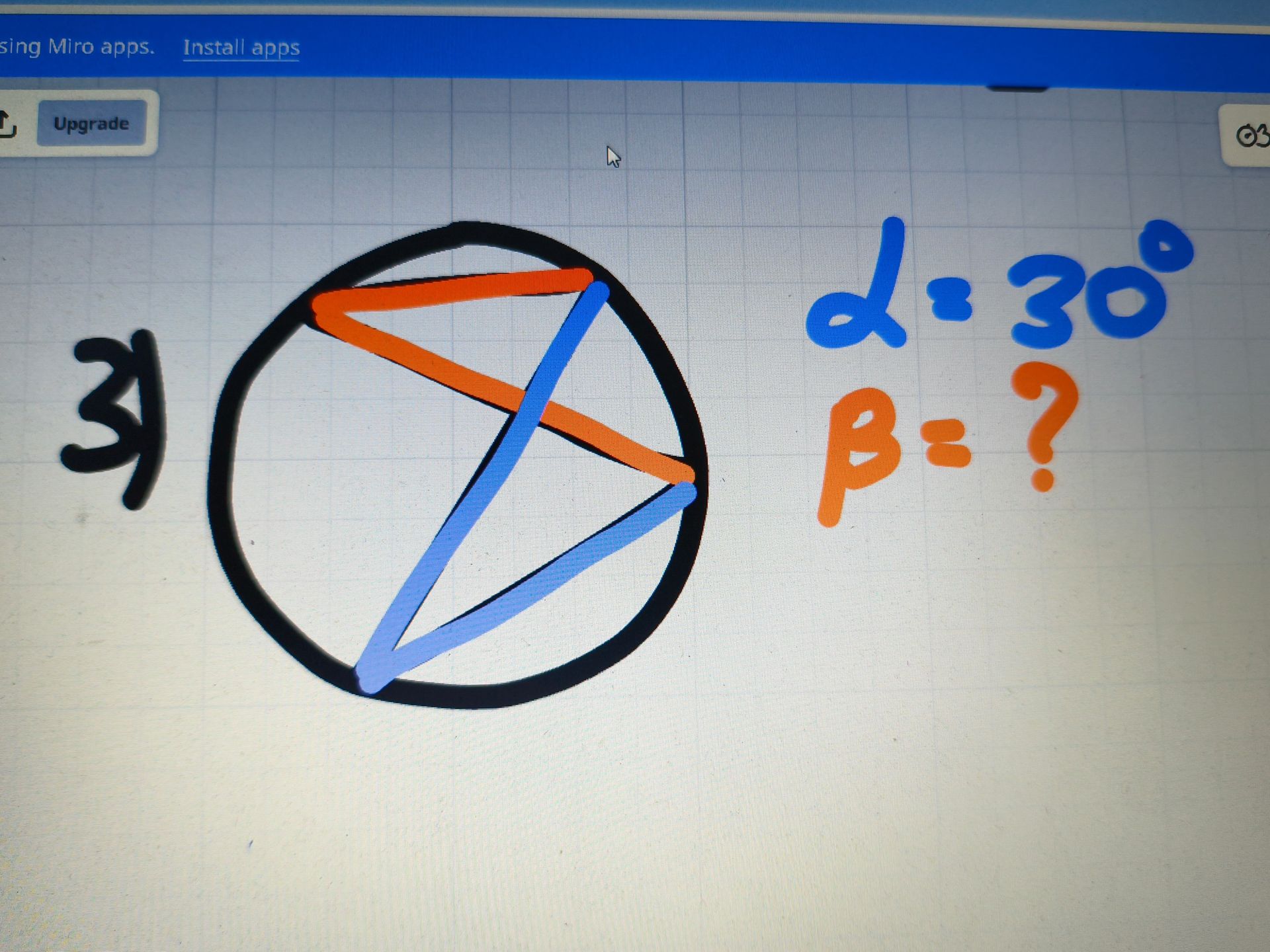
In the given figure, angle \(\alpha\) is 30 degrees. Find angle \(\beta\).
Ответ:
Solution:
The inscribed angle theorem states that the measure of an inscribed angle is half the measure of its intercepted arc. The central angle is equal to the measure of its intercepted arc.
In the figure, \(\alpha\) is an inscribed angle that intercepts an arc. Let the measure of this arc be \(m\).
According to the inscribed angle theorem:
\(\alpha = \frac{1}{2} m\)
Given \(\alpha = 30^{\circ}\), we can find \(m\):
\(30^{\circ} = \frac{1}{2} m\)
Multiply both sides by 2:
\(m = 2 \times 30^{\circ} = 60^{\circ}\)
Now, \(\beta\) is a central angle that intercepts the same arc with measure \(m\).
According to the definition of a central angle:
\(\beta = m\)
Therefore:
\(\beta = 60^{\circ}\)
Answer: \(\beta = 60^{\circ}\)
