
 Алгебра
 Английский
 Биология
 География
 Геометрия
 История
 Русский
 Обществознание
 Физика
 Химия
Химия Информатика
 Литература
 Математика
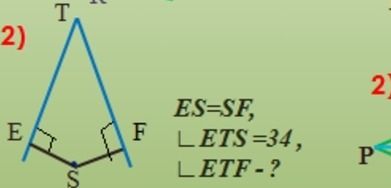
In the given figure, ES=SF, \(\angle\) ETS = 34 degrees. Find \(\angle\) ETF.
Ответ:
Solution:
We are given a triangle TEF with a point S inside it. We are provided with the following information:
- ES = SF: This means that triangle ESF is an isosceles triangle.
- \(\angle ETS = 34^{\circ}\)
We need to find \(\angle ETF\).
Let's analyze the given figure. We can see right angle symbols at points E and F, indicating that segments SE and SF are perpendicular to the sides TE and TF respectively. However, the markings on the sides TE and TF with single strokes suggest that TE = TF. If TE = TF, then triangle TEF is an isosceles triangle. In an isosceles triangle, the angles opposite the equal sides are equal, so \(\angle TEF = \angle TFE\).
Also, the markings on SE and SF with double strokes indicate SE = SF. This confirms that triangle ESF is isosceles.
Consider triangles TES and TFS:
- TE = TF (given by the markings on the sides, implying \(\triangle TEF\) is isosceles)
- ES = SF (given)
- TS is common to both triangles.
Therefore, by SSS congruence criterion, \(\triangle TES \cong \triangle TFS\).
From the congruence, we have:
- \(\angle ETS = \angle FTS\)
- \(\angle TES = \angle TFS\)
- \(\angle EST = \angle FST\)
We are given \(\angle ETS = 34^{\circ}\). Since \(\triangle TES \cong \triangle TFS\), it follows that \(\angle FTS = \angle ETS = 34^{\circ}\).
The angle \(\angle ETF\) is the sum of \(\angle ETS\) and \(\angle FTS\).
\[ \angle ETF = \angle ETS + \angle FTS \]
\[ \angle ETF = 34^{\circ} + 34^{\circ} \]
\[ \angle ETF = 68^{\circ} \]
Alternatively, if we consider the right angles indicated at E and F, it means that SE \(\perp\) TE and SF \(\perp\) TF. This would imply that \(\angle TES = 90^{\circ}\) and \(\angle TFS = 90^{\circ}\). However, the diagram also has markings indicating TE=TF and SE=SF. The markings for equal sides (single strokes on TE and TF, double strokes on SE and SF) are more definitive than the right angle symbols which seem to be inaccurately placed if TE=TF and SE=SF are true. Assuming the markings for equal sides are correct, and the triangle TEF is isosceles with TE=TF, and ES=SF:
In \(\triangle TEF\), since TE = TF, it is an isosceles triangle.
In \(\triangle ESF\), since ES = SF, it is an isosceles triangle.
Consider the triangles \(\triangle TES\) and \(\triangle TFS\).
- TE = TF (given)
- ES = SF (given)
- TS = TS (common side)
By SSS congruence, \(\triangle TES \cong \triangle TFS\).
Therefore, \(\angle ETS = \angle FTS\).
Given \(\angle ETS = 34^{\circ}\).
So, \(\angle FTS = 34^{\circ}\).
The angle \(\angle ETF\) is the sum of these two angles:
\[ \angle ETF = \angle ETS + \angle FTS = 34^{\circ} + 34^{\circ} = 68^{\circ} \]
Answer: \(\angle ETF = 68^{\circ}\).
