
 Алгебра
 Английский
 Биология
 География
 Геометрия
 История
 Русский
 Обществознание
 Физика
 Химия
Химия Информатика
 Литература
 Математика
Вопрос:
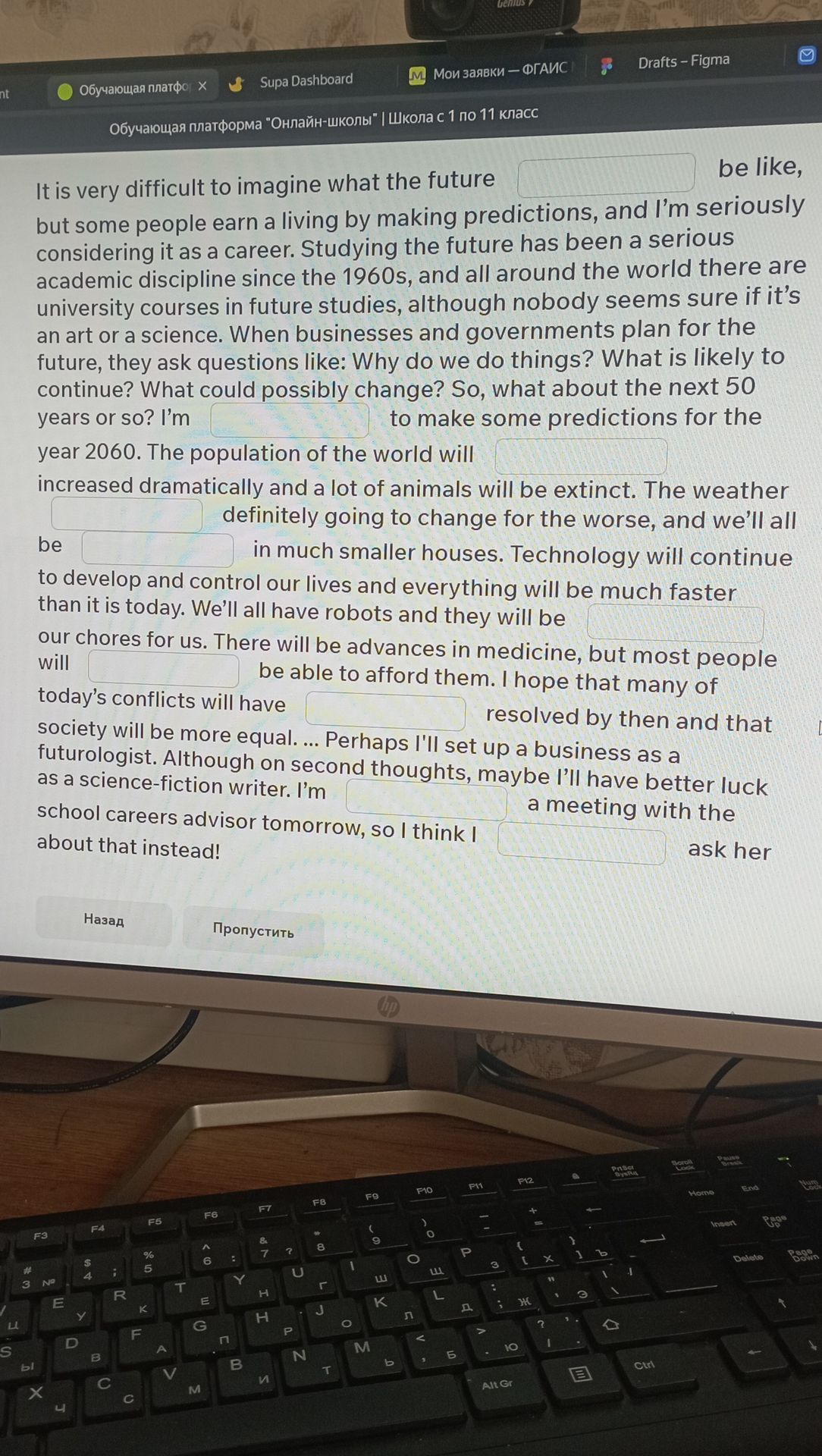
It is very difficult to imagine what the future ____ be like, but some people earn a living by making predictions, and I'm seriously considering it as a career. Studying the future has been a serious academic discipline since the 1960s, and all around the world there are university courses in future studies, although nobody seems sure if it's an art or a science. When businesses and governments plan for the future, they ask questions like: Why do we do things? What is likely to continue? What could possibly change? So, what about the next 50 years or so? I'm ____ to make some predictions for the year 2060. The population of the world will ____ increased dramatically and a lot of animals will be extinct. The weather will ____ definitely going to change for the worse, and we'll all be ____ in much smaller houses. Technology will continue to develop and control our lives and everything will be much faster than it is today. We'll all have robots and they will be ____ our chores for us. There will be advances in medicine, but most people will ____ be able to afford them. I hope that many of today's conflicts will have ____ resolved by then and that society will be more equal. ... Perhaps I'll set up a business as a futurologist. Although on second thoughts, maybe I'll have better luck as a science-fiction writer. I'm ____ a meeting with the school careers advisor tomorrow, so I think I ____ about that instead!
Ответ:
Решение:
Заполним пропуски подходящими по смыслу словами, чтобы текст стал логичным и завершенным.
- what - вводит придаточное предложение, описывающее будущее.
- trying - означает «пытаюсь», что соответствует контексту предсказаний.
- will - указывает на будущее время и предсказывает значительное увеличение.
- surely - подчеркивает уверенность в неизбежности изменения погоды.
- living - описывает состояние людей, живущих в меньших домах.
- doing - глагол, указывающий на выполнение роботами бытовых задач.
- be - вспомогательный глагол, образующий будущее время с 'will' и указывающий на возможность покупки.
- be - вспомогательный глагол, необходимый для образования страдательного залога с 'resolved'.
- having - предлог 'having' здесь используется для обозначения обстоятельства или состояния, связанного с будущим.
- going - 'going' в сочетании с 'I'm' (I am) образует Present Continuous, используемое для обозначения планов на ближайшее будущее.
Ответ: what; trying; will; surely; living; doing; be; be; having; going.
