
 Алгебра
 Английский
 Биология
 География
 Геометрия
 История
 Русский
 Обществознание
 Физика
 Химия
Химия Информатика
 Литература
 Математика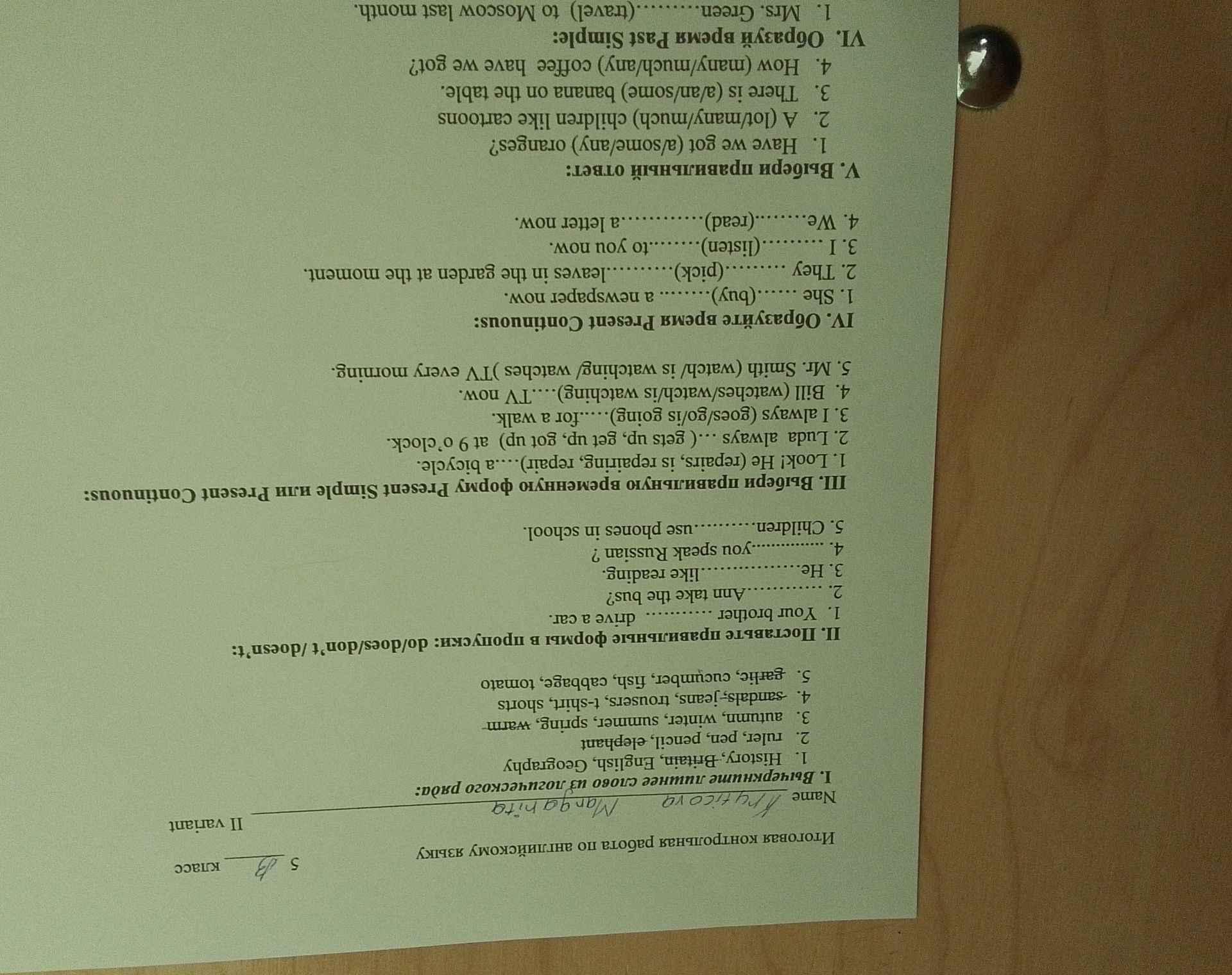
Ответ:
Итоговая контрольная работа по английскому языку
Name: Aruticova Margarita
Класс: 5 Б
II variant
I. Вычеркните лишнее слово из логического ряда:
- History, Britain, English, Geography (Geography is a science/subject, the others are related to places/language)
- ruler, pen, pencil, elephant (Elephant is an animal, the others are stationery items)
- autumn, winter, summer, spring, warm (Warm is a condition/adjective, the others are seasons)
- sandals, jeans, trousers, t-shirt, shorts (Shorts is a type of clothing, but distinct from the others in length, or consider 'warm' as the outlier in the previous question and re-evaluate. Assuming 'warm' is the outlier as it's an adjective. Shorts is also a type of clothing, making this debatable. However, if we consider the category of clothing items, 'shorts' fits better with the others than 'warm' does with seasons.) Let's assume the intended logic is 'warm' being an adjective and the others are nouns representing seasons. Then 'shorts' also fits as a clothing item. Let's stick with the initial logic for now and re-evaluate if needed. If 'warm' is an outlier because it's an adjective, then 'shorts' could also be an outlier if the others are considered a set of 'bottoms' or 'full-length' items. However, contextually, 'warm' is the most distinct as an adjective among seasons. If 'shorts' were removed, the remaining would be full-length garments or a broader category of attire. Let's stick with the first pass: warm is an adjective among seasons.
- garlic, cucumber, fish, cabbage, tomato (Tomato is a fruit, the others are vegetables or a protein)
II. Поставьте правильные формы в пропуски: do/does/don't/doesn't:
- Your brother does drive a car.
- Does Ann take the bus?
- He does like reading.
- Do you speak Russian?
- Children don't use phones in school.
III. Выбери правильную временную форму Present Simple или Present Continuous:
- Look! He is repairing a bicycle. (Present Continuous for an action happening now)
- Luda always gets up at 9 o'clock. (Present Simple for a habitual action)
- I always go for a walk. (Present Simple for a habitual action)
- Bill is watching TV now. (Present Continuous for an action happening now)
- Mr. Smith watches TV every morning. (Present Simple for a habitual action)
IV. Образуйте время Present Continuous:
- She is buying a newspaper now.
- They are picking leaves in the garden at the moment.
- I am listening to you now.
- We are reading a letter now.
V. Выбери правильный ответ:
- Have we got any oranges? (Used in questions and negative sentences)
- A lot of children like cartoons (or 'many' if 'children' is considered countable and the quantity is emphasized, 'a lot of' is more common in general statements). Let's assume 'a lot of' is the intended phrase for quantity. If 'many' is the intended answer, it implies a specific, possibly larger, countable quantity. Given the options are not provided, 'a lot of' is a reasonable interpretation of a general quantity. If we have to choose between 'a lot of' and 'many', 'a lot of' is often used in more informal contexts, while 'many' can be more formal or specific. Without explicit options, 'a lot of' seems plausible for a general statement. However, if the context implies a choice between 'a lot of' and 'many', 'many' might be preferred for countable nouns in affirmative sentences. The structure 'A ... children' suggests a phrase. Let's consider 'A lot of children'. If the options were 'a lot of', 'many', 'much', 'some', then 'a lot of' or 'many' would fit. If it's simply filling in a blank to complete a phrase, 'a lot of' is a common construction. Let's assume 'A lot of' is the intended completion.
- There is a banana on the table. (Singular countable noun)
- How much coffee have we got? (Uncountable noun)
VI. Образуй время Past Simple:
- Mrs. Green travelled to Moscow last month.
