
 Алгебра
 Английский
 Биология
 География
 Геометрия
 История
 Русский
 Обществознание
 Физика
 Химия
Химия Информатика
 Литература
 Математика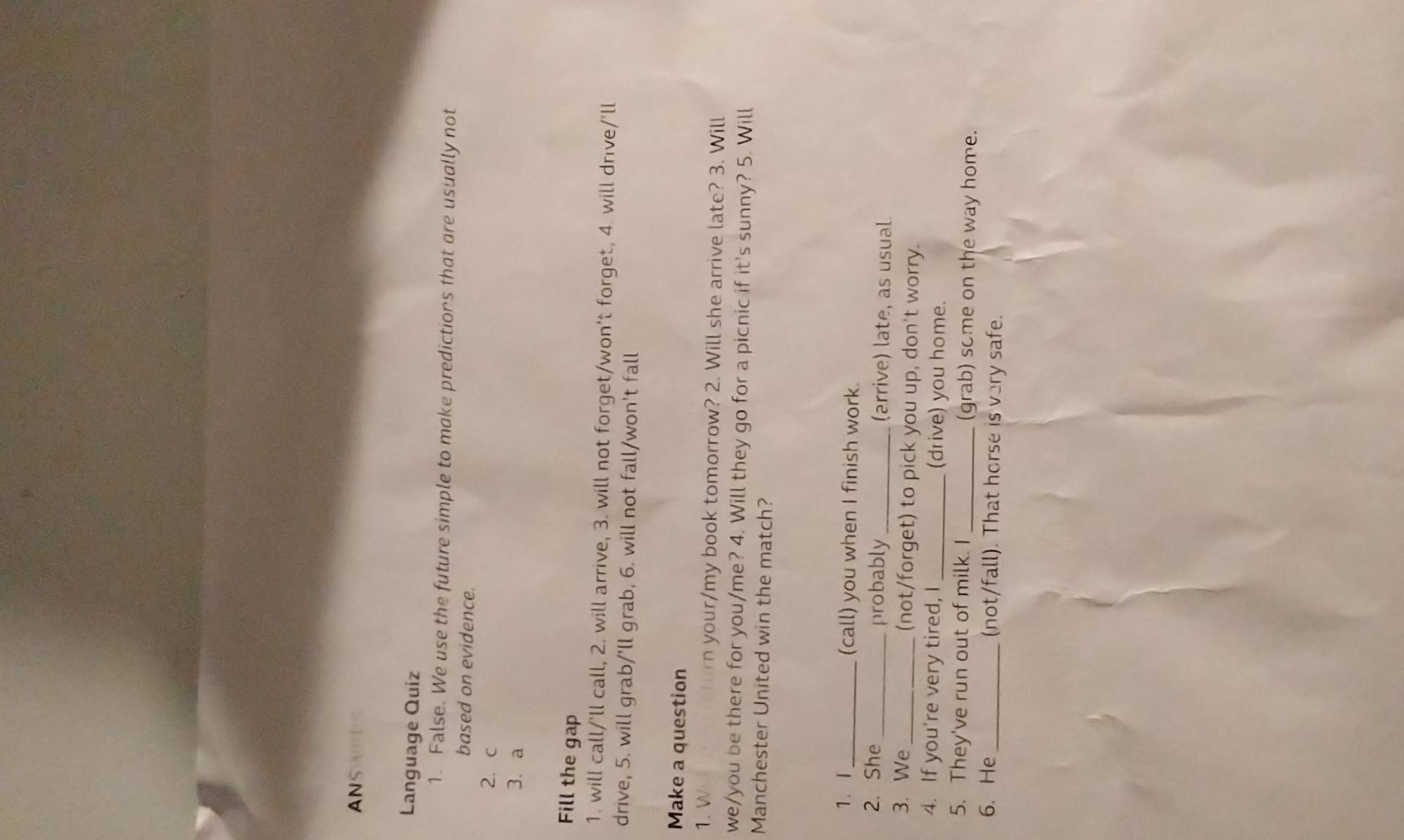
Ответ:
Language Quiz
- True. The future simple is commonly used for predictions without present evidence.
- c
- d
Fill the gap: 1) I’ll call when I arrive. 2) She will arrive late. 3) He won’t forget. 4) I’ll drive you home. 5) I’ll grab some. 6) He won’t fall.
Make a question: 1) Will you be in your book tomorrow? The first item is partly obscured in the image, so the complete original sentence cannot be restored reliably. 2) Will she arrive late? 3) Will we be there for you? 4) Will they go for a picnic if it’s sunny? 5) Will Manchester United win the match?
Complete sentences: 1) I will call you when I finish work. 2) She will probably arrive late, as usual. 3) We won’t forget to pick you up, don’t worry. 4) If you’re very tired, I will drive you home. 5) They’ve run out of milk. I will grab some on the way home. 6) He won’t fall. That horse is very safe.
В русском переводе: «Я позвоню тебе, когда закончу работу»; «Она, вероятно, опоздает, как обычно»; «Мы не забудем забрать тебя»; «Я отвезу тебя домой»; «Я захвачу немного молока»; «Он не упадёт».
