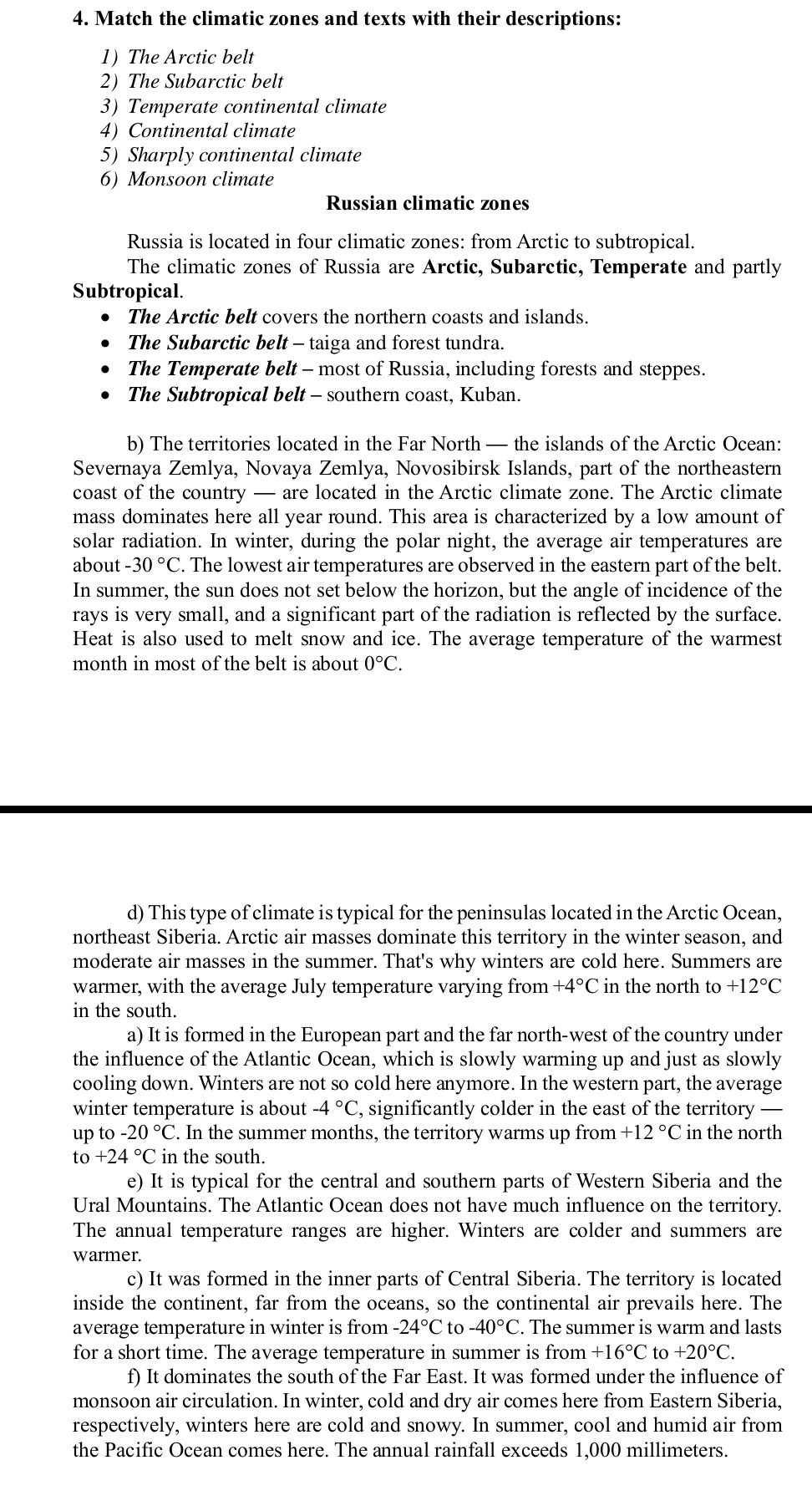
Match the climatic zones and texts with their descriptions:
Сопоставление климатических зон и их описаний:
- 1) The Arctic belt — b) The territories located in the Far North — the islands of the Arctic Ocean: Severnaya Zemlya, Novaya Zemlya, Novosibirsk Islands, part of the northeastern coast of the country are located in the Arctic climate zone. The Arctic climate mass dominates here all year round. This area is characterized by a low amount of solar radiation. In winter, during the polar night, the average air temperatures are about -30 °C. The lowest air temperatures are observed in the eastern part of the belt. In summer, the sun does not set below the horizon, but the angle of incidence of the rays is very small, and a significant part of the radiation is reflected by the surface. Heat is also used to melt snow and ice. The average temperature of the warmest month in most of the belt is about 0°C.
- 2) The Subarctic belt — The Subarctic belt - taiga and forest tundra.
- 3) Temperate continental climate — e) It is typical for the central and southern parts of Western Siberia and the Ural Mountains. The Atlantic Ocean does not have much influence on the territory. The annual temperature ranges are higher. Winters are colder and summers are warmer.
- 4) Continental climate — c) It was formed in the inner parts of Central Siberia. The territory is located inside the continent, far from the oceans, so the continental air prevails here. The average temperature in winter is from -24°C to -40°C. The summer is warm and lasts for a short time. The average temperature in summer is from +16°C to +20°C.
- 5) Sharply continental climate — d) This type of climate is typical for the peninsulas located in the Arctic Ocean, northeast Siberia. Arctic air masses dominate this territory in the winter season, and moderate air masses in the summer. That's why winters are cold here. Summers are warmer, with the average July temperature varying from +4°C in the north to +12°C in the south.
- 6) Monsoon climate — f) It dominates the south of the Far East. It was formed under the influence of monsoon air circulation. In winter, cold and dry air comes here from Eastern Siberia, respectively, winters here are cold and snowy. In summer, cool and humid air from the Pacific Ocean comes here. The annual rainfall exceeds 1,000 millimeters.

 Алгебра
 Английский
 Биология
 География
 Геометрия
 История
 Русский
 Обществознание
 Физика
 Химия
Химия Информатика
 Литература
 Математика