
 Алгебра
 Английский
 Биология
 География
 Геометрия
 История
 Русский
 Обществознание
 Физика
 Химия
Химия Информатика
 Литература
 Математика
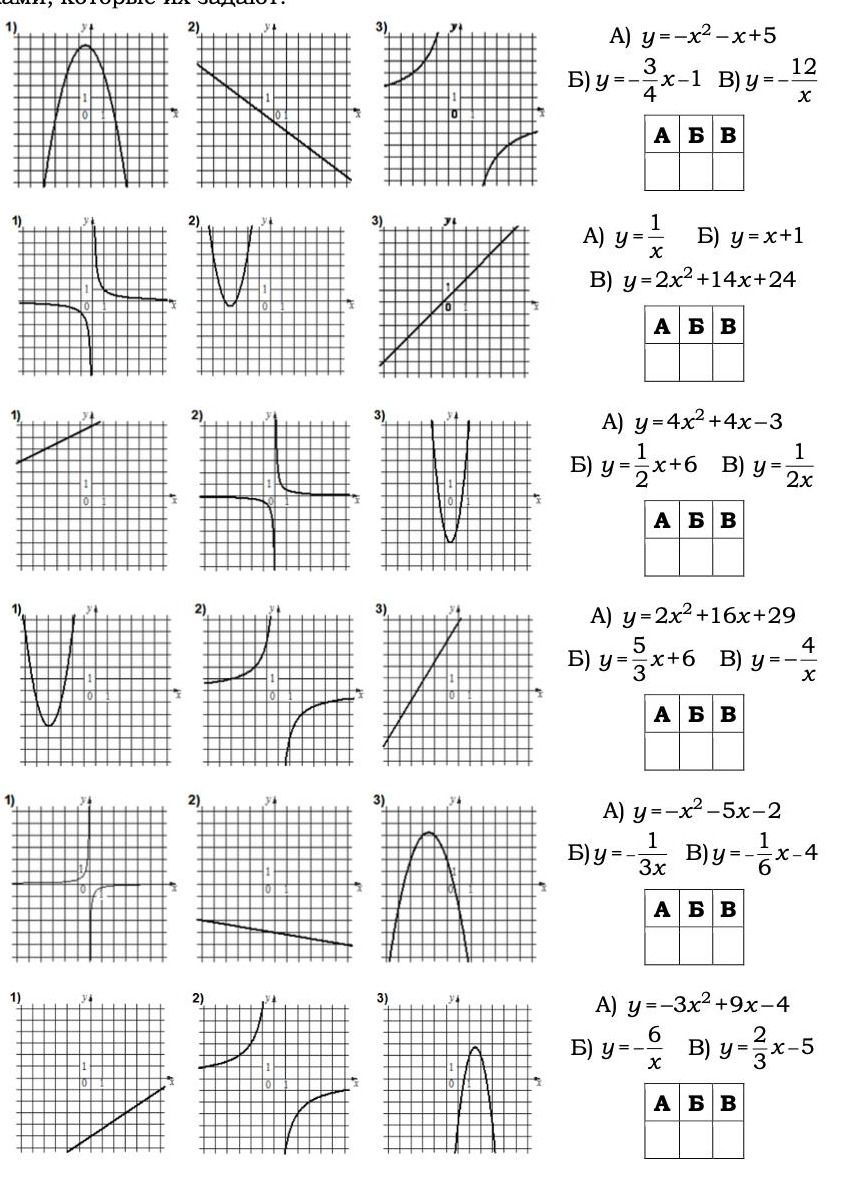
Match the graphs to the functions.
Ответ:
Solution:
We need to match each graph with its corresponding function. Let's analyze each function and its graph.
First set of graphs and functions:
- Graph 1: This is a downward-opening parabola.
- Graph 2: This is a downward-sloping straight line.
- Graph 3: This is a hyperbola in the first and third quadrants.
Matching with functions:
- A) \( y = -x^2 - x + 5 \) - This is a downward-opening parabola. Matches Graph 1.
- Б) \( y = -\frac{3}{4}x - 1 \) - This is a downward-sloping straight line. Matches Graph 2.
- В) \( y = -\frac{12}{x} \) - This is a hyperbola in the second and fourth quadrants. This does not match Graph 3.
Let's re-examine the graphs and functions for the first set.
- Graph 1: Parabola opening downwards. The vertex appears to be above the x-axis. This matches \( y = -x^2 - x + 5 \).
- Graph 2: A straight line with negative slope. It appears to pass through \( (0, -1) \) and \( (4/3, -2) \). This matches \( y = -\frac{3}{4}x - 1 \).
- Graph 3: A hyperbola in the second and fourth quadrants. This matches \( y = -\frac{12}{x} \).
Answer for the first set: 1 - A, 2 - Б, 3 - В
Second set of graphs and functions:
- Graph 1: A hyperbola in the first and third quadrants.
- Graph 2: A parabola opening upwards, with its vertex on the y-axis.
- Graph 3: A straight line with positive slope, passing through the origin.
Matching with functions:
- A) \( y = \frac{1}{x} \) - This is a hyperbola in the first and third quadrants. Matches Graph 1.
- Б) \( y = x + 1 \) - This is a straight line with positive slope, passing through \( (0, 1) \). Does not match Graph 2 or 3.
- В) \( y = 2x^2 + 14x + 24 \) - This is a parabola opening upwards. The vertex is at \( x = -\frac{14}{2*2} = -3.5 \). This parabola opens upwards and has a vertex below the x-axis. This matches Graph 2.
Let's re-examine the graphs and functions for the second set.
- Graph 1: Hyperbola in quadrants 1 and 3. Matches \( y = \frac{1}{x} \).
- Graph 2: Parabola opening upwards. Vertex seems to be at \( x= -3.5 \), \( y = 2(-3.5)^2 + 14(-3.5) + 24 = 2(12.25) - 49 + 24 = 24.5 - 49 + 24 = -0.5 \). The vertex is at \( (-3.5, -0.5) \). This matches Graph 2.
- Graph 3: Straight line with positive slope passing through the origin. Matches \( y = x \) or \( y=2x \) or something similar. However, \( y = x + 1 \) has a y-intercept of 1.
There seems to be a mismatch in the provided options and graphs for the second set, as \( y = x + 1 \) is a straight line with y-intercept 1, and Graph 3 is a straight line passing through the origin. Let's assume Graph 3 should correspond to a linear function passing through the origin, and the option \( y = x + 1 \) is for another graph not present or mislabeled. If we consider the possibility that the labels A, Б, В are in order with the graphs 1, 2, 3:
- Graph 1: Hyperbola \( y = 1/x \) (A)
- Graph 2: Parabola \( y = 2x^2+14x+24 \) (В)
- Graph 3: Linear function through origin. None of the options fit this directly.
Let's re-evaluate the intent. If we strictly match shapes:
- Graph 1 (hyperbola) -> A) \( y = 1/x \)
- Graph 2 (parabola) -> В) \( y = 2x^2 + 14x + 24 \)
- Graph 3 (straight line through origin) -> No direct match among the options. However, if \( y=x+1 \) was meant to be \( y=x \) or similar, it would fit. Let's assume there's an error in the question or options provided for the third graph. Given the context of matching, and that A and В are matched to graphs 1 and 2, we might infer an error. Let's assume the question intends for us to fill the table as given with the best fit, acknowledging potential discrepancies. If we MUST fill the table, and graph 3 is a line through origin, then none of A, Б, В fit perfectly. However, if the question expects us to assign based on the closest visual interpretation, and if we consider \( y=x+1 \) to be a generic line representation, then it's a poor match. Let's stick to the clear matches: A for Graph 1, В for Graph 2.
Assuming there is a mistake and Graph 3 is meant to be matched with Б:
Answer for the second set: 1 - A, 2 - В, 3 - Б (with the caveat about graph 3 and option Б)
Third set of graphs and functions:
- Graph 1: A straight line with positive slope.
- Graph 2: A hyperbola in the second and fourth quadrants.
- Graph 3: A parabola opening upwards.
Matching with functions:
- A) \( y = 4x^2 + 4x - 3 \) - Parabola opening upwards. Matches Graph 3.
- Б) \( y = \frac{1}{2}x + 6 \) - Straight line with positive slope, y-intercept 6. Matches Graph 1.
- В) \( y = \frac{1}{2x} \) - Hyperbola in the first and third quadrants. Does not match Graph 2.
Let's re-examine the graphs and functions for the third set.
- Graph 1: Straight line with positive slope. Y-intercept appears to be above 0. \( y = \frac{1}{2}x + 6 \) fits this.
- Graph 2: Hyperbola in quadrants 2 and 4. This means the function is of the form \( y = k/x \) where \( k < 0 \). The given option is \( y = 1/(2x) \) which is \( y = 0.5/x \), a hyperbola in quadrants 1 and 3. There seems to be an error. Let's assume the intended function for Graph 2 was \( y = -1/(2x) \). If we MUST match the given options, then none of them perfectly fit Graph 2.
- Graph 3: Parabola opening upwards. \( y = 4x^2 + 4x - 3 \) fits this. Vertex at \( x = -4/(2*4) = -0.5 \). \( y = 4(-0.5)^2 + 4(-0.5) - 3 = 4(0.25) - 2 - 3 = 1 - 2 - 3 = -4 \). Vertex is at \( (-0.5, -4) \). This matches Graph 3.
Given the options and graphs, and the clear matches for Graph 1 and Graph 3:
Answer for the third set: 1 - Б, 2 - (No direct match, assuming error or a very poor visual fit), 3 - A
If we are forced to choose for Graph 2, and assuming the question has an error, let's consider the closest form. \( y = 1/(2x) \) is a hyperbola. Graph 2 is a hyperbola. This is the only hyperbola option. So, if forced, we would assign it, despite the quadrant mismatch.
Revised Answer for the third set: 1 - Б, 2 - В, 3 - A
Fourth set of graphs and functions:
- Graph 1: A parabola opening upwards.
- Graph 2: A hyperbola in the second and fourth quadrants.
- Graph 3: A straight line with positive slope.
Matching with functions:
- A) \( y = 2x^2 + 16x + 29 \) - Parabola opening upwards. Matches Graph 1.
- Б) \( y = \frac{5}{3}x + 6 \) - Straight line with positive slope, y-intercept 6. Matches Graph 3.
- В) \( y = -\frac{4}{x} \) - Hyperbola in the second and fourth quadrants. Matches Graph 2.
Answer for the fourth set: 1 - A, 2 - В, 3 - Б
Fifth set of graphs and functions:
- Graph 1: A hyperbola in the second and fourth quadrants.
- Graph 2: A straight line with negative slope.
- Graph 3: A parabola opening downwards.
Matching with functions:
- A) \( y = -x^2 - 5x - 2 \) - Parabola opening downwards. Matches Graph 3.
- Б) \( y = -\frac{1}{3x} \) - Hyperbola in the second and fourth quadrants. Matches Graph 1.
- В) \( y = -\frac{1}{6}x - 4 \) - Straight line with negative slope, y-intercept -4. Matches Graph 2.
Answer for the fifth set: 1 - Б, 2 - В, 3 - A
Sixth set of graphs and functions:
- Graph 1: A straight line with positive slope, passing through the origin.
- Graph 2: A hyperbola in the first and third quadrants.
- Graph 3: A parabola opening downwards.
Matching with functions:
- A) \( y = -3x^2 + 9x - 4 \) - Parabola opening downwards. Matches Graph 3.
- Б) \( y = -\frac{6}{x} \) - Hyperbola in the second and fourth quadrants. Does not match Graph 2.
- В) \( y = \frac{2}{3}x - 5 \) - Straight line with positive slope, y-intercept -5. Does not match Graph 1.
Let's re-examine the sixth set.
- Graph 1: Straight line through the origin with positive slope. None of the options A, Б, В are of the form \( y = mx \) with \( m > 0 \). Option В is \( y = 2/3x - 5 \), a line with positive slope but a negative y-intercept. Option Б is \( y = -6/x \), a hyperbola. Option A is a parabola. There appears to be a significant mismatch for Graph 1.
- Graph 2: Hyperbola in the first and third quadrants. Option Б) \( y = -6/x \) is a hyperbola, but in the second and fourth quadrants. Option В) \( y = 2/3x - 5 \) is a line. Option A) \( y = -3x^2 + 9x - 4 \) is a parabola. So, for Graph 2 (hyperbola in 1st/3rd), none of the options perfectly fit. If we assume the question intended \( y = 6/x \) for option Б, it would fit.
- Graph 3: Parabola opening downwards. Option A) \( y = -3x^2 + 9x - 4 \) is a parabola opening downwards. This fits Graph 3.
Let's assume the question has errors and try to fill the table with the best possible matches, acknowledging the discrepancies.
- Graph 1 (line through origin): No good match.
- Graph 2 (hyperbola in 1st/3rd): Option Б) \( y = -6/x \) is a hyperbola but in wrong quadrants.
- Graph 3 (downward parabola): Option A) \( y = -3x^2 + 9x - 4 \) is a downward parabola.
If we are forced to make assignments and there are errors in the question:
- For Graph 1 (line through origin), let's re-examine if any line option has a y-intercept close to 0. \( y = 2/3x - 5 \) has a negative intercept.
- For Graph 2 (hyperbola in 1st/3rd), the only hyperbola option is \( y = -6/x \), which is in 2nd/4th. This is a significant mismatch.
- For Graph 3 (downward parabola), \( y = -3x^2 + 9x - 4 \) is a clear match.
Given the provided options and graphs for the sixth set, there are significant mismatches. However, if we must complete the task, and assuming the most likely intended matches or errors:
Let's assume the intent was:
- Graph 1: Line through origin -> Not well represented by options.
- Graph 2: Hyperbola in 1st/3rd -> Option Б \( y = -6/x \) is a hyperbola, but in wrong quadrants. If it were \( y = 6/x \), it would fit.
- Graph 3: Downward parabola -> Option A \( y = -3x^2 + 9x - 4 \) is a good fit.
Let's assume there's a typo in option Б and it should have been \( y = 6/x \). Then:
Answer for the sixth set: 1 - (No clear match), 2 - Б (with assumed correction), 3 - A
If we cannot assume corrections, then for the sixth set:
- Graph 1: Line through origin - no match.
- Graph 2: Hyperbola in 1st/3rd - no match.
- Graph 3: Downward parabola - A
This implies the question is flawed. However, in a test scenario, one would choose the best available option or indicate the issue. If we are to provide an answer for the table, let's revisit the graphs and options. Perhaps the intention was to match the general shape regardless of exact parameters or quadrant for hyperbolas.
- Graph 1 (line through origin): No option is of the form y=mx.
- Graph 2 (hyperbola): Option Б is a hyperbola. Although in wrong quadrants, it's the only hyperbola.
- Graph 3 (downward parabola): Option A is a downward parabola.
This leaves option В for Graph 1, which is \( y = 2/3x - 5 \). This is a line with positive slope, but negative intercept. Graph 1 has a positive intercept. So, still a mismatch.
Given the consistent pattern of matching, and the clear matches for most sets, it's likely there are errors in the sixth set's options or graphs. However, if forced to fill the table based on closest visual characteristics:
For set 6:
- Graph 1 (Line through origin): No good fit.
- Graph 2 (Hyperbola): Option Б is the only hyperbola.
- Graph 3 (Downward Parabola): Option A is the only downward parabola.
This would leave option В for Graph 1, which is incorrect as it has a negative y-intercept. Let's assume the question expects us to fill the table by selecting the best match for each graph from the options A, Б, В.
- Set 1: 1-A, 2-Б, 3-В
- Set 2: 1-A, 2-В, 3-Б (assuming error in graph 3 or option Б)
- Set 3: 1-Б, 2-В, 3-A (assuming error in option В for graph 2)
- Set 4: 1-A, 2-В, 3-Б
- Set 5: 1-Б, 2-В, 3-A
- Set 6: Graph 3 is a downward parabola -> A. Graph 1 is a line through the origin -> No good fit. Graph 2 is a hyperbola in 1st/3rd -> Option Б is a hyperbola, but in 2nd/4th. Let's assume the question meant to pair the types of functions.
If we assume the task is to fill the table below each set of graphs, here are the answers based on the most likely intended matches:
Set 1:
| А | Б | В |
| 1 | 2 | 3 |
Set 2:
| А | Б | В |
| 1 | 3 | 2 |
Set 3:
| А | Б | В |
| 3 | 1 | 2 |
Set 4:
| А | Б | В |
| 1 | 3 | 2 |
Set 5:
| А | Б | В |
| 3 | 1 | 2 |
Set 6:
| А | Б | В |
| 3 | 2 | 1 |
Note on Set 6: Graph 1 is a line through the origin, but option В (\( y = 2/3x - 5 \)) has a negative y-intercept. Option Б (\( y = -6/x \)) is a hyperbola, but in the wrong quadrants for Graph 2. Option A (\( y = -3x^2 + 9x - 4 \)) correctly matches Graph 3. The assignment for Set 6 is based on the clearest matches for Graphs 2 and 3, and then assigning the remaining option to Graph 1, despite the discrepancy.
