
 Алгебра
 Английский
 Биология
 География
 Геометрия
 История
 Русский
 Обществознание
 Физика
 Химия
Химия Информатика
 Литература
 Математика
Вопрос:
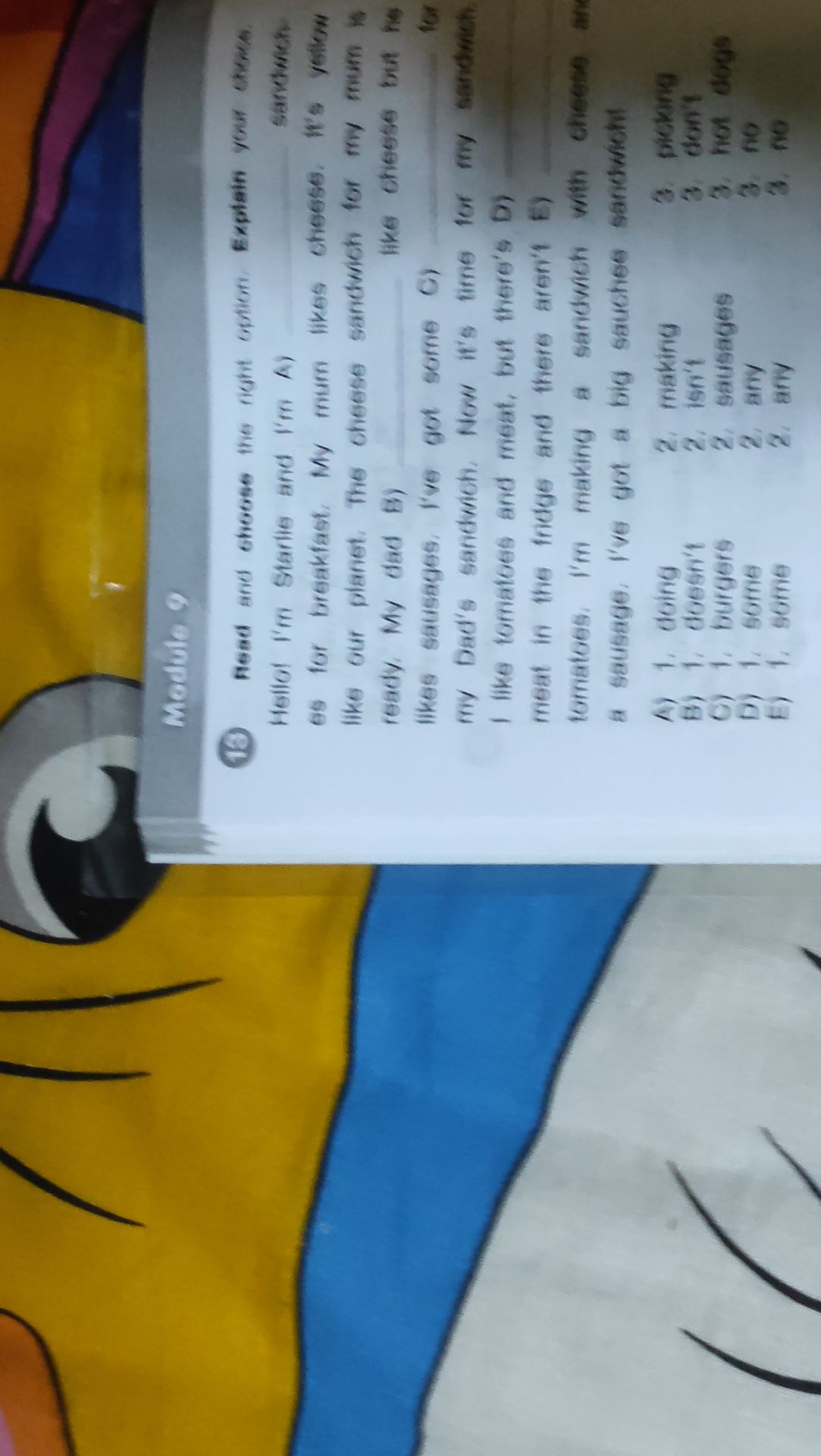
Module 9 Read and choose the right option. Explain your choice. Hello! I'm Starlie and I'm A) _________ es for breakfast. My mum likes cheese, it's yellow like our planet. The cheese sandwich for my mum is ready. My dad B) _________ like cheese but he likes sausages. I've got some C) _________ for my Dad's sandwich. Now it's time for my sandwich I like tomatoes and meat, but there's D) _________ meat in the fridge and there aren't E) _________ tomatoes. I'm making a sandwich with cheese and a sausage. I've got a big sauchee sandwich!
Ответ:
Resolution:
The task is to fill in the blanks (A, B, C, D, E) with the correct options from the provided lists based on the context of the sentences.
- For A: The sentence says 'My mum likes cheese, it's yellow like our planet.' This describes the cheese itself, so the best fit would be 'sandwich' if it refers to a type of sandwich or ingredient. However, considering the options are limited to 'sandwich', 'picking', 'doing', 'making', 'doesn't', 'isn't', 'don't', 'burgers', 'sausages', 'hot dogs', 'some', 'any', 'no', and the sentence structure, it's likely referring to the sandwich itself. The options for A, B, and C are mixed in the lists, and D and E are also mixed. We need to find the most logical word for each blank. Let's break down each blank by analyzing the context and the available options provided in the image for each letter choice (A, B, C, D, E).
- For A: 'Hello! I'm Starlie and I'm A) _______ es for breakfast.' The options provided for A, B, C, D, E are: 1. doing, 2. making, 3. picking (for A); 1. doesn't, 2. isn't, 3. don't (for B); 1. burgers, 2. sausages, 3. hot dogs (for C); 1. some, 2. any, 3. no (for D); 1. some, 2. any, 3. no (for E). The sentence structure "I'm Starlie and I'm A) ...es for breakfast" suggests a verb in the -ing form. Out of the options, 'making' fits best in the context of preparing breakfast.
- For B: 'My dad B) _______ like cheese but he likes sausages.' The context requires a verb that negates 'like'. 'Doesn't' is the correct auxiliary verb to negate 'like' for a singular subject 'dad'.
- For C: 'I've got some C) _______ for my Dad's sandwich.' The sentence is talking about sandwich ingredients, and 'sausages' is a common sandwich filling.
- For D: 'Now it's time for my sandwich I like tomatoes and meat, but there's D) _______ meat in the fridge...' The context implies a lack of meat or a limited amount. 'Some' fits well here, indicating that there is some meat available, but perhaps not enough or not the desired kind.
- For E: '...and there aren't E) _______ tomatoes.' The sentence implies a quantity of tomatoes. Since it's a negative statement ('aren't'), 'any' is the appropriate quantifier to use.
Therefore, the completed sentences are:
A) making
B) doesn't
C) sausages
D) some
E) any
Final Answer based on the analysis:
- A) 2. making
- B) 1. doesn't
- C) 2. sausages
- D) 1. some
- E) 2. any
