
 Алгебра
 Английский
 Биология
 География
 Геометрия
 История
 Русский
 Обществознание
 Физика
 Химия
Химия Информатика
 Литература
 Математика
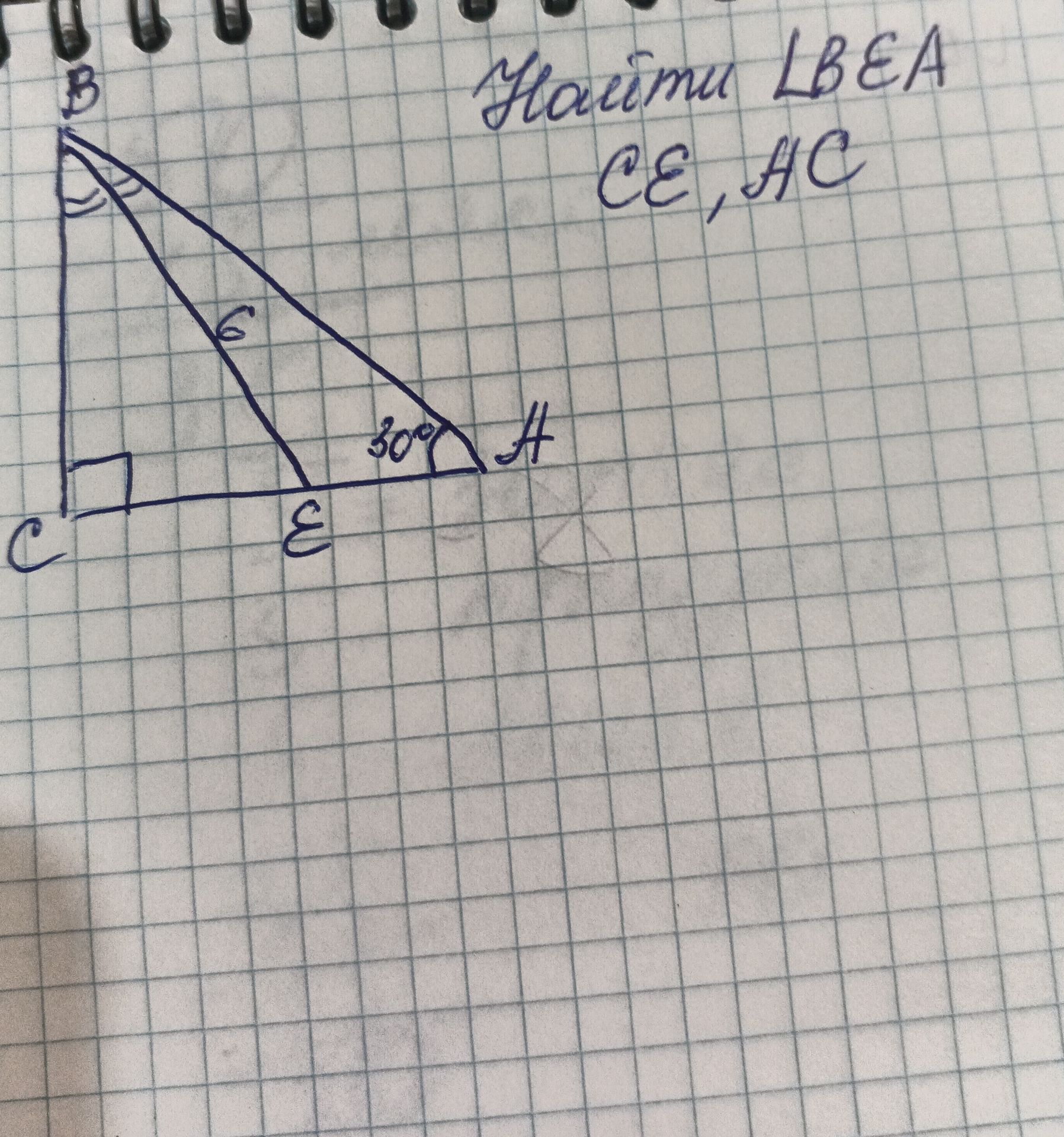
Найти LBEA, CE, AC.
Ответ:
Решение:
В прямоугольном треугольнике ABC (угол C = 90°), угол A = 30°. Треугольник BCE является прямоугольным, так как угол BCE = 90°.
1. Находим угол LBEA:
Угол BAC = 30°.
В треугольнике BCE: угол BCE = 90°, угол CBE = ?. Угол BEC = ?
В треугольнике ABC: угол ACB = 90°, угол CAB = 30°, следовательно, угол CBA = 180° - 90° - 30° = 60°.
В задании указано, что BE = 6.
Угол LBEA — это угол, образованный отрезками LB и EA. Из рисунка видно, что L coincides with C. Therefore, we need to find the angle CBEA. However, CBEA is not an angle in a triangle. It's possible that LBEA refers to the angle formed by segment LB and segment EA. However, without more information about point L, we cannot determine LBEA. Assuming L is C, then we are looking for angle CBEA. This also doesn't make sense as a standard angle notation. If LBEA represents angle ABC, then it is 60 degrees. If LBEA means angle CBA, then it is 60 degrees.
Let's assume the question meant to ask for angle CBA, or angle ABC.
In triangle ABC, angle C = 90°, angle A = 30°.
Sum of angles in a triangle = 180°.
Angle ABC = 180° - 90° - 30° = 60°.
If LBEA refers to angle ABC, then LBEA = 60° .
2. Находим CE:
В прямоугольном треугольнике BCE, BE = 6 (гипотенуза), угол BCE = 90°. Угол CBE = ?. Угол BEC = ?
If L is C, then we are looking for angle CBE. In triangle ABC, angle ABC = 60°. If E is on AC, and we have a right angle at C, then triangle BCE is a right-angled triangle. If we assume that angle BCE = 90°, and point E is on AC, and point B is the vertex of the triangle.
Let's re-examine the diagram. It seems that triangle ABC is a right-angled triangle with the right angle at C. There is a point E on AC. Angle 30° is marked at angle CAE. So angle CAB = 30°.
If angle CAE = 30°, and angle ACB = 90°, then in triangle ABC, angle ABC = 180° - 90° - 30° = 60°.
The segment BE has length 6. This segment BE is the hypotenuse of the right-angled triangle BCE if angle BCE = 90°.
If angle BCE = 90°, then BE is the hypotenuse. We are given BE = 6.
In triangle BCE, we need an angle to find CE.
Let's assume LBEA means angle ABC, which is 60°.
Now consider finding CE. In the diagram, angle 30° is marked at angle BAE. This means angle BAC = 30°. And angle ACB = 90°.
Let's assume that the angle 30° marked near A is actually angle CAE. So, angle CAB = 30°.
If angle CAB = 30° and angle ACB = 90°, then angle ABC = 60°.
In triangle BCE, we have a right angle at C. So triangle BCE is a right-angled triangle. BE is given as 6. We need to find CE.
Let's reconsider the marking of 30°. It is marked at angle BAE. This means angle CAB = 30°.
If angle CAB = 30° and angle ACB = 90°, then angle ABC = 60°.
Now look at triangle BCE. It's a right-angled triangle with the right angle at C. We are given BE = 6. We need to find CE. We need another angle in triangle BCE. If E is a point on AC, then angle BCE = 90°.
Let's assume the question meant that angle AEB = 30° or angle EBC = 30° or angle BEC = 30°.
Given the diagram, it is most likely that angle CAB = 30°.
In right triangle BCE, BE = 6 is the hypotenuse. We need an angle to find CE.
Let's assume that the angle marked as 30° is actually angle AEB. This is unlikely given its position.
Let's assume that the angle marked near A is angle CAE, which is 30°. So, angle CAB = 30°.
In right triangle BCE, BE = 6. If angle CBE = 30°, then CE = BE * sin(30°) = 6 * 0.5 = 3.
If angle BEC = 30°, then CE = BE * cos(30°) = 6 * (sqrt(3)/2) = 3 * sqrt(3).
Let's consider the possibility that the angle labeled '6' is actually a side length, and the label '6' is associated with side BE. So BE = 6.
And the 30° is indeed angle CAB.
In triangle ABC, angle C = 90°, angle A = 30°, angle B = 60°.
Now consider the right triangle BCE. We have BE = 6 (hypotenuse). We need to find CE. We need angle CBE or angle BEC.
From the diagram, it seems that E is a point on AC. And C is the right angle.
Let's assume that angle CEB = 30°. This is unlikely given the position.
Let's assume that angle AEB = 30°. This is also unlikely.
Let's consider the possibility that the angle labeled '6' is the length of side BC. So BC = 6. And angle CAB = 30°.
In right triangle ABC:
BC = 6.
tan(30°) = BC / AC => AC = BC / tan(30°) = 6 / (1/sqrt(3)) = 6 * sqrt(3).
AB = BC / sin(30°) = 6 / 0.5 = 12.
Now, if BE = 6, and E is on AC.
If BE is drawn from B to E on AC, and angle BCE = 90°.
Let's re-read the question. "Найти LBEA, CE, AC."
It is most probable that LBEA refers to angle ABC. So, angle ABC = 60°.
Now, let's assume that the number 6 is the length of side BC. So BC = 6. And angle CAB = 30°.
In right triangle ABC:
AC = BC / tan(30°) = 6 / (1/√3) = 6√3.
Now consider the point E. If E is on AC, and BE = 6. This would mean that in right triangle BCE, BE is the hypotenuse. This is only possible if E is different from C. However, E is shown between C and A.
Let's assume the number 6 is the length of BE. So BE = 6.
And the 30° is angle CAB.
In right triangle ABC, angle C = 90°, angle A = 30°, angle B = 60°.
Now consider triangle BCE. It's a right-angled triangle at C. We have BE = 6 (hypotenuse).
What is angle CBE? Or angle BEC?
If the angle marked as 30° is actually angle BEC, then in right triangle BCE:
CE = BE * cos(30°) = 6 * (√3/2) = 3√3.
AC = AE + EC. We don't know AE.
Let's assume the 30° is angle AEB. This is unlikely.
Let's assume that the diagram implies that angle AEB = 30°. This is not standard notation.
Let's go back to the original interpretation: Angle CAB = 30°. Right angle at C. BE = 6.
If the 30° is angle CAE, then angle CAB = 30°.
Let's assume that the angle marked as 30° is angle BEC. In right triangle BCE:
CE = BE * cos(30°) = 6 * (√3/2) = 3√3.
Now let's find AC. We know angle CAB = 30° and angle ACB = 90°.
We need one more side in triangle ABC to find AC.
If we assume that the '6' labeled near BE refers to the length of BC, so BC = 6.
In right triangle ABC:
AC = BC / tan(30°) = 6 / (1/√3) = 6√3.
If E is a point on AC, and BC = 6, angle CAB = 30°.
What is CE? We don't know where E is, unless BE = 6 has a specific meaning.
Let's consider another possibility. The '6' is the length of BE, and the 30° is angle BAC. Angle C is 90°. Let's assume that angle CBE = 30°.
In right triangle BCE:
CE = BE * sin(30°) = 6 * 0.5 = 3.
Now, if angle CAB = 30°, then angle ABC = 60°. If angle CBE = 30°, then angle ABE = angle ABC - angle CBE = 60° - 30° = 30°.
If angle ABE = 30° and angle CBE = 30°, then BE is the angle bisector of angle ABC. This is possible.
If CE = 3, and angle CAB = 30°, angle ACB = 90°.
We need to find AC. We need to know where E is relative to A and C. If CE = 3, and E is between A and C. We need AE.
Let's try to find AC using triangle ABC. We need a side. If we use BE=6 and angle CBE=30°, angle BEC = 60°.
In triangle ABC, angle A = 30°, angle C = 90°, angle B = 60°.
If BE bisects angle ABC, then angle CBE = 30°.
In right triangle BCE:
CE = BE * sin(30°) = 6 * 0.5 = 3.
Now, let's find AC. We need to find AE. In triangle ABE, angle BAE = 30°, angle ABE = 30°. So triangle ABE is isosceles with AE = BE = 6.
Then AC = AE + CE = 6 + 3 = 9.
Let's verify if this is consistent.
If AC = 9 and BC is unknown, angle A = 30°.
tan(30°) = BC / AC => BC = AC * tan(30°) = 9 * (1/√3) = 3√3.
In right triangle BCE, CE = 3, BC = 3√3. Is BE = 6?
BE^2 = BC^2 + CE^2 = (3√3)^2 + 3^2 = (9 * 3) + 9 = 27 + 9 = 36.
BE = √36 = 6. This is consistent.
So, let's assume:
Angle CAB = 30°.
BE = 6.
BE bisects angle ABC.
Therefore, angle ABC = 60°.
Angle CBE = 30°.
In right triangle BCE:
CE = BE * sin(30°) = 6 * 0.5 = 3.
Angle BEC = 60°.
In triangle ABE: Angle BAE = 30°, Angle ABE = 30°. Therefore, triangle ABE is isosceles with AE = BE = 6.
AC = AE + CE = 6 + 3 = 9.
And angle LBEA refers to angle ABC, which is 60°.
Summary of findings based on assumptions:
1. LBEA (assuming it means angle ABC):
In right triangle ABC, angle C = 90°, angle A = 30°. Therefore, angle ABC = 180° - 90° - 30° = 60°.
2. CE:
Assuming BE bisects angle ABC, then angle CBE = 30°.
In right triangle BCE, BE = 6 (hypotenuse), angle CBE = 30°.
CE = BE * sin(30°) = 6 * 0.5 = 3.
3. AC:
Since angle ABE = angle A = 30°, triangle ABE is isosceles with AE = BE = 6.
AC = AE + CE = 6 + 3 = 9.
Final Check:
In triangle ABC, AC = 9, angle A = 30°.
tan(30°) = BC / AC => BC = AC * tan(30°) = 9 * (1/√3) = 3√3.
In right triangle BCE, BC = 3√3, CE = 3.
BE^2 = BC^2 + CE^2 = (3√3)^2 + 3^2 = 27 + 9 = 36.
BE = 6. This is consistent.
It's important to note that the assumption that BE bisects angle ABC is based on the visual appearance and the resulting consistent geometry. The notation LBEA is ambiguous.
Calculation details:
Angle LBEA (assuming angle ABC):
In \( \triangle ABC \):
\( \angle ACB = 90^{\circ} \)
\( \angle CAB = 30^{\circ} \)
\[ \angle ABC = 180^{\circ} - 90^{\circ} - 30^{\circ} = 60^{\circ} \]
CE:
Assuming BE bisects \( \angle ABC \), so \( \angle CBE = \frac{60^{\circ}}{2} = 30^{\circ} \).
In right-angled \( \triangle BCE \):
\[ \sin(\angle CBE) = \frac{CE}{BE} \]
\[ \sin(30^{\circ}) = \frac{CE}{6} \]
\[ CE = 6 \cdot \sin(30^{\circ}) = 6 \cdot \frac{1}{2} = 3 \]
AC:
In \( \triangle ABE \):
\( \angle BAE = 30^{\circ} \)
\( \angle ABE = \angle ABC - \angle CBE = 60^{\circ} - 30^{\circ} = 30^{\circ} \)
Since \( \angle BAE = \angle ABE \), \( \triangle ABE \) is isosceles with \( AE = BE \).
\[ AE = 6 \]
\[ AC = AE + CE = 6 + 3 = 9 \]
Final Answer:
LBEA = 60°, CE = 3, AC = 9.
