
 Алгебра
 Английский
 Биология
 География
 Геометрия
 История
 Русский
 Обществознание
 Физика
 Химия
Химия Информатика
 Литература
 Математика
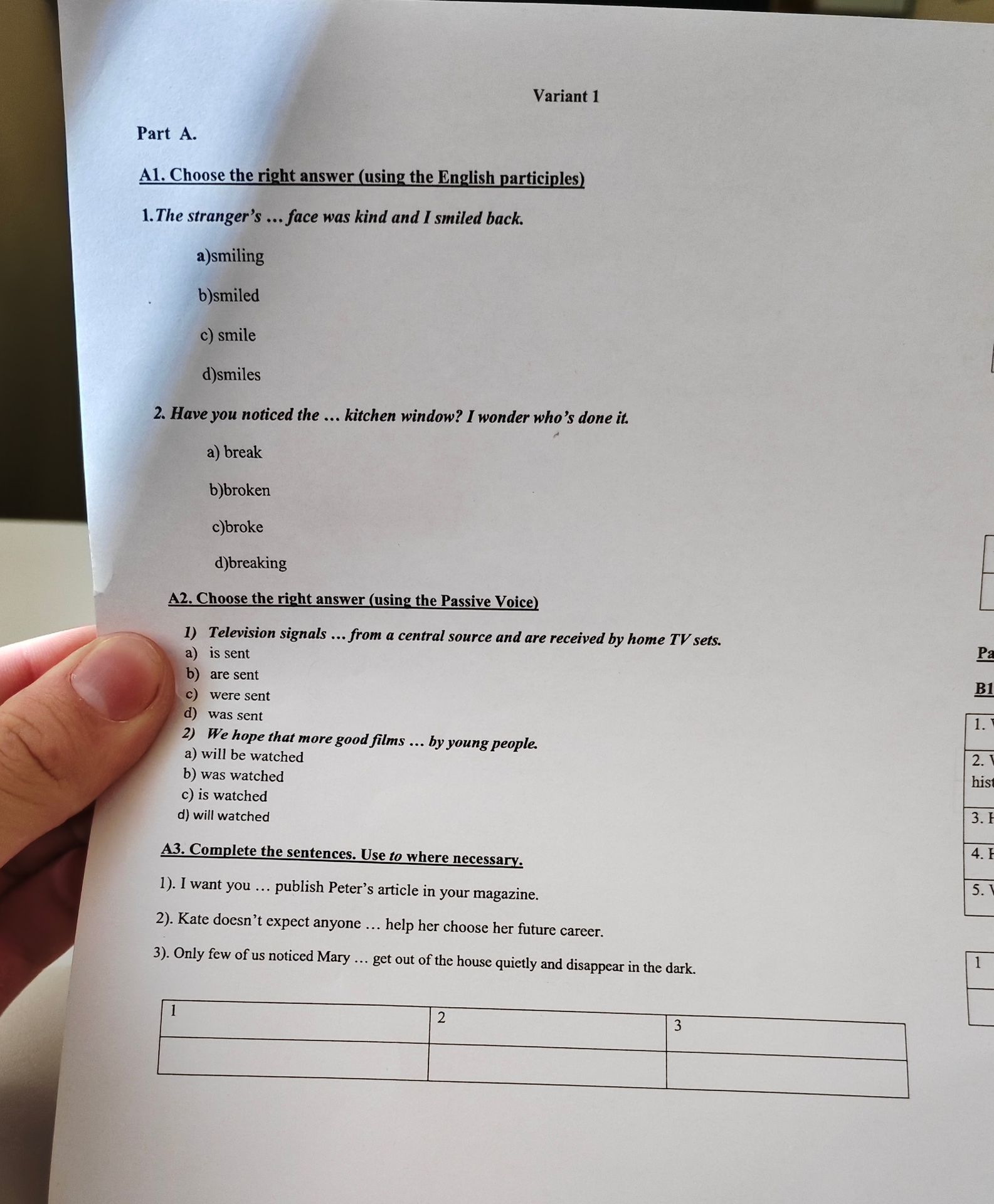
Part A. A1. Choose the right answer (using the English participles) 1. The stranger's ... face was kind and I smiled back. a)smiling b)smiled c) smile d)smiles 2. Have you noticed the ... kitchen window? I wonder who's done it. a) break b)broken c)broke d)breaking A2. Choose the right answer (using the Passive Voice) 1) Television signals ... from a central source and are received by home TV sets. a) is sent b) are sent c) were sent d) was sent 2) We hope that more good films ... by young people. a) will be watched b) was watched c) is watched d) will watched A3. Complete the sentences. Use to where necessary. 1). I want you ... publish Peter's article in your magazine. 2). Kate doesn't expect anyone ... help her choose her future career. 3). Only few of us noticed Mary ... get out of the house quietly and disappear in the dark.
Ответ:
A1. Choose the right answer (using the English participles)
1. The stranger's ... face was kind and I smiled back.
Here, we need a word to describe the stranger's face. The word 'smiling' is a present participle, which functions as an adjective here, describing the face. The other options don't fit grammatically or contextually.
Answer: a) smiling
2. Have you noticed the ... kitchen window? I wonder who's done it.
The sentence implies the window is in a state of damage. 'Broken' is the past participle of 'break' and functions as an adjective here, fitting the context of a damaged window.
Answer: b) broken
A2. Choose the right answer (using the Passive Voice)
1) Television signals ... from a central source and are received by home TV sets.
The subject 'Television signals' is plural. The verb needs to agree with the plural subject in the passive voice. 'Are sent' is the correct plural form in the present tense passive.
Answer: b) are sent
2) We hope that more good films ... by young people.
The sentence refers to future films and a future hope. The passive voice is used because the films will be watched by people. The future passive form 'will be watched' fits the context.
Answer: a) will be watched
A3. Complete the sentences. Use to where necessary.
1). I want you ... publish Peter's article in your magazine.
After 'want you', the infinitive form of the verb is used, which requires 'to'.
Answer: to publish
2). Kate doesn't expect anyone ... help her choose her future career.
After 'expect someone', the infinitive form of the verb is used, which requires 'to'.
Answer: to help
3). Only few of us noticed Mary ... get out of the house quietly and disappear in the dark.
After verbs of perception like 'noticed', we can use the bare infinitive (without 'to') when the action is seen as a complete event, or the -ing form. In this case, the bare infinitive 'get' is appropriate, implying the entire action of getting out was noticed.
Answer: get
