
 Алгебра
 Английский
 Биология
 География
 Геометрия
 История
 Русский
 Обществознание
 Физика
 Химия
Химия Информатика
 Литература
 Математика
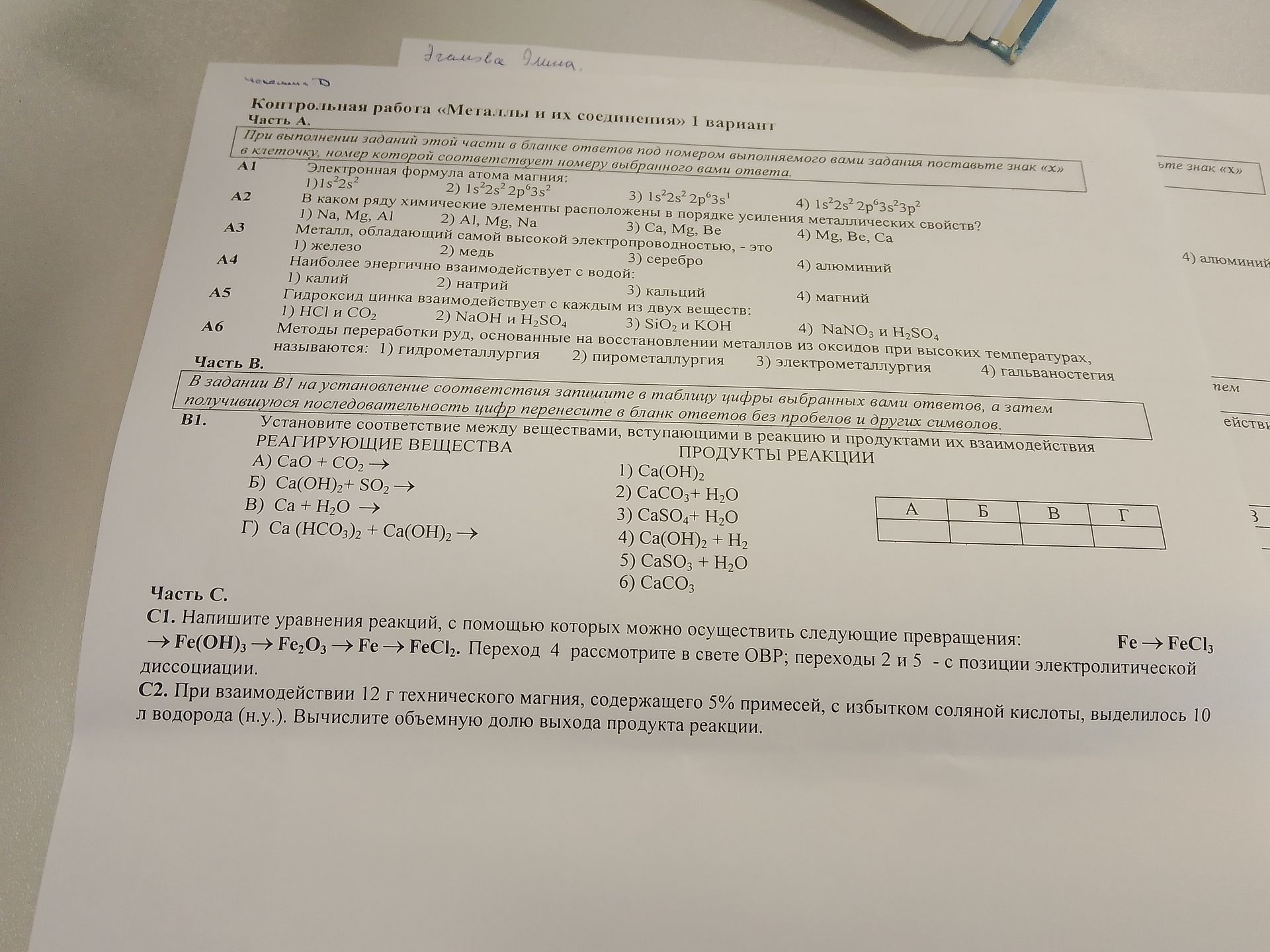
Part A. For tasks in this part, put an "x" in the box under the number of the answer you have chosen. The number of the cell should correspond to the number of the answer you have chosen. A1. Electronic formula of the magnesium atom: 1) 1s²2s² 2) 1s²2s²2p⁶3s² 3) 1s²2s²2p⁶3s¹ 4) 1s²2s²2p⁶3s²3p² A2. In which row are the chemical elements arranged in order of increasing metallic properties? 1) Na, Mg, Al 2) Al, Mg, Na 3) Ca, Mg, Be 4) Mg, Be, Ca A3. The metal with the highest electrical conductivity is 1) iron 2) copper 3) silver 4) aluminum A4. Most vigorously reacts with water: 1) potassium 2) sodium 3) calcium 4) magnesium A5. Zinc hydroxide reacts with each of the following two substances: 1) HCl and CO₂ 2) NaOH and H₂SO₄ 3) SiO₂ and KOH 4) NaNO₃ and H₂SO₄ A6. Methods of ore processing based on the reduction of metals from oxides at high temperatures are called: 1) hydrometallurgy 2) pyrometallurgy 3) electrometallurgy 4) galvanizing Part B. For task B1, establish the correspondence, write the numbers of your chosen answers in the table, and then transfer the resulting sequence of numbers to the answer sheet without spaces or other symbols. B1. Establish the correspondence between the reacting substances and the products of their interaction. REACTING SUBSTANCES PRODUCT OF REACTION A) CaO + CO₂ → 1) Ca(OH)₂ B) Ca(OH)₂ + SO₂ → 2) CaCO₃ + H₂O B) Ca + H₂O → 3) CaSO₄ + H₂O Γ) Ca(HCO₃)₂ + Ca(OH)₂ → 4) Ca(OH)₂ + H₂ 5) CaSO₃ + H₂O 6) CaCO₃ Part C. C1. Write the reaction equations by means of which the following transformations can be carried out: Fe → Fe(OH)₃ → Fe₂O₃ → Fe → FeCl₂. Consider transition 4 in terms of redox reactions; transitions 2 and 5 from the standpoint of electrolytic dissociation. C2. Upon interaction of 12 g of technical magnesium, containing 5% impurities, with an excess of hydrochloric acid, 10 L of hydrogen (n. conditions) were released. Calculate the volumetric yield of the reaction product.
Ответ:
Part A:
A1. Correct answer: 2. The electronic configuration of magnesium (atomic number 12) is 1s²2s²2p⁶3s².
A2. Correct answer: 1. Metallic properties increase from right to left and from top to bottom in the periodic table. The order Na, Mg, Al shows increasing metallic properties.
A3. Correct answer: 2. Copper has the highest electrical conductivity among the given options.
A4. Correct answer: 1. Potassium is an alkali metal and reacts vigorously with water.
A5. Correct answer: 1. Zinc hydroxide is an amphoteric hydroxide and reacts with acids (HCl) and acidic oxides (CO₂).
A6. Correct answer: 2. Pyrometallurgy involves processing ores at high temperatures.
Part B:
B1. Let's establish the correspondence:
A) CaO + CO₂ → CaCO₃ (or Ca(HCO₃)₂ if water is present, but CaCO₃ is the main product of the reaction between a basic oxide and an acidic oxide). The closest option is 6) CaCO₃.
Б) Ca(OH)₂ + SO₂ → CaSO₃ + H₂O. This corresponds to option 5).
B) Ca + H₂O → Ca(OH)₂ + H₂. This corresponds to option 4).
Г) Ca(HCO₃)₂ + Ca(OH)₂ → 2CaCO₃ + 2H₂O. This corresponds to option 6).
In cases where there are multiple correct options or ambiguity, we will select the most direct and common reaction. For A, typically the formation of a carbonate. For Г, the formation of carbonate is the primary reaction.
| A | Б | B | Г | |
|---|---|---|---|---|
| PRODUCT OF REACTION | 6 | 5 | 4 | 6 |
The resulting sequence is 6546.
Part C:
C1. Let's write the reaction equations:
- Fe → Fe(OH)₃: This transformation usually involves multiple steps, for example, oxidation of Fe to Fe²⁺ or Fe³⁺, then precipitation. A common path would be Fe → FeCl₃ → Fe(OH)₃. For simplicity, let's assume Fe³⁺ is formed first. A possible simplified path: $$2Fe + 3Cl_2 \rightarrow 2FeCl_3$$. Then $$FeCl_3 + 3NaOH \rightarrow Fe(OH)_3 \rfloor + 3NaCl$$.
- Fe(OH)₃ → Fe₂O₃: This is a dehydration reaction. $$2Fe(OH)_3 \rightarrow Fe_2O_3 + 3H_2O$$. This is considered in terms of electrolytic dissociation of water molecules within the hydroxide.
- Fe₂O₃ → Fe: This is a reduction of iron(III) oxide, typically done using a reducing agent like carbon at high temperatures (thermite reaction or smelting). $$Fe_2O_3 + 3CO \rightarrow 2Fe + 3CO_2$$ (using CO as a reducing agent).
- Fe → FeCl₂: This is a reaction of iron with a non-oxidizing acid or a milder oxidizing agent. $$Fe + 2HCl \rightarrow FeCl_2 + H_2$$. This is a redox reaction. Iron is oxidized from 0 to +2.
C2. Calculation of the volumetric yield of hydrogen:
First, let's determine the mass of pure magnesium:
Mass of impurities = 12 g * 5% = 0.6 g
Mass of pure Mg = 12 g - 0.6 g = 11.4 g
Now, let's find the moles of pure magnesium:
Molar mass of Mg = 24.305 g/mol
\[ n(Mg) = \frac{11.4 \text{ g}}{24.305 \text{ g/mol}} \approx 0.469 \text{ mol} \]
The reaction of magnesium with hydrochloric acid is:
\[ Mg + 2HCl \rightarrow MgCl_2 + H_2 \]
From the stoichiometry, 1 mole of Mg produces 1 mole of H₂. So, the theoretical moles of H₂ produced are approximately 0.469 mol.
Now, let's calculate the theoretical volume of H₂ at standard conditions (n.u. - normal conditions, usually taken as 0 °C and 1 atm, where molar volume is 22.4 L/mol):
\[ V_{\text{theoretical}}(H_2) = 0.469 \text{ mol} \times 22.4 \text{ L/mol} \approx 10.5056 \text{ L} \]
The actual volume of H₂ released is given as 10 L.
The volumetric yield of the reaction product is calculated as:
\[ \text{Yield} = \frac{\text{Actual Volume}}{\text{Theoretical Volume}} \times 100\% \]
\[ \text{Yield} = \frac{10 \text{ L}}{10.5056 \text{ L}} \times 100\% \approx 95.19\% \]
Ответ:
A1: 2
A2: 1
A3: 2
A4: 1
A5: 1
A6: 2
B1: 6546
C1:
- $$2Fe + 3Cl_2 \rightarrow 2FeCl_3$$; $$FeCl_3 + 3NaOH \rightarrow Fe(OH)_3 \rfloor + 3NaCl$$
- $$2Fe(OH)_3 \rightarrow Fe_2O_3 + 3H_2O$$
- $$Fe_2O_3 + 3CO \rightarrow 2Fe + 3CO_2$$
- $$Fe + 2HCl \rightarrow FeCl_2 + H_2$$
C2. Объемная доля выхода продукта реакции составляет приблизительно 95.19%.
