
 Алгебра
 Английский
 Биология
 География
 Геометрия
 История
 Русский
 Обществознание
 Физика
 Химия
Химия Информатика
 Литература
 Математика
Вопрос:
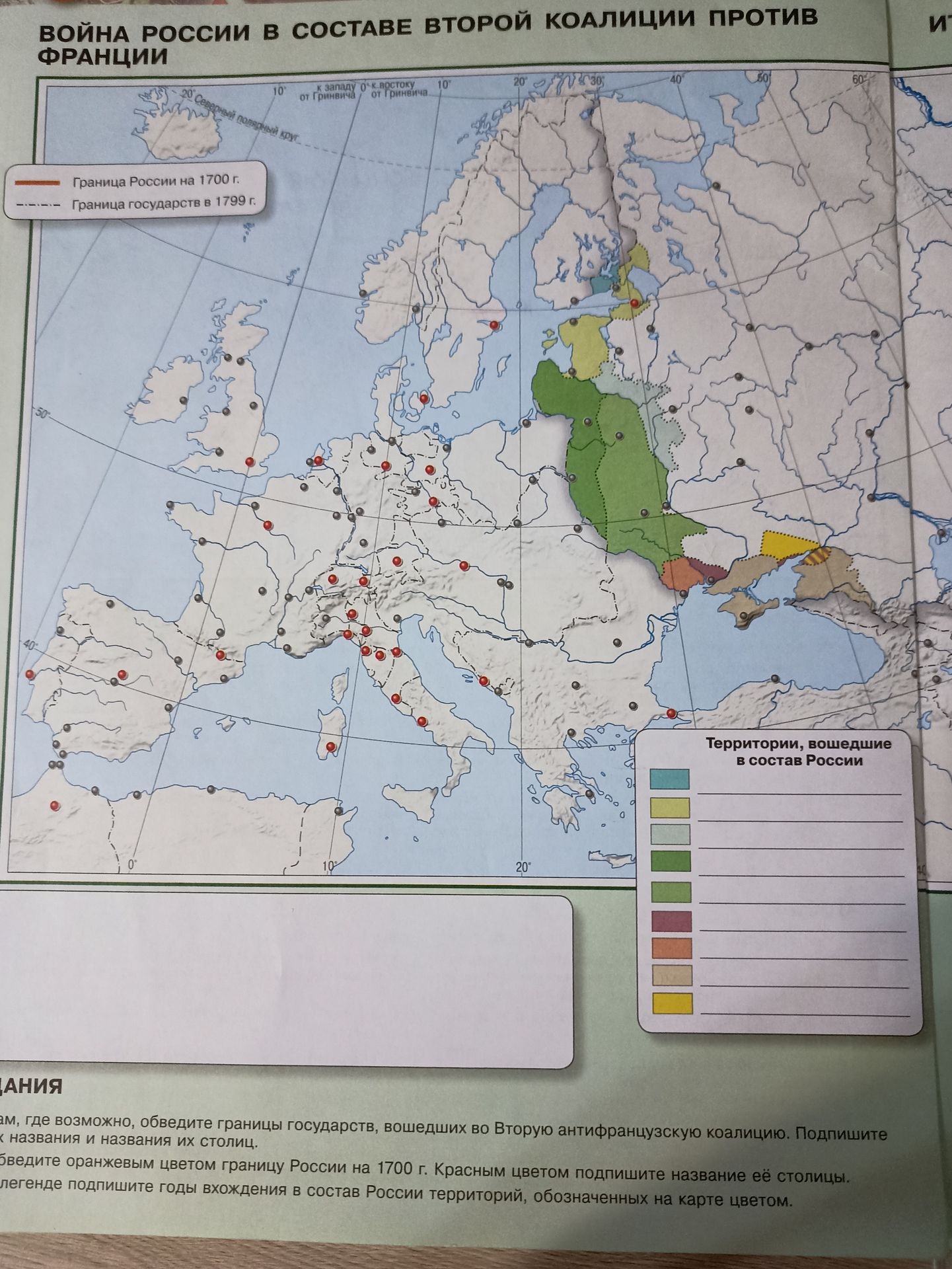
Please provide the historical context and significance of the given map of Europe during the Napoleonic Wars.
Ответ:
Historical Context:
The map depicts Europe during the War of the Second Coalition against Napoleonic France. This conflict, spanning from 1798 to 1802, involved a coalition of powers, primarily Great Britain, the Austrian Empire, the Russian Empire, the Ottoman Empire, and others, seeking to contain and defeat the expansionist ambitions of the French Republic under Napoleon Bonaparte.
The map specifically highlights:
- The Russian Empire's borders in 1700 (indicated by a solid orange line) and its territories in 1799 (indicated by a dashed line). This shows the significant territorial extent of Russia at the turn of the 18th century and how it might have changed or been perceived in relation to the ongoing conflicts.
- Territories that became part of Russia, visualized with different colored blocks. This suggests a focus on Russia's expansion or influence during or around this period.
- The capitals of European states marked with red dots. These likely represent key strategic locations or centers of power for the nations involved in the coalition or affected by the conflict.
- The formation of the Second Coalition, which aimed to curb French influence following Napoleon's successful campaigns in Italy and Egypt, and the subsequent coup that brought him to power in France.
Significance:
- Shift in Power Balance: The War of the Second Coalition was a crucial period that tested the resolve of European monarchies against the revolutionary ideals and military might of France. Its outcome significantly influenced the subsequent Napoleonic Wars and the reshaping of Europe's political map.
- Russia's Role: Russia played a significant, albeit complex, role in this coalition. Initially a key member, internal politics and strategic disagreements led to its eventual withdrawal. The map's emphasis on Russian territories underscores its importance as a major European power.
- Napoleonic Dominance: Despite the coalition's efforts, Napoleon emerged victorious from this phase of conflict, consolidating his power in France and setting the stage for further expansion and dominance across Europe in the following years. The map serves as a visual representation of the geopolitical landscape during this transformative era.
- Territorial Changes: The colored territories indicate areas that were either annexed by or came under the influence of Russia, reflecting the shifting borders and political allegiances of the time, particularly in Eastern Europe and the Black Sea region.
