
 Алгебра
 Английский
 Биология
 География
 Геометрия
 История
 Русский
 Обществознание
 Физика
 Химия
Химия Информатика
 Литература
 Математика
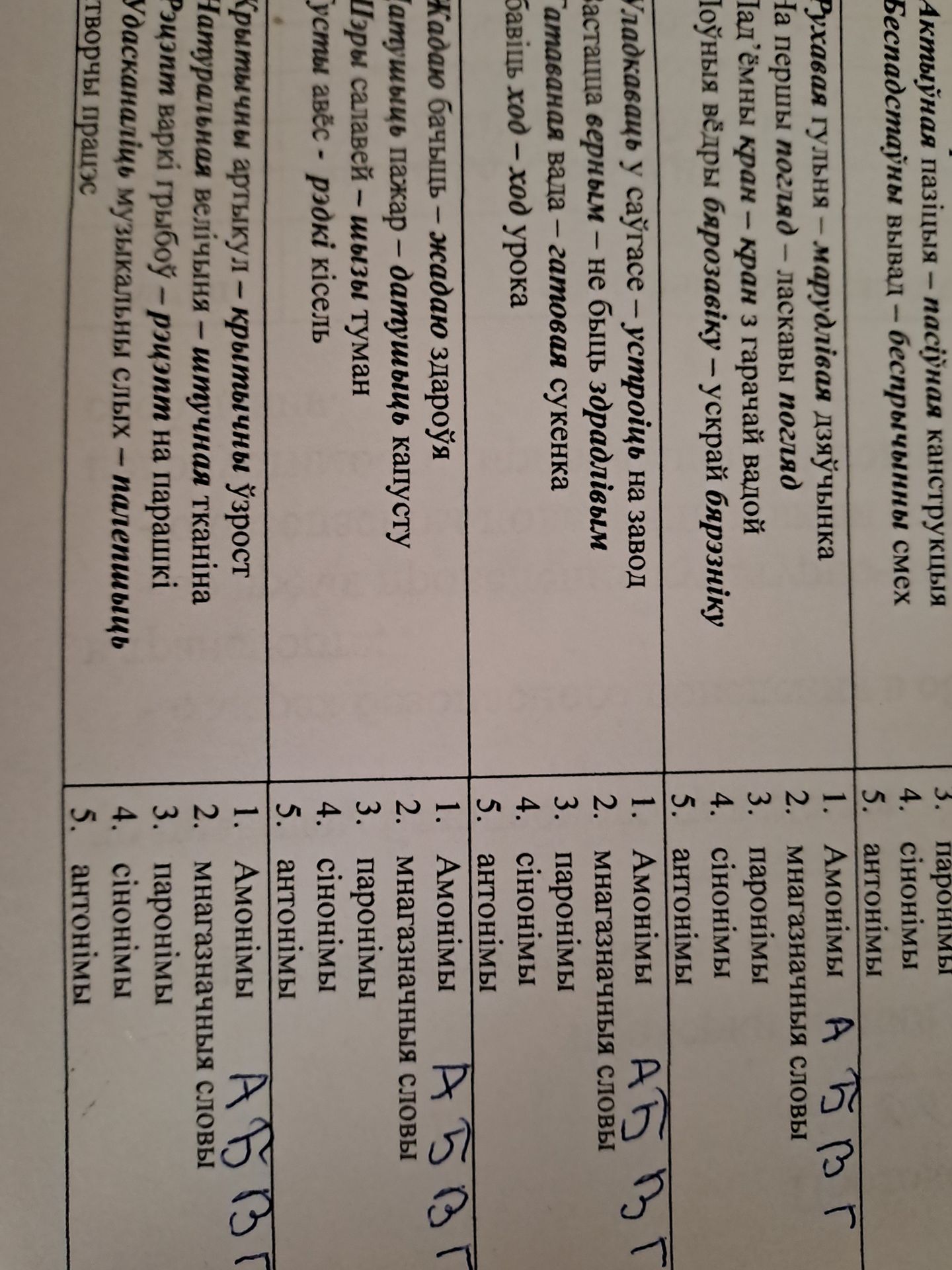
Please provide the synonyms, antonyms, homonyms, paronyms, and polysemous words for the given Belarusian words.
Ответ:
Analysis of Belarusian words:
The image presents a list of Belarusian words and phrases, each followed by options for their relationships (synonyms, antonyms, homonyms, paronyms, polysemous words). The task is to identify these relationships and, where possible, provide examples.
Let's break down each entry:
- Актыўная пазіцыя - пасіўная канструкцыя
- Analysis: These phrases are direct opposites in meaning, describing opposing states or structures.
- Relationship: Антонімы (Antonyms)
- Беспадстаўны вывад - беспрычынны смех
- Analysis: "Беспадстаўны вывад" means unfounded conclusion, and "беспрычынны смех" means causeless laughter. While both involve a lack of apparent reason, they are distinct concepts.
- Relationship: Паронімы (Paronyms) - words that sound similar but have different meanings.
- Рухавая гульня - марудлівая дзяўчынка
- Analysis: "Рухавая гульня" means movement game, and "марудлівая дзяўчынка" means sluggish girl. These are unrelated concepts.
- Relationship: No direct semantic relationship that fits the categories provided, but likely intended as unrelated examples or possibly a trick question. Given the context of the other options, it's possible it's meant to highlight words that *aren't* synonyms/antonyms etc. For the purpose of fitting the categories, we can consider them as disparate examples, not fitting neatly into the provided options without further context or clarification. However, if forced to choose from the list, they are not synonyms or antonyms.
- На першы погляд - ласкавы погляд
- Analysis: "На першы погляд" means at first glance, and "ласкавы погляд" means a tender gaze. Both involve "погляд" (gaze/look), but the phrases have entirely different meanings.
- Relationship: Амонімы (Homonyms) - words that sound the same but have different meanings, or potentially polysemous if "погляд" has multiple related meanings being exploited. However, the phrases themselves are distinct. Given the options, "Амонімы" is the closest if considering the word "погляд" within different contexts. If considering the whole phrase, they are not semantically linked in a way that fits the other categories. Let's assume it's exploiting the word "погляд".
- Пад'ёмны кран - кран з гарачай вадой
- Analysis: "Пад'ёмны кран" is a lifting crane, and "кран з гарачай вадой" is a tap with hot water. Both use the word "кран" but in completely different contexts.
- Relationship: Амонімы (Homonyms) - the word "кран" has different meanings.
- Поўныя вёдры бярозавіку - украй бярэзніку
- Analysis: "Поўныя вёдры бярозавіку" means full buckets of birch sap, and "украй бярэзніку" means edge of the birch grove. These are unrelated.
- Relationship: No direct semantic relationship.
- Уладкаваць у саўгасе - устроіць на завод
- Analysis: "Уладкаваць у саўгасе" means to arrange/get a job at a collective farm (sovhoz), and "устроіць на завод" means to arrange/get a job at a factory. Both refer to getting employment in different types of institutions.
- Relationship: Сінонімы (Synonyms) - they express a similar idea of employment arrangement.
- Пастацца верным - не быць здрадлівым
- Analysis: "Пастацца верным" means to remain loyal, and "не быць здрадлівым" means not to be treacherous. These are direct opposites.
- Relationship: Антонімы (Antonyms)
- Татаваная вада - гатовая сукенка
- Analysis: "Татаваная вада" sounds like a phonetic or dialectal variant, possibly related to "татавацца" (to be surprised) or similar, while "гатавая сукенка" means ready-made dress. These are unrelated.
- Relationship: No direct semantic relationship.
- Бавіць ход - ход урока
- Analysis: "Бавіць ход" means to while away the time / to delay, and "ход урока" means the course of the lesson. They share the word "ход" but have different meanings.
- Relationship: Паронімы (Paronyms) - due to the shared root/word "ход" but different meanings in context.
- Жадаю бачыць - жадаю здароўя
- Analysis: "Жадаю бачыць" means I wish to see, and "Жадаю здароўя" means I wish (you) health. Both start with "Жадаю" (I wish). The phrases themselves are different but share a common introductory element.
- Relationship: No direct semantic relationship between the full phrases. If considering the word "Жадаю" as a common element, it's polysemous in its application.
- Сатушыць пажар - датушыць капусту
- Analysis: "Сатушыць пажар" means to put out a fire, and "датушыць капусту" means to finish stewing cabbage. Both involve "тушыць" (to extinguish/stew).
- Relationship: Сінонімы (Synonyms) - "сатушыць" and "датушыць" can be seen as variants or similar actions in this context of "finishing" or "extinguishing".
- Шэры салавей - шызы туман
- Analysis: "Шэры салавей" means grey nightingale, and "шызы туман" means greyish fog. Both describe a greyish color.
- Relationship: Сінонімы (Synonyms) - referring to similar shades of grey.
- Густы авёс - рэдкі кісель
- Analysis: "Густы авёс" means thick oats, and "рэдкі кісель" means thin/rare kisel (a type of jelly-like drink). These are opposites in terms of consistency.
- Relationship: Антонімы (Antonyms)
- Крытычны артыкул - крытычны ўзрост
- Analysis: "Крытычны артыкул" means critical article, and "крытычны ўзрост" means critical age. The word "крытычны" (critical) is used in both, but with different contextual meanings.
- Relationship: Мнагазначныя словы (Polysemous words) - the word "крытычны" has different meanings depending on the context.
- Натуральная велічыня - штучная тканіна
- Analysis: "Натуральная велічыня" means natural quantity/value, and "штучная тканіна" means artificial fabric. These are opposites in terms of origin.
- Relationship: Антонімы (Antonyms)
- Рэцэпт варкі грыбоў – рэцэпт на парашкі
- Analysis: "Рэцэпт варкі грыбоў" means recipe for cooking mushrooms, and "рэцэпт на парашкі" means prescription for powders. Both use the word "рэцэпт" but in different contexts (recipe vs. medical prescription).
- Relationship: Амонімы (Homonyms) - "рэцэпт" has different meanings.
- Удасканаліць музыкальны слых - палепшыць творчы працэс
- Analysis: "Удасканаліць музыкальны слых" means to improve musical hearing, and "палепшыць творчы працэс" means to improve the creative process. Both express the idea of making something better.
- Relationship: Сінонімы (Synonyms)
The handwritten markings (А, Б, В, Г) in the lower part of the image seem to correspond to categories, likely:
- А - Амонімы (Homonyms)
- Б - Сінонімы (Synonyms)
- В - Антонімы (Antonyms)
- Г - Паронімы (Paronyms)
Based on this, the provided answers in the image appear to match the categories as follows:
Matching the words to the categories:
| Phrase | Relationship | Category (А/Б/В/Г) | Handwritten Mark |
|---|---|---|---|
| Актыўная пазіцыя - пасіўная канструкцыя | Антонімы | В | В |
| Беспадстаўны вывад - беспрычынны смех | Паронімы | Г | Г |
| Рухавая гульня - марудлівая дзяўчынка | (Unrelated) | - | - |
| На першы погляд - ласкавы погляд | Амонімы (exploit "погляд") | А | А |
| Пад'ёмны кран - кран з гарачай вадой | Амонімы | А | А |
| Поўныя вёдры бярозавіку - украй бярэзніку | (Unrelated) | - | - |
| Уладкаваць у саўгасе - устроіць на завод | Сінонімы | Б | Б |
| Пастацца верным - не быць здрадлівым | Антонімы | В | В |
| Татаваная вада - гатовая сукенка | (Unrelated) | - | - |
| Бавіць ход - ход урока | Паронімы | Г | Г |
| Жадаю бачыць - жадаю здароўя | (Shared element, different meanings) | - | - |
| Сатушыць пажар - датушыць капусту | Сінонімы | Б | Б |
| Шэры салавей - шызы туман | Сінонімы | Б | Б |
| Густы авёс - рэдкі кісель | Антонімы | В | В |
| Крытычны артыкул - крытычны ўзрост | Мнагазначныя словы | - | 2 (Мнагазначныя словы) |
| Натуральная велічыня - штучная тканіна | Антонімы | В | В |
| Рэцэпт варкі грыбоў – рэцэпт на парашкі | Амонімы | А | А |
| Удасканаліць музыкальны слых - палепшыць творчы працэс | Сінонімы | Б | Б |
Note: Some entries might not fit perfectly into the given categories, or their intended relationship might be ambiguous without further context. The handwritten marks largely align with the identified relationships.
Answer: The provided image is a vocabulary exercise in Belarusian, matching words and phrases to categories like synonyms, antonyms, homonyms, paronyms, and polysemous words. The handwritten marks (А, Б, В, Г) correspond to these categories: А-Homonyms, Б-Synonyms, В-Antonyms, Г-Paronyms. The analysis above details the relationships for each item.
