
 Алгебра
 Английский
 Биология
 География
 Геометрия
 История
 Русский
 Обществознание
 Физика
 Химия
Химия Информатика
 Литература
 Математика
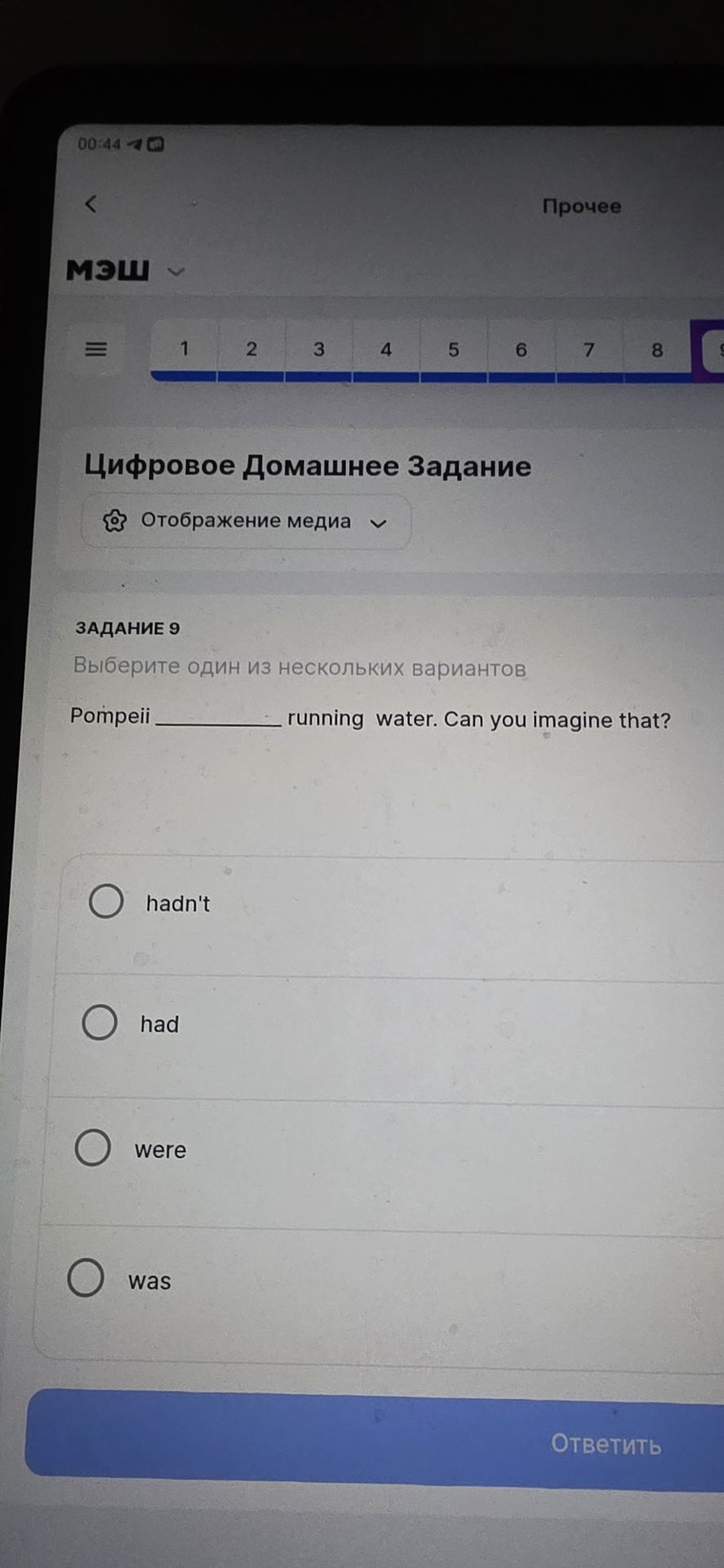
Pompeii running water. Can you imagine that?
Ответ:
Explanation:
The sentence describes a past event that did not happen. Therefore, we need to use the past perfect tense to indicate that Pompeii did not have running water. The past perfect tense is formed with 'had' + past participle. In this case, the past participle of 'to have' is 'had'. So, the correct form is 'hadn't had'.
Let's look at the options:
- hadn't: This is an auxiliary verb and is incomplete on its own.
- had: This indicates possession in the past, but doesn't fit the negative context of the sentence.
- were: This is a form of 'to be' and is used for plural subjects in the past, or with 'if' clauses for hypothetical situations. It doesn't fit here.
- was: This is a form of 'to be' for singular subjects in the past. It doesn't fit here.
The sentence structure requires a past perfect negative to express lack of something in the past before another event (implied or stated). If the sentence were about something existing, it would be 'Pompeii had running water', but the question implies it did not.
Considering the options, and the need for a past perfect negative, the most logical completion of the sentence implying Pompeii did not possess running water in the past before some other event or consideration is to use 'hadn't had'. However, 'hadn't' by itself is not a complete verb phrase. If the options were more complete, it would be clearer.
Let's re-evaluate the options in the context of a fill-in-the-blank question where only one word is expected to complete the phrase 'Pompeii ____ running water'.
The sentence is 'Pompeii ____ running water. Can you imagine that?' This is asking about whether running water existed in Pompeii historically. The common understanding is that Pompeii did have running water as part of its advanced infrastructure.
If the question is asking whether Pompeii *had* running water, then the answer should be affirmative. If it's asking about a hypothetical or counterfactual situation, it would be different.
However, the presence of 'hadn't' suggests a negative completion is being considered. If we interpret the sentence as 'Pompeii [did not have] running water', then 'hadn't' would be part of the answer.
Let's assume the question is asking for the verb that would fit in the blank to make a grammatically correct and contextually plausible sentence about the past.
Option 1: Pompeii hadn't running water. (This is grammatically incomplete as a standalone verb phrase. It would need a past participle like 'hadn't had').
Option 2: Pompeii had running water. (This is grammatically correct and historically accurate, implying the existence of running water).
Option 3: Pompeii were running water. (Incorrect verb for a singular subject 'Pompeii').
Option 4: Pompeii was running water. (This would imply Pompeii *was* the running water, which makes no sense).
Given the options, and the fact that Pompeii *did* have running water, the most logical completion if we ignore the implied negative from 'hadn't' being an option, would be 'had'.
However, if the question is designed to trick or test understanding of a specific grammatical construction, and 'hadn't' is provided as an option, it strongly implies a negative context. If we are forced to choose from the given options and assume one is correct:
The sentence is a statement followed by a rhetorical question. The statement is about Pompeii and running water. Historically, Pompeii *did* have advanced aqueduct systems and running water. So, the statement should be affirmative.
Let's re-examine the options:
- 'hadn't' - This implies a negative. If it were 'hadn't had', it would make sense for a past perfect negative.
- 'had' - This is the simple past affirmative. 'Pompeii had running water.' This is historically correct.
- 'were' - Incorrect verb agreement.
- 'was' - Incorrect verb agreement and meaning.
The question is presented as a multiple-choice question for completing the sentence: "Pompeii ____ running water. Can you imagine that?"
The most historically accurate and grammatically sound completion from the options provided, assuming the sentence is meant to state a fact about Pompeii's infrastructure, is that Pompeii *had* running water.
The presence of "hadn't" as an option might be misleading, or it could be that the question is poorly phrased, or it's testing a specific nuance of past tense or lack of something. However, if we are to make a factual statement about Pompeii, it possessed running water.
Let's consider the possibility that the question is asking about a specific time frame or condition. But without further context, the most straightforward interpretation is a statement of fact.
If the intent was to say that Pompeii *didn't* have running water, then 'hadn't' would be the start of 'hadn't had'. But 'hadn't' alone is not enough.
Given the options, and the historical fact that Pompeii *did* have running water, the choice 'had' seems the most appropriate to form the affirmative statement "Pompeii had running water." The follow-up "Can you imagine that?" could be expressing amazement at this advanced feature for its time.
However, if the question is implicitly asking for a negative statement, then 'hadn't' would be the beginning of the correct negative past perfect. But as a single word choice, it's incomplete.
Let's assume this is a question about English grammar, specifically about completing a sentence with the correct form of a verb. The options are: hadn't, had, were, was.
The sentence is: Pompeii ____ running water. Can you imagine that?
1. Pompeii hadn't running water. (Grammatically incomplete. Needs 'had' after 'hadn't' to form past perfect negative.)
2. Pompeii had running water. (Grammatically correct simple past affirmative. Historically accurate.)
3. Pompeii were running water. (Incorrect subject-verb agreement. 'Pompeii' is singular.)
4. Pompeii was running water. (Incorrect meaning. 'was running' would mean it was actively running, not possessing it. Also, 'was' is the past tense of 'to be'. This sentence is not about 'being' running water.)
Therefore, the only grammatically correct and contextually sensible option for completing the sentence with the given choices, assuming the intent is to state a fact about Pompeii, is 'had'.
The question asks to choose one of the several variants. The sentence is about Pompeii and running water. Pompeii was an ancient Roman city that had an advanced aqueduct system. Therefore, it HAD running water.
Let's check the options:
- hadn't: This is the negative auxiliary verb for past perfect. The sentence would need to be "Pompeii hadn't had running water." Since "had" is not an option following "hadn't", this choice is incomplete.
- had: This is the simple past tense of "to have". "Pompeii had running water." This is historically correct and grammatically sound.
- were: This is the past tense of "to be" for plural subjects. "Pompeii" is singular. So, this is incorrect.
- was: This is the past tense of "to be" for singular subjects. "Pompeii was running water" would mean that Pompeii itself was the running water, which is nonsensical. If it meant "Pompeii was running water," it would imply an ongoing action of running, which doesn't fit the context of possession or existence of a system.
Thus, the only correct option to complete the sentence "Pompeii ____ running water." is had.
