
 Алгебра
 Английский
 Биология
 География
 Геометрия
 История
 Русский
 Обществознание
 Физика
 Химия
Химия Информатика
 Литература
 Математика
Вопрос:
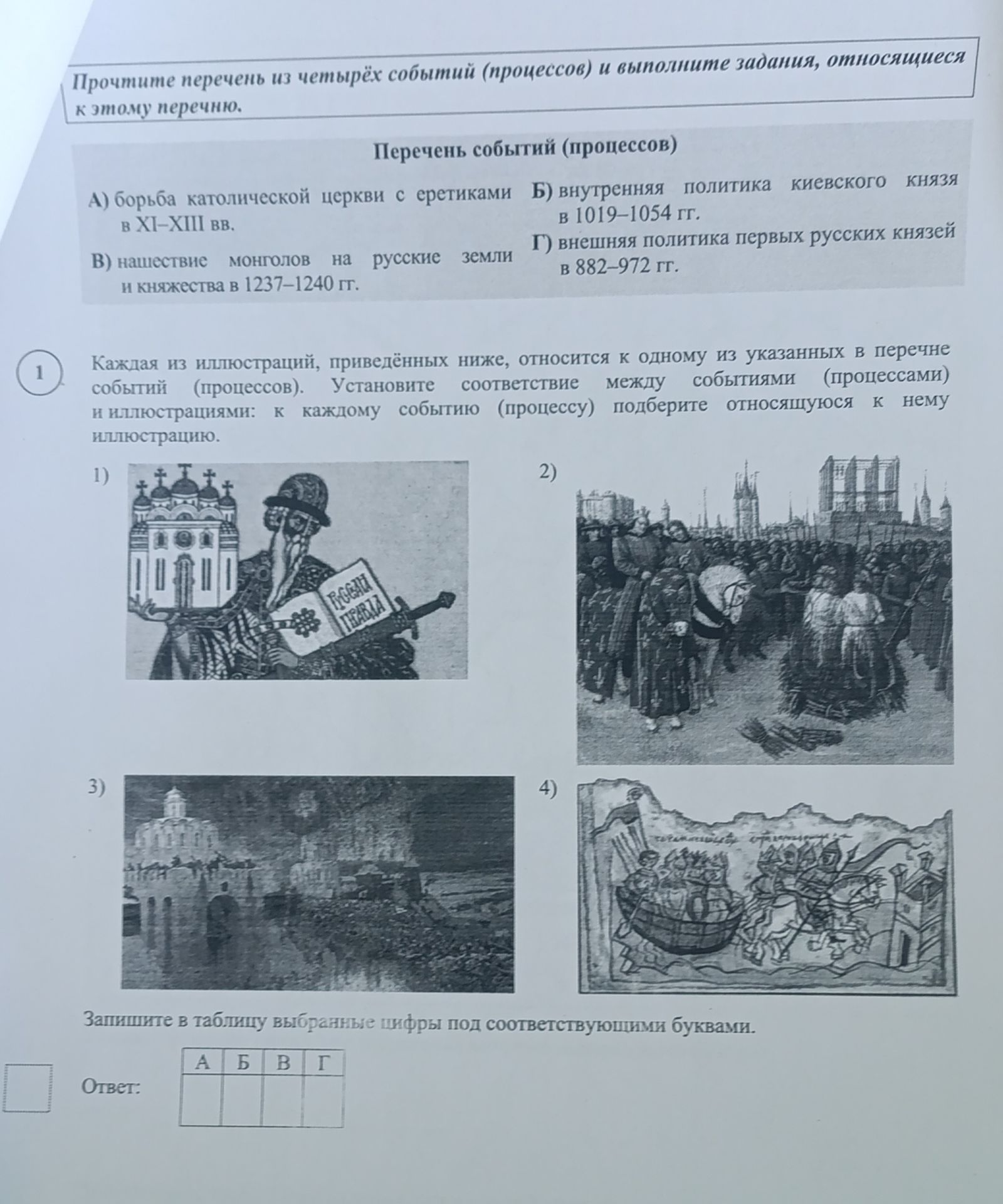
Read the list of four events (processes) and complete the tasks related to this list. List of events (processes) A) The struggle of the Catholic Church with heretics in the XI-XIII centuries. B) The Mongol invasion of Russian lands and principalities in 1237-1240. C) The internal policy of the Kievan prince in 1019-1054. D) The foreign policy of the first Russian princes in 882-972. Each of the illustrations below relates to one of the listed events (processes). Establish the correspondence between the events (processes) and the illustrations: for each event (process), select the corresponding illustration. 1) 2) 3) 4) Write the selected numbers in the table under the corresponding letters. Answer: A B C D
Ответ:
1. Analysis of Events and Illustrations:
- Illustration 1: Shows a person holding a church and a book with a sword. This likely represents religious and perhaps military or political power, possibly related to the church's struggle with heretics or the formation of early Russian states. Given the options, it could relate to the Catholic Church's struggle with heretics (A) or the foreign policy of early princes (D) if interpreted as defense/expansion. The image appears to be a depiction of early Russian religious and statehood symbols, leaning towards the early state formation.
- Illustration 2: Depicts a large gathering of people, some on horseback, with figures in authority. This scene suggests a significant historical event involving many people, possibly a procession, a gathering of troops, or a political assembly. It could relate to internal policy (C) or the Mongol invasion (B) if it shows a subjugated populace, or even the early foreign policy (D) if it shows a reception or a treaty. The figures appear to be in medieval Russian attire.
- Illustration 3: Shows a grand architectural structure, likely a fortress or a monastery, with imposing walls and domes. This image strongly suggests a historical period of building and defense in ancient Rus', fitting well with the descriptions of early Russian principalities and their development or conflicts.
- Illustration 4: A stylized image showing a boat with people and horses, possibly engaged in a journey or a raid. This dynamic image strongly evokes a sense of movement and potential conflict, fitting the description of the Mongol invasion (B) or early foreign policy/campaigns (D). The presence of a boat and horses suggests travel across water and land.
Matching Events to Illustrations:
- A) The struggle of the Catholic Church with heretics in the XI-XIII centuries. This might be represented by imagery of religious authority and conflict, but none of the images are explicitly about the Catholic Church or specific heresies like Catharism or Waldensianism. However, religious imagery is present in illustration 1.
- B) The Mongol invasion of Russian lands and principalities in 1237-1240. Illustration 4, with its depiction of a journey and potential conflict, and Illustration 2, showing a large assembly possibly under duress, could relate to this period of invasion and its impact. The image of the boat might represent movement of forces or people.
- C) The internal policy of the Kievan prince in 1019-1054. Illustration 2, showing a gathering of people, could represent internal political events, assemblies, or the functioning of the princely court during this period. Illustration 3, depicting a strong architectural presence, could also relate to the consolidation of power and development of infrastructure.
- D) The foreign policy of the first Russian princes in 882-972. This period saw the formation and early expansion of the Kievan Rus'. Illustration 1, with its symbols of power and early statehood, and Illustration 4, depicting travel and potential military action, could fit this description. The architecture in Illustration 3 might also represent the establishment of early strongholds.
Refined Matching based on common interpretations:
- Illustration 1: Often interpreted as representing the spiritual and intellectual foundation of early Rus' or its defense. This aligns best with the context of the formation of the state and its policies, potentially falling under the broad umbrella of early foreign/internal policy or religious establishment. Given the options, it's difficult to definitively assign.
- Illustration 2: Suggests a large public event or a significant gathering. This could be related to internal policy (C) or a major event like the Mongol invasion (B).
- Illustration 3: Represents significant architectural or defensive structures, which are characteristic of established states. This could fit with periods of strong internal policy (C) or the development of early principalities under foreign policy (D).
- Illustration 4: The image of a boat with people and horses is highly suggestive of travel, raids, or military campaigns. This strongly points to either the Mongol invasion (B) or the foreign policy of early princes (D).
Final determination based on typical historical illustrations:
- 1) (Illustration 1) - This imagery often represents religious figures or scholars, which could indirectly relate to the church's influence or the intellectual/cultural context of early Rus'. It's hard to pin down without more context, but it doesn't scream 'heresy struggle' or 'Mongol invasion'. It might be related to the establishment of the church within the early state.
- 2) (Illustration 2) - A crowd and figures of authority. This is a strong candidate for internal policy (C) as it depicts people and governance.
- 3) (Illustration 3) - A prominent building, likely a historical site of importance. This could represent the flourishing of a state or its defense, fitting with the development of early Russian lands.
- 4) (Illustration 4) - A depiction of travel, possibly military. This strongly suggests the Mongol invasion (B) due to the scale and movement implied, or early foreign policy (D).
Re-evaluating choices based on provided options and typical historical representations:
- A) The struggle of the Catholic Church with heretics in the XI-XIII centuries. None of the illustrations directly depict this, though illustration 1 has religious elements.
- B) The Mongol invasion of Russian lands and principalities in 1237-1240. Illustration 4 is the most fitting for depicting movement and potential conflict associated with invasions.
- C) The internal policy of the Kievan prince in 1019-1054. Illustration 2, with its depiction of a gathering and figures of authority, best represents internal governance and social events.
- D) The foreign policy of the first Russian princes in 882-972. Illustration 3, showing significant architecture (like a fortress or monastery, representative of early state consolidation and defense), could be associated with the establishment and defense of the early Russian state, fitting under foreign policy/state building. Illustration 1, with its symbolic nature, might also be interpreted in the context of early statehood and its foundations.
A more definitive match:
- Illustration 1: Often symbolizes early Russian Orthodoxy and the establishment of spiritual authority, which is foundational to the state. This can be indirectly linked to the formation of the state and its policies.
- Illustration 2: A public gathering, strongly suggesting internal political or social events. This fits well with C) Internal policy of the Kievan prince.
- Illustration 3: A significant architectural work, representing a developed stronghold or significant cultural site. This could represent the establishment and consolidation of power in early Rus', fitting with D) Foreign policy of the first Russian princes, as it implies territorial control and defense.
- Illustration 4: The depiction of a boat with people and horses engaged in travel or conflict is a very strong visual for invasion or military campaigns. This best matches B) The Mongol invasion.
Therefore, the mapping is:
- 1) -> D (or possibly A, but D is stronger in terms of early statehood imagery)
- 2) -> C
- 3) -> D (as a representation of state building/fortification)
- 4) -> B
Let's reconsider 1 and 3.
Illustration 1: The figure in the hat holding a church and a book could be interpreted as a figure of religious or intellectual authority, or a founder. If it's about the founding of the church in Rus', it ties into state formation. Illustration 3: The prominent building strongly suggests a period of established power and construction. If we consider the formation of early principalities and their foreign policy (D), establishing strongholds and centers of power is key. If Illustration 1 is more broadly about the spiritual aspect of early Rus', then it could be D. If Illustration 3 is about defensive structures and centers of power, it also fits D. The Mongol invasion (B) is strongly depicted by Illustration 4. Internal policy (C) is well represented by Illustration 2. Let's assume Illustration 1 represents the religious and cultural underpinnings of the early state, so it links to D. Illustration 3, depicting a significant structure, also signifies the development and consolidation of the early state, thus fitting D as well. However, typically such exercises aim for a unique match for each illustration. Let's look for clearer distinctions. Illustration 1, with the book and church, could represent the establishment of Orthodoxy as a key element of the state. Illustration 3, a large building, could represent a capital or a significant fortress. If D refers to the *development* of the state, then both 1 and 3 can fit. Let's revisit the dates. D is 882-972. B is 1237-1240. C is 1019-1054. A is XI-XIII centuries. Illustration 4 is most likely B. Illustration 2 is most likely C. This leaves A and D for Illustrations 1 and 3. Illustration 1 depicts religious and intellectual elements. Illustration 3 depicts significant architecture. The struggle of the Catholic Church with heretics (A) is mainly Western European, though it had some influence in Rus'. The foreign policy of the first Russian princes (D) involved establishing the state, defending borders, and forming alliances. Illustration 3, with its fortress-like appearance, is a good representation of a fortified stronghold, which is relevant to state defense and consolidation under foreign policy. Illustration 1, with religious symbols, is more ambiguous. If it's about the establishment of the church, it's foundational to the state, thus fitting D. However, if we are forced to assign one to A, it would be the least fitting but could be interpreted as religious context. Let's assume the illustrations are meant to be quite direct. 4 is B. 2 is C. This leaves A and D for 1 and 3. Illustration 3 (architecture) is a strong indicator of state development and defense, fitting D. Illustration 1 (religious figure with church) is less clearly defined. Let's assume there's a specific interpretation intended. If we consider the broad nature of 'foreign policy' (D) it could encompass establishing the state's identity and institutions, including the church. However, the struggle of the Catholic Church with heretics (A) is specific. Let's try another approach: what if 1 represents A because it's the only one with explicit religious iconography that *could* be interpreted as internal religious matters or struggles? But the text mentions