
 Алгебра
 Английский
 Биология
 География
 Геометрия
 История
 Русский
 Обществознание
 Физика
 Химия
Химия Информатика
 Литература
 Математика
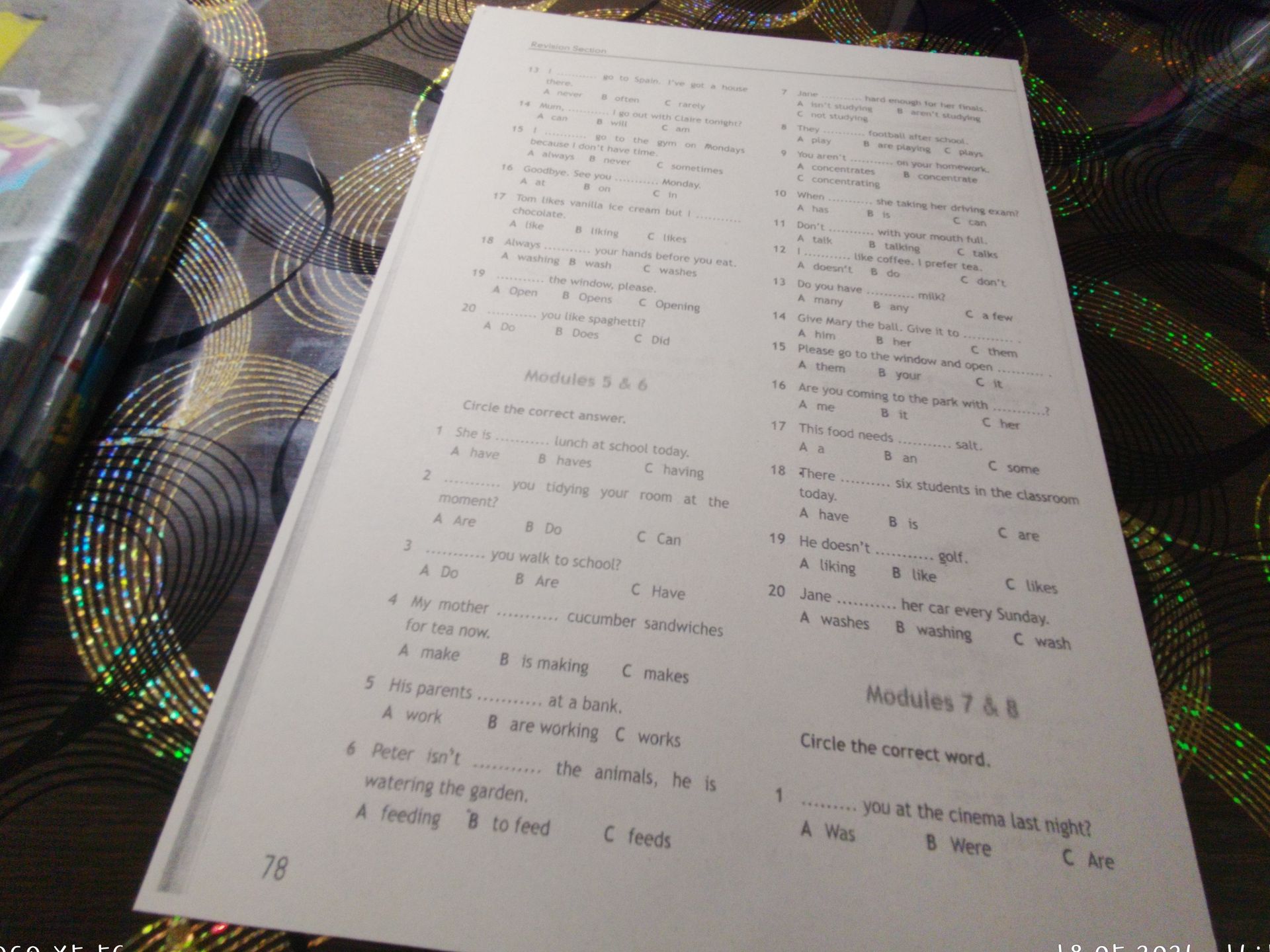
Revision Section - Fill in the blanks 7. Jane ______ hard enough for her finals. A isn't studying B aren't studying C not studying 8. They ______ football after school. A play B are playing C plays 9. You aren't ______ on your homework. A concentrates B concentrate C concentrating 10. When ______ she taking her driving exam? A has B is C can 11. Don't ______ with your mouth full. A talk B talking C talks 12. I ______ like coffee, I prefer tea. A doesn't B do C don't 13. Do you have ______ milk? A many B any C a few 14. Give Mary the ball. Give it to ______. A him B her C them 15. Please go to the window and open ______. A them B your C it 16. Are you coming to the park with ______? A me B it C her 17. This food needs ______ salt. A a B an C some 18. There ______ six students in the classroom today. A have B is C are 19. He doesn't ______ golf. A liking B like C likes 20. Jane ______ her car every Sunday. A washes B washing C wash
Ответ:
Решение:
7. Jane isn't studying hard enough for her finals. (Jane - 3 лицо ед.ч., Present Continuous для обозначения действия, происходящего сейчас или в текущий период).
8. They play football after school. (They - мн.ч., Present Simple для обозначения регулярного действия).
9. You aren't concentrating on your homework. (You - мн.ч., Present Continuous для обозначения действия, происходящего сейчас).
10. When is she taking her driving exam? (Для вопросов в Present Continuous используется вспомогательный глагол 'is' перед подлежащим).
11. Don't talk with your mouth full. (В отрицательных предложениях в повелительном наклонении используется базовая форма глагола).
12. I don't like coffee, I prefer tea. (I - 1 лицо ед.ч., Present Simple, отрицание).
13. Do you have any milk? (В вопросах и отрицаниях часто используется 'any' с неисчисляемыми существительными).
14. Give Mary the ball. Give it to her. (После предлога 'to' используется объектный падеж).
15. Please go to the window and open it. ('it' относится к 'the window').
16. Are you coming to the park with me? (После предлога 'with' используется объектный падеж).
17. This food needs some salt. ('some' используется с неисчисляемыми существительными, когда мы говорим о неопределенном количестве).
18. There are six students in the classroom today. (Множественное число существительного 'students' требует 'are').
19. He doesn't like golf. (После 'doesn't' используется базовая форма глагола).
20. Jane washes her car every Sunday. (Jane - 3 лицо ед.ч., Present Simple, окончание -es).
Ответ: isn't studying, play, concentrating, is, talk, don't, any, her, it, me, some, are, like, washes.
Похожие
- Revision Section - Fill in the blanks 13. I ______ go to Spain. I've got a house there. A never B often C rarely 14. Mum, ______ I go out with Claire tonight? A can B will C am 15. ______ go to the gym on Mondays because I don't have time. A always B never C sometimes 16. Goodbye. See you ______ Monday. A at B on C in 17. Tom likes vanilla ice cream but I ______ chocolate. A like B liking C likes 18. Always ______ your hands before you eat. A washing B wash C washes 19. ______, the window, please. A Open B Opens C Opening 20. ______ you like spaghetti? A Do B Does C Did
- Modules 5 & 6 - Circle the correct answer. 1. She is ______ lunch at school today. A have B haves C having 2. ______ you tidying your room at the moment? A Are B Do C Can 3. ______ you walk to school? A Do B Are C Have 4. My mother ______ cucumber sandwiches for tea now. A make B is making C makes 5. His parents ______ at a bank. A work B are working C works 6. Peter isn't ______ the animals, he is watering the garden. A feeding B to feed C feeds
- Modules 7 & 8 - Circle the correct word. 1. ______ you at the cinema last night? A Was B Were C Are
