
 Алгебра
 Английский
 Биология
 География
 Геометрия
 История
 Русский
 Обществознание
 Физика
 Химия
Химия Информатика
 Литература
 Математика
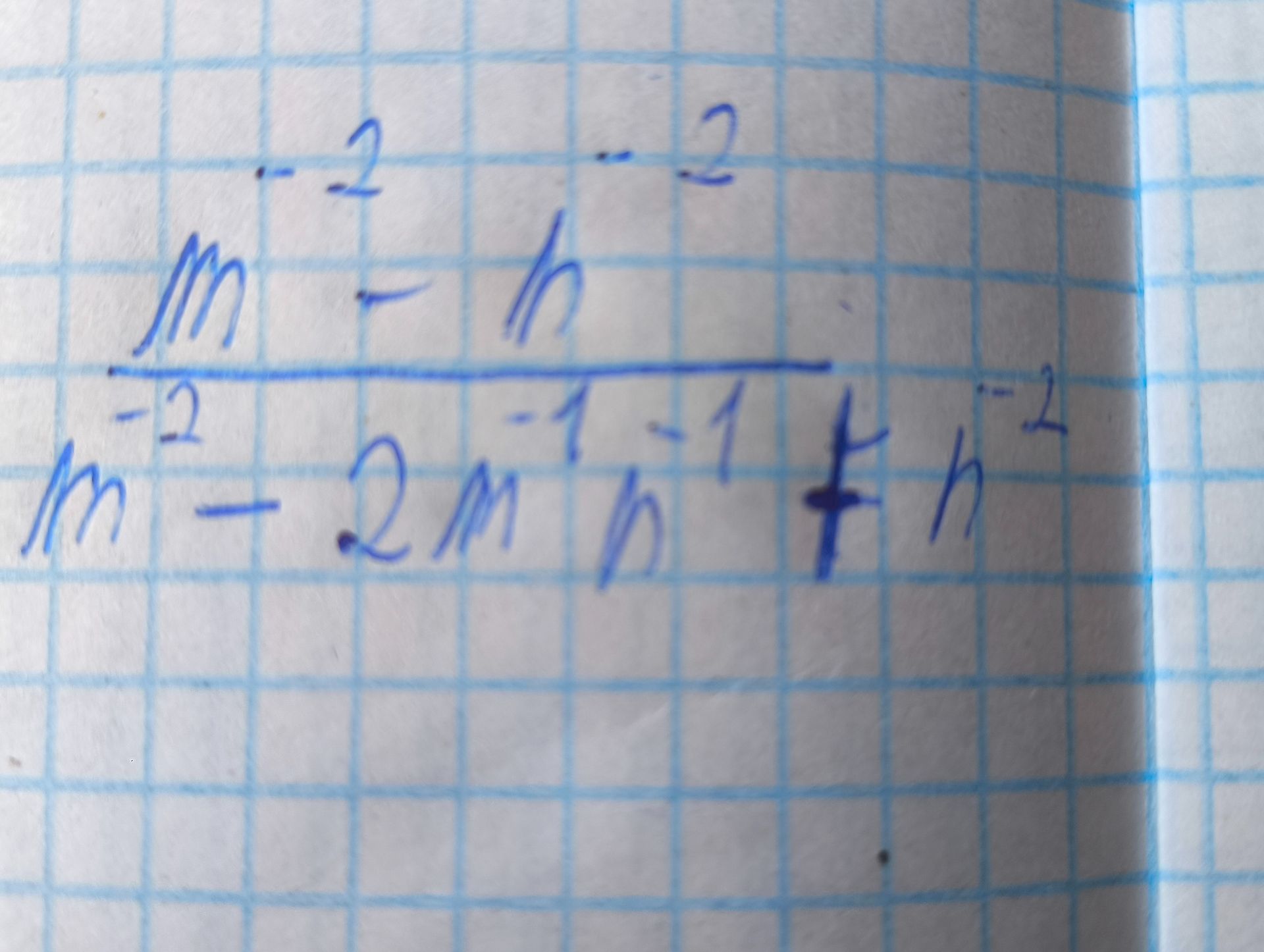
Simplify the following expression: m^{-2} - h^{-2} / m^{-2} - 2m^{-1}h^{-1} + h^{-2}
Ответ:
Solution:
We are asked to simplify the expression $$\frac{m^{-2} - h^{-2}}{m^{-2} - 2m^{-1}h^{-1} + h^{-2}}$$.
First, let's rewrite the expression with positive exponents. Recall that $$x^{-n} = \frac{1}{x^n}$$.
Numerator: $$m^{-2} - h^{-2} = \frac{1}{m^2} - \frac{1}{h^2} = \frac{h^2 - m^2}{m^2 h^2}$$
Denominator: $$m^{-2} - 2m^{-1}h^{-1} + h^{-2} = \frac{1}{m^2} - \frac{2}{mh} + \frac{1}{h^2}$$
To combine the terms in the denominator, find a common denominator, which is $$m^2 h^2$$.
$$ = \frac{h^2}{m^2 h^2} - \frac{2mh}{m^2 h^2} + \frac{m^2}{m^2 h^2} = \frac{h^2 - 2mh + m^2}{m^2 h^2}$$
Notice that the numerator of the denominator is a perfect square trinomial: $$m^2 - 2mh + h^2 = (m-h)^2$$. So, the denominator is $$\frac{(m-h)^2}{m^2 h^2}$$.
Now, we can write the original expression as:
$$ \frac{\frac{h^2 - m^2}{m^2 h^2}}{\frac{(m-h)^2}{m^2 h^2}} $$
To divide by a fraction, we multiply by its reciprocal:
$$ \frac{h^2 - m^2}{m^2 h^2} \times \frac{m^2 h^2}{(m-h)^2} $$
Cancel out the $$m^2 h^2$$ terms:
$$ \frac{h^2 - m^2}{(m-h)^2} $$
The numerator is a difference of squares: $$h^2 - m^2 = (h-m)(h+m)$$.
So, the expression becomes:
$$ \frac{(h-m)(h+m)}{(m-h)^2} $$
We know that $$(h-m) = -(m-h)$$. Substituting this into the expression:
$$ \frac{-(m-h)(h+m)}{(m-h)^2} $$
Cancel out one $$(m-h)$$ term from the numerator and denominator:
$$ \frac{-(h+m)}{m-h} $$
We can also write this as:
$$ \frac{h+m}{h-m} $$
Or, by multiplying the numerator and denominator by -1:
$$ \frac{-(h+m)}{-(h-m)} = \frac{-h-m}{m-h} $$
Let's double check by factoring the numerator of the denominator as $$(m-h)^2$$. The expression is $$\frac{h^2 - m^2}{(m-h)^2}$$.
Since $$h^2 - m^2 = -(m^2 - h^2) = -(m-h)(m+h)$$, we have:
$$ \frac{-(m-h)(m+h)}{(m-h)^2} = \frac{-(m+h)}{m-h} $$
This can be written as $$\frac{m+h}{h-m}$$.
Let's re-examine the denominator. The expression $$m^{-2} - 2m^{-1}h^{-1} + h^{-2}$$ can be seen as $$(\frac{1}{m} - \frac{1}{h})^2$$.
$$(\frac{1}{m} - \frac{1}{h})^2 = (\frac{h-m}{mh})^2 = \frac{(h-m)^2}{m^2h^2}$$
The numerator is $$\frac{1}{m^2} - \frac{1}{h^2} = \frac{h^2-m^2}{m^2h^2}$$.
So, we have $$\frac{\frac{h^2-m^2}{m^2h^2}}{\frac{(h-m)^2}{m^2h^2}} = \frac{h^2-m^2}{(h-m)^2}$$.
Since $$h^2 - m^2 = (h-m)(h+m)$$, the expression becomes:
$$ \frac{(h-m)(h+m)}{(h-m)^2} = \frac{h+m}{h-m} $$
This is the simplified form.
Alternatively, we can write the denominator as $$(m^{-1} - h^{-1})^2$$.
The expression is $$\frac{(m^{-1}-h^{-1})(m^{-1}+h^{-1})}{(m^{-1}-h^{-1})^2} = \frac{m^{-1}+h^{-1}}{m^{-1}-h^{-1}}$$.
$$ \frac{\frac{1}{m} + \frac{1}{h}}{\frac{1}{m} - \frac{1}{h}} = \frac{\frac{h+m}{mh}}{\frac{h-m}{mh}} = \frac{h+m}{h-m} $$
Final check:
Let $$m=1, h=2$$. Then $$m^{-2} = 1, h^{-2} = 1/4$$. $$m^{-1}=1, h^{-1}=1/2$$.
Numerator: $$1 - 1/4 = 3/4$$.
Denominator: $$1 - 2(1)(1/2) + 1/4 = 1 - 1 + 1/4 = 1/4$$.
Expression: $$(3/4) / (1/4) = 3$$.
Simplified form: $$\frac{h+m}{h-m} = \frac{2+1}{2-1} = \frac{3}{1} = 3$$. The results match.
Another way to write the denominator is $$(m^{-1}-h^{-1})^2$$.
The expression is $$\frac{(m^{-1}-h^{-1})(m^{-1}+h^{-1})}{(m^{-1}-h^{-1})^2} = \frac{m^{-1}+h^{-1}}{m^{-1}-h^{-1}}$$.
$$ \frac{\frac{1}{m} + \frac{1}{h}}{\frac{1}{m} - \frac{1}{h}} = \frac{\frac{h+m}{mh}}{\frac{h-m}{mh}} = \frac{h+m}{h-m} $$
This is equivalent to $$\frac{m+h}{h-m}$$.
It seems there might be a slight ambiguity in the interpretation of the handwritten formula. Assuming the expression is $$\frac{m^{-2} - h^{-2}}{(m^{-1} - h^{-1})^2}$$ as suggested by the denominator structure.
Let's re-evaluate the denominator $$m^{-2} - 2m^{-1}h^{-1} + h^{-2}$$. This is indeed $$(m^{-1} - h^{-1})^2$$.
So, the expression is $$\frac{m^{-2} - h^{-2}}{(m^{-1} - h^{-1})^2}$$.
We can factor the numerator as a difference of squares: $$m^{-2} - h^{-2} = (m^{-1} - h^{-1})(m^{-1} + h^{-1})$$.
So, the expression becomes:
$$ \frac{(m^{-1} - h^{-1})(m^{-1} + h^{-1})}{(m^{-1} - h^{-1})^2} $$
Cancel out one term of $$(m^{-1} - h^{-1})$$ from the numerator and denominator:
$$ \frac{m^{-1} + h^{-1}}{m^{-1} - h^{-1}} $$
Now, substitute back $$m^{-1} = \frac{1}{m}$$ and $$h^{-1} = \frac{1}{h}$$:
$$ \frac{\frac{1}{m} + \frac{1}{h}}{\frac{1}{m} - \frac{1}{h}} $$
Find a common denominator for the numerator and the denominator:
Numerator: $$\frac{1}{m} + \frac{1}{h} = \frac{h}{mh} + \frac{m}{mh} = \frac{h+m}{mh}$$
Denominator: $$\frac{1}{m} - \frac{1}{h} = \frac{h}{mh} - \frac{m}{mh} = \frac{h-m}{mh}$$
Now, divide the numerator by the denominator:
$$ \frac{\frac{h+m}{mh}}{\frac{h-m}{mh}} $$
Multiply the numerator by the reciprocal of the denominator:
$$ \frac{h+m}{mh} \times \frac{mh}{h-m} $$
Cancel out the $$mh$$ terms:
$$ \frac{h+m}{h-m} $$
This can also be written as $$\frac{m+h}{h-m}$$ or $$-\frac{m+h}{m-h}$$.
Ответ: $$\frac{m+h}{h-m}$$.
