
 Алгебра
 Английский
 Биология
 География
 Геометрия
 История
 Русский
 Обществознание
 Физика
 Химия
Химия Информатика
 Литература
 Математика
Solve the following logic puzzle:
Ответ:
Analysis:
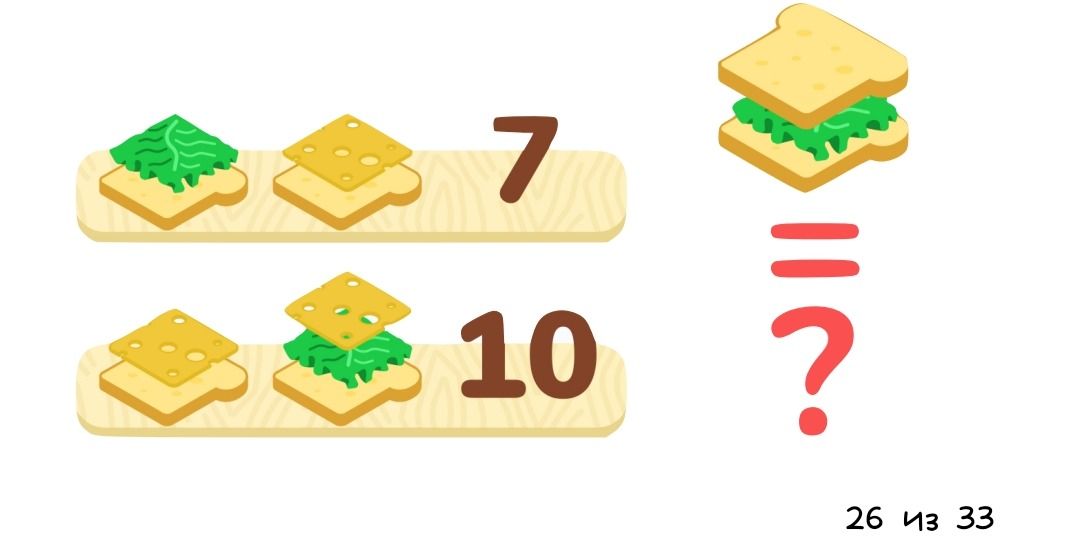
The image presents a logic puzzle involving sandwiches and numbers. We need to determine the numerical value of a sandwich based on the given equations.
Let 'B' represent a slice of bread and 'L' represent a slice of lettuce, and 'C' represent a slice of cheese.
The first equation shows two pieces of bread with lettuce on top, and a slice of cheese on top of the lettuce. This combination equals 7.
Based on the visual, we can infer the following:
- Sandwich 1: Bread + Lettuce + Cheese = 7
- Sandwich 2: Cheese + Bread + Lettuce = 10
Let's assume each component has a numerical value. From the images, we can observe that the arrangement of the components might matter, or the components themselves have values.
Looking at Sandwich 1 and Sandwich 2:
- Sandwich 1: Appears to be 1 bread + 1 lettuce + 1 cheese = 7
- Sandwich 2: Appears to be 1 cheese + 1 bread + 1 lettuce = 10
The visual representations are slightly different. Let's analyze the components:
- In the first row, we see two separate items: one is bread with lettuce, and the other is bread with two slices of cheese. The sum is 7.
- In the second row, we see two separate items: one is bread with two slices of cheese, and the other is bread with lettuce. The sum is 10.
Let's denote:
A= bread with lettuceB= bread with cheeseC= bread with lettuce and cheese (implied by the top right image)
From the image, it seems the items on the left are: 1) bread with lettuce, 2) bread with two slices of cheese. This sum is 7.
And in the second line: 1) bread with two slices of cheese, 2) bread with lettuce. This sum is 10.
This interpretation is inconsistent with the overall sandwich in the top right.
Let's re-examine the image. There are two rows, each with two items and a number. The top right shows a complete sandwich with a question mark.
Let's assume the items on the wooden boards represent parts of a sandwich construction, and the number is the total value of that line-up.
Row 1:
- Item 1: Bread + Lettuce = X
- Item 2: Bread + 2 Cheese = Y
- X + Y = 7
Row 2:
- Item 1: Bread + 2 Cheese = Y
- Item 2: Bread + Lettuce = X
- Y + X = 10
This leads to 7 = 10, which is a contradiction. Therefore, the items on the boards are not independent additive components like this.
Let's consider the possibility that the components have values and are assembled.
Let 'b' be the value of one slice of bread, 'l' be the value of lettuce, and 'c' be the value of cheese.
Looking at the top right, we see a sandwich which is 2 bread + 1 lettuce + 1 cheese.
The first row shows:
- Item 1: Bread + Lettuce. Let's call this 'A'.
- Item 2: Bread + 2 Cheese. Let's call this 'B'.
- A + B = 7
The second row shows:
- Item 1: Bread + 2 Cheese. This is 'B'.
- Item 2: Bread + Lettuce. This is 'A'.
- B + A = 10
Again, this results in 7 = 10, which is a contradiction.
Let's re-interpret the image. The items are not added together. Instead, they represent distinct components of equations.
Let's consider the components of the sandwich: Bread (B), Lettuce (L), Cheese (C).
The first line shows:
(Bread + Lettuce) + (Bread + 2 Cheese) = 7
The second line shows:
(Bread + 2 Cheese) + (Bread + Lettuce) = 10
This still doesn't make sense if the order doesn't matter or if the addition is straightforward.
Let's consider the components shown in the first row:
- Item 1: Bread with Lettuce.
- Item 2: Bread with two slices of Cheese.
- Total value of the line = 7.
Second row:
- Item 1: Bread with two slices of Cheese.
- Item 2: Bread with Lettuce.
- Total value of the line = 10.
This still implies the same set of items add up to two different numbers, which is impossible.
Let's consider the possibility that the visual representations on the boards are not combinations being added, but rather single items whose values sum up to the number.
Let's look at the components as units:
First Row:
- Unit 1: Bread + Lettuce
- Unit 2: Bread + 2 Cheese
- Sum of Unit 1 and Unit 2 = 7
Second Row:
- Unit 1: Bread + 2 Cheese
- Unit 2: Bread + Lettuce
- Sum of Unit 1 and Unit 2 = 10
This implies that (Bread + Lettuce) + (Bread + 2 Cheese) = 7 and (Bread + 2 Cheese) + (Bread + Lettuce) = 10. This is still a contradiction.
Let's consider that the two items on each board are to be treated as separate entities whose individual values are not directly shown, but their combination results in the given sum.
Let's think about the sandwich on the top right. It has 2 slices of bread, 1 layer of lettuce, and 1 slice of cheese.
Let's define the values:
- Bread = B
- Lettuce = L
- Cheese = C
Row 1:
- Item 1: Bread + Lettuce. Let's represent this as (B+L).
- Item 2: Bread + 2 Cheese. Let's represent this as (B+2C).
- (B+L) + (B+2C) = 7? Or are these separate entities being summed?
Let's consider the interpretation where the elements on the board are not summed additively but represent a structure related to the number.
Let's look at the structure of the items on the boards:
First Row:
- Item 1: A slice of bread with lettuce on top.
- Item 2: A slice of bread with two slices of cheese on top.
- The sum of these two entities is 7.
Second Row:
- Item 1: A slice of bread with two slices of cheese on top.
- Item 2: A slice of bread with lettuce on top.
- The sum of these two entities is 10.
This implies a contradiction if the items are identical and additive.
Let's assume there's a different interpretation. What if the
