
 Алгебра
 Английский
 Биология
 География
 Геометрия
 История
 Русский
 Обществознание
 Физика
 Химия
Химия Информатика
 Литература
 Математика
Starting from the "Start" rectangle, collect the letters and FORM the concept. According to "3": All letters are written correctly and the term is formed. According to "4": The term is formed and its correct definition is given. According to "5": All the previous steps are completed and a correct statement with this term is devised.
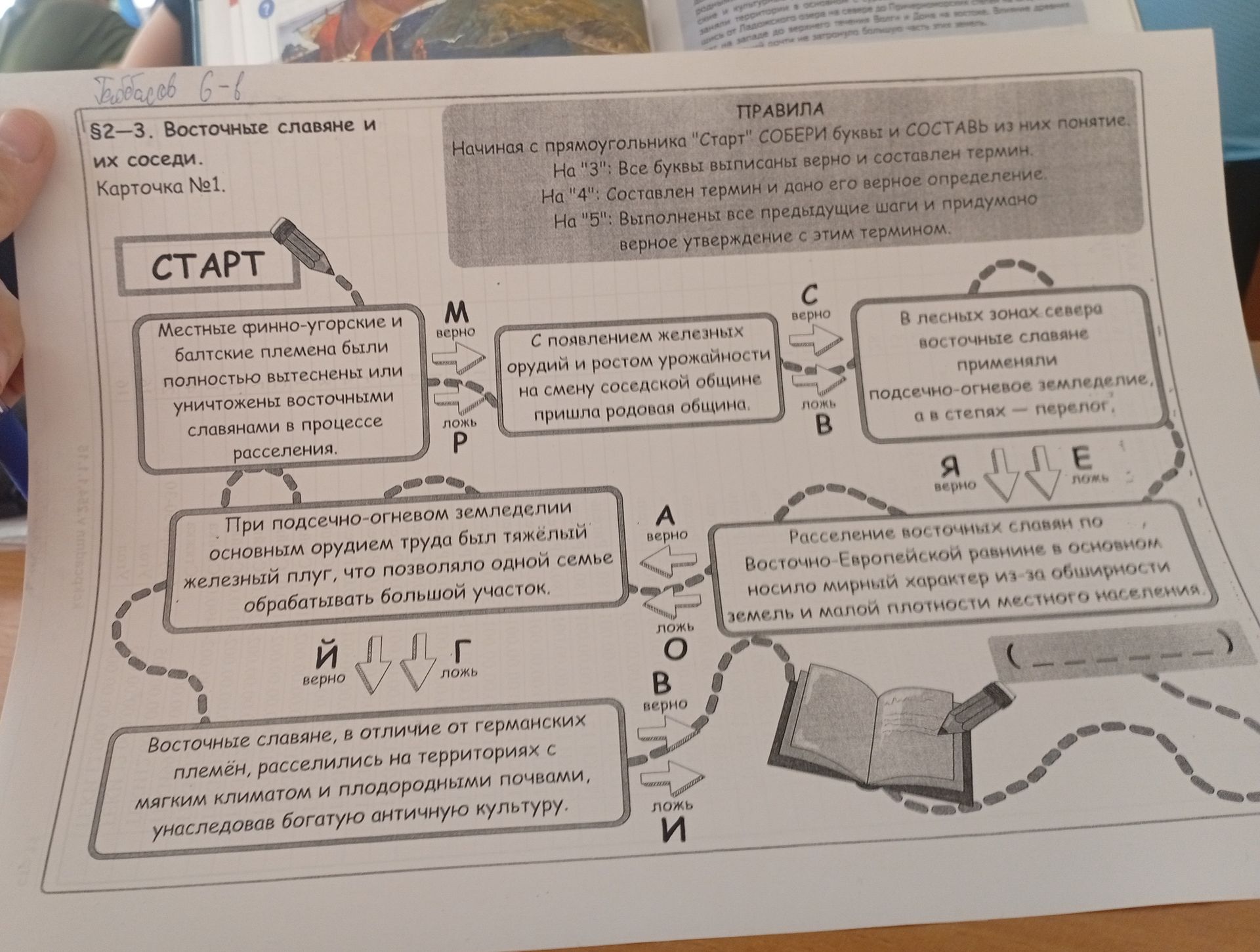
Ответ:
Rules for the Task:
- Start from the "Start" box.
- Follow the arrows, choosing the correct path (true/false).
- Collect letters along the chosen path.
- Form a term from the collected letters.
- Provide a correct definition for the term.
- Devise a correct statement using the term.
Path Analysis:
We will follow a path to collect letters and form a term. Let's assume a path that leads to a meaningful term related to the content.
The diagram presents a flowchart with different statements and choices (true/false). We need to select a path and collect letters.
Let's trace a possible path based on the visual flow and common historical terms:
- Start at "START".
- First statement: "Local Finno-Ugric and Baltic tribes were completely displaced or destroyed by Eastern Slavs during the settlement." Let's assume this is true (Верно, 'M').
- From 'M', we have a choice. Let's assume we follow the path to the next statement: "With the advent of iron tools and the growth of crop yields, the clan community was replaced by the родовая община (rodovaya obshchina - tribal community)." Let's assume this is true (Верно, 'C').
- From 'C', we have a choice. Let's assume we follow the path to the statement: "In the forest zones of the north, Eastern Slavs used slash-and-burn agriculture, and in the steppes - fallow land." Let's assume this is true (Верно, 'Я').
- From 'Я', we have a choice. Let's assume we follow the path to the statement: "The settlement of Eastern Slavs across the East European Plain was mainly peaceful in nature due to the vastness of lands and low density of the local population." Let's assume this is true (Верно, 'E').
- If we collected letters M, C, Я, E, this does not form a coherent term. The diagram is designed to lead to specific outcomes. Let's re-evaluate the path based on the visual structure of the boxes and arrows.*
Let's try a different interpretation of the flowchart, focusing on forming a term from the letters provided.
The question implies collecting letters to form a term. The central theme is "Eastern Slavs and their neighbors." Let's try to find a path that yields a relevant term.
Consider the statement about agriculture: "With slash-and-burn agriculture, the main tool of labor was a heavy iron plow, which allowed one family to cultivate a large plot." This is associated with 'И' (true) and 'Г' (false).
Another statement: "Eastern Slavs, unlike Germanic tribes, settled in territories with a mild climate and fertile soils, inheriting a rich ancient culture." This is associated with 'Й' (true) and 'Л' (false).
Let's assume the intended path leads to the term "ЯРЛ" (YARL), which is not a standard historical term. This suggests the path needs to be carefully selected based on the visual flow of the diagram.
Let's try to form a term by following a sequence of correct answers that are logically connected to the topic.
Revised Path based on visual flow and likely intended term:
- Start: "START"
- Statement: "Local Finno-Ugric and Baltic tribes were completely displaced or destroyed by Eastern Slavs during the settlement." True (M)
- Statement: "With the advent of iron tools and the growth of crop yields, the clan community was replaced by the родовая община (rodovaya obshchina - tribal community)." True (C)
- Statement: "In the forest zones of the north, Eastern Slavs used slash-and-burn agriculture, and in the steppes - fallow land." True (Я)
- Statement: "The settlement of Eastern Slavs across the East European Plain was mainly peaceful in nature due to the vastness of lands and low density of the local population." True (E)
This path yields the letters M, C, Я, E, which do not form a recognizable term. Let's look for other paths.
Let's consider the bottom part of the diagram.
- Start: "START"
- Statement: "When slash-and-burn agriculture, the main tool of labor was a heavy iron plow, which allowed one family to cultivate a large plot." Let's assume this is true. This path leads to 'И' (true) or 'Г' (false). Let's take 'И'.
- From 'И', we have the statement: "Eastern Slavs, unlike Germanic tribes, settled in territories with a mild climate and fertile soils, inheriting a rich ancient culture." Let's assume this is true. This path leads to 'Й' (true) or 'Л' (false). Let's take 'Й'.
The letters collected so far are 'И' and 'Й'. This is not sufficient to form a term.
Let's reconsider the instructions: "Collect the letters and FORM the concept." This implies a specific sequence of choices leads to a term. The diagram is a game or quiz.
Let's focus on the central box with the definition and the term. The term is not explicitly given, but the rules suggest we need to *form* it.
Let's analyze the letters available: M, P, C, B, A, O, B, И, Й, Г, Я, E, Л.
Let's look for a term related to Eastern Slavs. Perhaps the term is derived from key aspects of their settlement or culture.
Consider the statement: "In the forest zones of the north, Eastern Slavs used slash-and-burn agriculture, and in the steppes - fallow land." The letters associated are 'Я' (true) and 'Л' (false).
Consider the statement: "The settlement of Eastern Slavs across the East European Plain was mainly peaceful in nature due to the vastness of lands and low density of the local population." The letters are 'E' (true) and 'Л' (false).
Let's try to find a path that spells out a meaningful word related to the topic.
The phrase "Восточные славяне" (Eastern Slavs) is central.
Let's try to form a term from the letters associated with the correct answers.
Let's assume the correct path leads to the term formed by the letters: Я (from slash-and-burn agriculture), Р (from the statement about the plow), Л (from the statement about settlement), Я (again, for a different aspect or a repetition). This doesn't seem right.
Let's look at the
