
 Алгебра
 Английский
 Биология
 География
 Геометрия
 История
 Русский
 Обществознание
 Физика
 Химия
Химия Информатика
 Литература
 Математика
Вопрос:
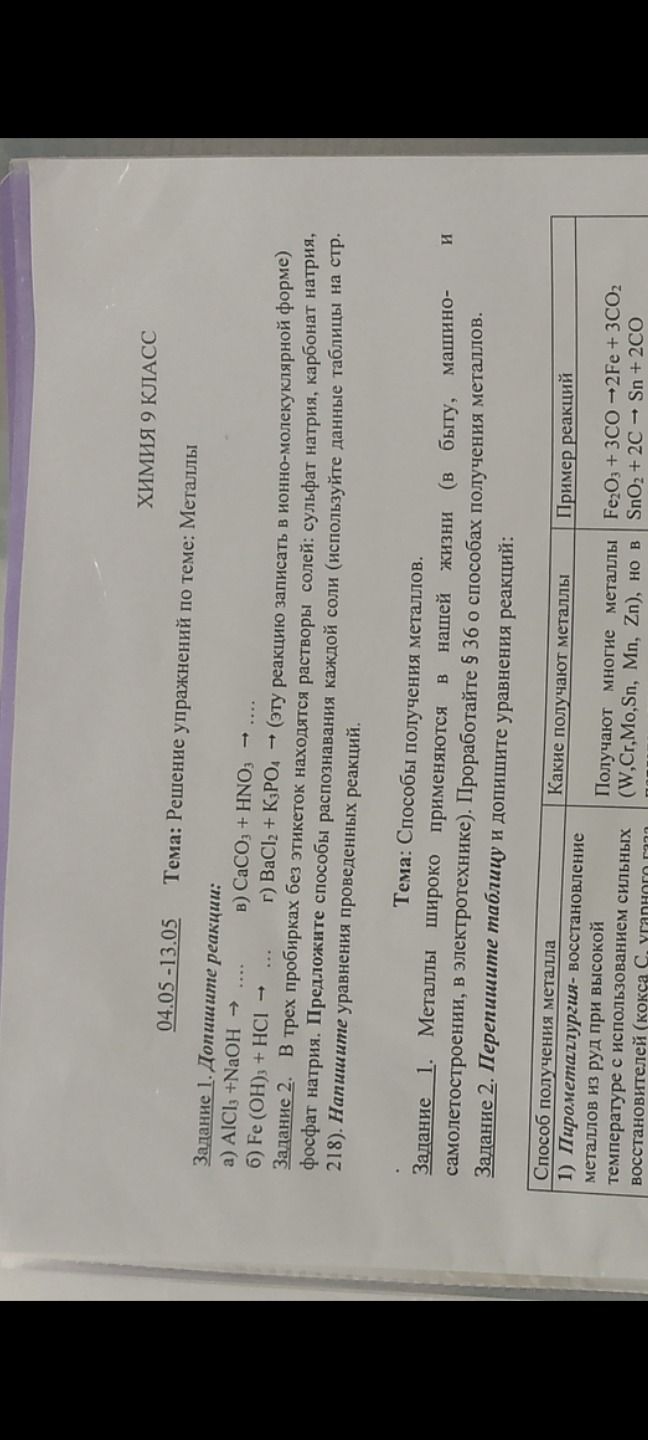
Task 1. Metals are widely used in our lives (in everyday life, aviation, and electrical engineering). Work through § 36 on methods for obtaining metals. Task 2. Rewrite the table and complete the reactions: Method of obtaining metal 1) Pyrometallurgy - reduction of metals from ores at high temperatures using strong reducing agents (coke C, carbon monoxide CO, etc.) What metals are obtained Many metals are obtained (W, Cr, Mo, Sn, Mn, Zn), but in Example reaction Fe2O3 + 3CO→2Fe + 3CO2 SnO2 + 2C → Sn + 2CO
Ответ:
Task 2. Rewriting and completing the table:
| Method of obtaining metal | What metals are obtained | Example reaction |
|---|---|---|
| 1) Pyrometallurgy - reduction of metals from ores at high temperatures using strong reducing agents (coke C, carbon monoxide CO, etc.) | Many metals are obtained (W, Cr, Mo, Sn, Mn, Zn), but in the form of alloys or impure metals. Also, less active metals like iron, tin, zinc. | \( \text{Fe}_2\text{O}_3 + 3\text{CO} \rightarrow 2\text{Fe} + 3\text{CO}_2 \) \( \text{SnO}_2 + 2\text{C} \rightarrow \text{Sn} + 2\text{CO} \) |
| 2) Hydrometallurgy - reduction of metals using less active metals or hydrogen. | Relatively active metals that are difficult to obtain by pyrometallurgy, or pure metals. For example, copper, lead, nickel, cadmium, etc. | \( \text{CuSO}_4 + \text{Fe} \rightarrow \text{FeSO}_4 + \text{Cu} \downarrow \) \( \text{ZnO} + \text{H}_2 \rightarrow \text{Zn} + \text{H}_2\text{O} \) |
| 3) Electrolysis - reduction of metal salts or oxides using electric current. | Highly reactive metals (alkali metals, alkaline earth metals, aluminum) and also some less reactive metals like copper, nickel, etc. | \( 2\text{NaCl} \text{(melt)} \xrightarrow{\text{electrolysis}} 2\text{Na} + \text{Cl}_2 \uparrow \) \( \text{Al}_2\text{O}_3 \text{(in cryolite)} \xrightarrow{\text{electrolysis}} 2\text{Al} + \frac{3}{2}\text{O}_2 \uparrow \) |
Explanation of completed parts:
- Under "What metals are obtained" for Pyrometallurgy, it's specified that it's used for many metals, including less active ones like iron, tin, and zinc, often yielding impure forms or alloys.
- Added a section for Hydrometallurgy, explaining it's used for metals difficult to obtain by pyrometallurgy or for obtaining pure metals, with examples like copper and lead, and provided corresponding reactions.
- Added a section for Electrolysis, explaining it's used for highly reactive metals (like alkali metals, alkaline earth metals, aluminum) and some less reactive ones, providing example reactions for sodium chloride and aluminum oxide electrolysis.
Answer: The table has been rewritten and completed with additional methods of metal obtaining, examples of obtained metals, and their corresponding reactions.
