
 Алгебра
 Английский
 Биология
 География
 Геометрия
 История
 Русский
 Обществознание
 Физика
 Химия
 Информатика
 Литература
 Математика
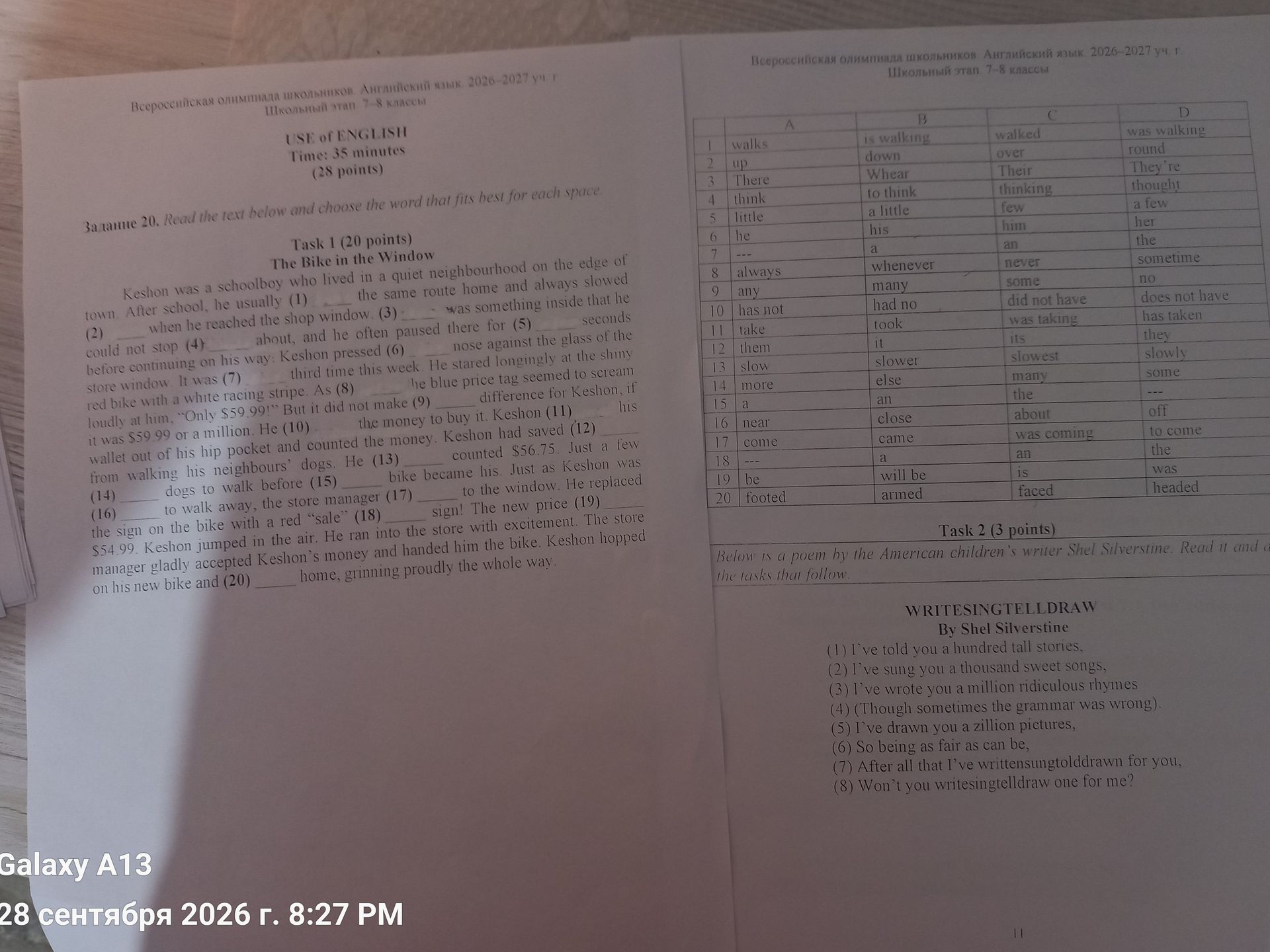
Ответ:
Ответы: 1 — walked; 2 — down; 3 — There; 4 — thinking; 5 — a few; 6 — his; 7 — the; 8 — always; 9 — any; 10 — did not have; 11 — took; 12 — it; 13 — slowly; 14 — more; 15 — the; 16 — about; 17 — came; 18 — a; 19 — was; 20 — headed.
Заполненный текст:
Keshon was a schoolboy who lived in a quiet neighbourhood on the edge of town. After school, he usually walked the same route home and always slowed down when he reached the shop window. There was something inside that he could not stop thinking about, and he often paused there for a few seconds before continuing on his way. Keshon pressed his nose against the glass of the store window. It was the third time this week. He stared longingly at the shiny red bike with a white racing stripe. As always, the blue price tag seemed to scream loudly at him, “Only $$59.99!” But it did not make any difference for Keshon, if it was $$59.99 or a million. He did not have the money to buy it. Keshon took his wallet out of his hip pocket and counted the money. Keshon had saved it from walking his neighbours’ dogs. He slowly counted $$56.75. Just a few more dogs to walk before the bike became his. Just as Keshon was about to walk away, the store manager came to the window. He replaced the sign on the bike with a red “sale” sign! The new price was $$54.99. Keshon jumped in the air. He ran into the store with excitement. The store manager gladly accepted Keshon’s money and handed him the bike. Keshon hopped on his new bike and headed home, grinning proudly the whole way.
В повествовании используется прошедшее время: walked, took, came, was. Остальные вставки определяются устойчивыми сочетаниями и грамматикой: slow down, stop thinking about, a few seconds, any difference, about to walk away, head home.
