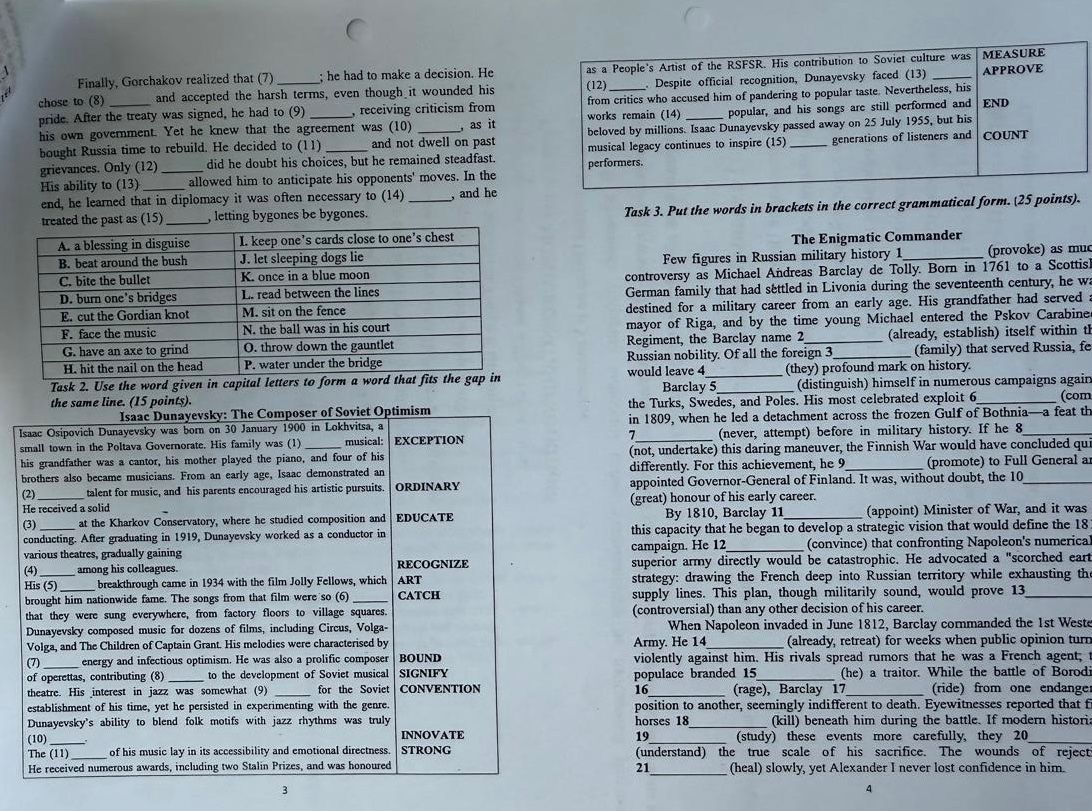
Task 2. Use the word given in capital letters to form a word that fits the gap in the same line. Isaac Dunayevsky: The Composer of Soviet Optimism. Isaac Osipovich Dunayevsky was born on 30 January 1900 in Lokhvitsa, a small town in the Poltava Governorate. His family was (1) ______ musical: his grandfather was a cantor, his mother played the piano, and four of his brothers became musicians. From an early age, Isaac demonstrated an (2) ______ talent for music, and his parents encouraged his artistic pursuits. He received a solid (3) ______ at the Kharkov Conservatory, where he studied composition and conducting. After graduating in 1919, Dunayevsky worked as a conductor in various theatres, gradually gaining (4) ______ among his colleagues. His (5) ______ came in 1934 with the film Jolly Fellows, which brought him nationwide fame. The songs from that film were so (6) ______ that they were sung everywhere, from factory floors to village squares. Dunayevsky composed music for dozens of films, including Circus, Volga-Volga, and The Children of Captain Grant. His melodies were characterised by (7) ______ energy and infectious optimism. He was also a prolific composer of operettas, contributing (8) ______ to the development of Soviet musical theatre. His interest in jazz was somewhat (9) ______ for the Soviet establishment of his time, yet he persisted in experimenting with the genre. Dunayevsky’s ability to blend folk motifs with jazz rhythms was truly (10) ______. The (11) ______ of his music lay in its accessibility and emotional directness. He received numerous awards, including two Stalin Prizes, and was honoured as a People’s Artist of the RSFSR. His contribution to Soviet culture was (12) ______. Despite official recognition, Dunayevsky faced (13) ______ from critics who accused him of pandering to popular taste. Nevertheless, his works remain (14) ______ popular, and his songs are still performed and beloved by millions. Isaac Dunayevsky passed away on 25 July 1955, but his musical legacy continues to inspire (15) ______ generations of listeners and performers. Words: EXCEPTION, ORDINARY, EDUCATE, RECOGNIZE, ART, CATCH, BOUND, SIGNIFY, CONVENTION, INNOVATE, STRONG, MEASURE, APPROVE, END, COUNT.

 Алгебра
 Английский
 Биология
 География
 Геометрия
 История
 Русский
 Обществознание
 Физика
 Химия
 Информатика
 Литература
 Математика