
 Алгебра
 Английский
 Биология
 География
 Геометрия
 История
 Русский
 Обществознание
 Физика
 Химия
Химия Информатика
 Литература
 Математика
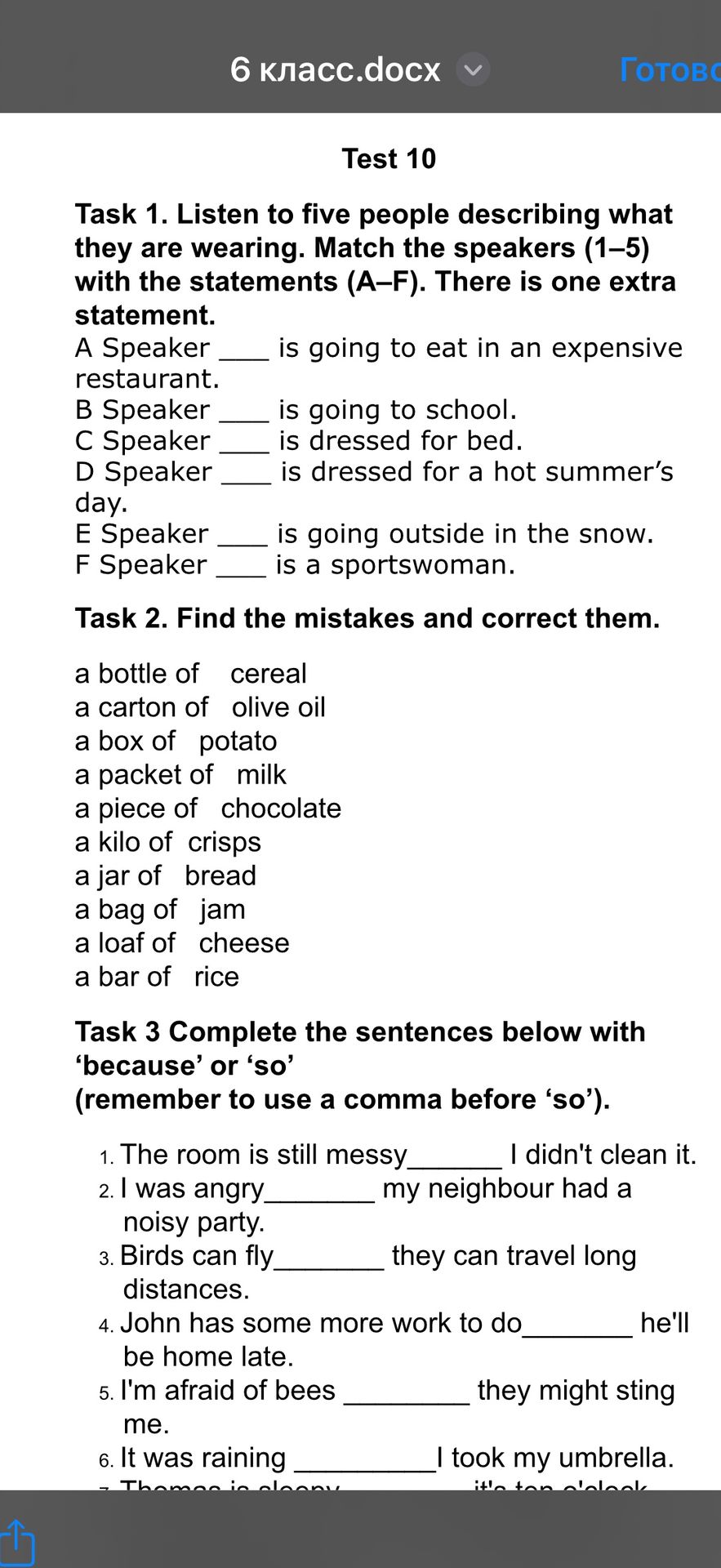
Task 3 Complete the sentences below with 'because' or 'so' (remember to use a comma before 'so'). 1. The room is still messy _______ I didn't clean it. 2. I was angry _______ my neighbour had a noisy party. 3. Birds can fly _______ they can travel long distances. 4. John has some more work to do _______ he'll be home late. 5. I'm afraid of bees _______ they might sting me. 6. It was raining _______ I took my umbrella.
Ответ:
Analysis of Task 3:
This task involves completing sentences using 'because' (to give a reason) or 'so' (to show a result). Remember that 'so' needs a comma before it when it introduces a clause showing a result.
Let's go through each sentence:
- 'The room is still messy _______ I didn't clean it.' Here, the reason why the room is messy is that you didn't clean it. So, 'because' fits best.
- 'I was angry _______ my neighbour had a noisy party.' The noisy party is the reason for your anger. So, 'because' is the correct word.
- 'Birds can fly _______ they can travel long distances.' Flying allows them to travel long distances; this is a result or purpose. 'So' fits here. Alternatively, one could argue that they fly *in order to* travel long distances, which might suggest 'so that', but 'so' can also be used to connect clauses where the second explains the consequence or purpose of the first. However, given the options, 'so' is the most appropriate choice to link the ability to fly with the ability to travel long distances, implying that flight enables this. Let's refine this: The ability to travel long distances is a *consequence* or *purpose* of their ability to fly. Thus, 'so' works to show the result/purpose.
- 'John has some more work to do _______ he'll be home late.' Having more work is the reason he will be home late. So, 'because' is correct here.
- 'I'm afraid of bees _______ they might sting me.' The possibility of being stung is the reason for the fear. So, 'because' is the correct choice.
- 'It was raining _______ I took my umbrella.' Taking an umbrella is a result of the rain. Therefore, we need 'so' and a comma before it.
Let's re-evaluate sentence 3. 'Birds can fly' and 'they can travel long distances'. If we say 'Birds can fly *so* they can travel long distances', it implies that the ability to fly *causes* or *enables* them to travel long distances. This is a cause-and-effect relationship, where 'so' indicates the effect. Another possibility is 'because', but that would imply 'Birds can fly *because* they can travel long distances', which is logically backwards. The sentence structure implies that the ability to fly is the *means* or *reason* why they *can* travel long distances. If we rephrase: 'Birds can fly, so they can travel long distances.' This implies that their ability to fly results in their ability to travel long distances. If we consider 'Birds can fly because they have wings', that's a reason. In sentence 3, the second clause is more of a consequence or capability enabled by the first. Therefore, 'so' seems more fitting than 'because'.
Let's reconsider sentence 4. 'John has some more work to do _______ he'll be home late.' The fact that he has more work is the *reason* he will be home late. So, 'because' is correct.
Let's re-examine sentence 3. 'Birds can fly _______ they can travel long distances.' This implies that the *reason* they can travel long distances is that they can fly. So, 'because' would imply that the ability to travel long distances is the reason they can fly, which is wrong. However, if it's interpreted as 'They can fly, and as a result, they can travel long distances,' then 'so' is appropriate. Let's look at the structure again. 'Birds can fly' is a statement. 'They can travel long distances' is another related statement. The link is that flying enables long-distance travel. This is a consequence. So, 'so' is the correct connector here, with a comma.
Let's double check sentence 4. 'John has some more work to do _______ he'll be home late.' This is clearly a reason-result structure. The reason he will be home late is that he has more work. So, 'because' is correct.
Final review:
- The room is still messy because I didn't clean it. (Reason)
- I was angry because my neighbour had a noisy party. (Reason)
- Birds can fly, so they can travel long distances. (Result/Consequence - the ability to fly leads to the ability to travel far).
- John has some more work to do, so he'll be home late. (Result - more work leads to being home late). Wait, no. The *reason* he'll be home late is that he has more work. So, 'because' is correct for #4. Let's redo #4.
Let's apply the rule: If you can replace the blank with 'because' and it makes sense, use 'because'. If you can replace it with 'so' and it makes sense, use 'so'. If 'so' shows a result, a comma usually comes before it.
- The room is still messy _______ I didn't clean it. -> The room is still messy because I didn't clean it. (Reason for messiness)
- I was angry _______ my neighbour had a noisy party. -> I was angry because my neighbour had a noisy party. (Reason for anger)
- Birds can fly _______ they can travel long distances. -> Birds can fly, so they can travel long distances. (Flight is the means/cause, long-distance travel is the result/capability). This sounds more like a result.
- John has some more work to do _______ he'll be home late. -> John has some more work to do, so he'll be home late. (More work is the cause, being home late is the result).
- I'm afraid of bees _______ they might sting me. -> I'm afraid of bees because they might sting me. (Stinging is the reason for fear).
- It was raining _______ I took my umbrella. -> It was raining, so I took my umbrella. (Rain is the cause, taking umbrella is the result).
The key difference is whether the second clause explains the *reason* for the first clause ('because') or the *result* of the first clause ('so').
Let's re-examine #3 and #4. Both seem to fit 'so' as a result connector. For #3, the ability to fly leads to the ability to travel long distances. For #4, having more work leads to being home late.
Therefore:
- The room is still messy because I didn't clean it.
- I was angry because my neighbour had a noisy party.
- Birds can fly, so they can travel long distances.
- John has some more work to do, so he'll be home late.
- I'm afraid of bees because they might sting me.
- It was raining, so I took my umbrella.
Final Answers:
- 1. because
- 2. because
- 3. so
- 4. so
- 5. because
- 6. so
Похожие
- Task 1. Listen to five people describing what they are wearing. Match the speakers (1–5) with the statements (A–F). There is one extra statement. A Speaker _______ is going to eat in an expensive restaurant. B Speaker _______ is going to school. C Speaker _______ is dressed for bed. D Speaker _______ is dressed for a hot summer's day. E Speaker _______ is going outside in the snow. F Speaker _______ is a sportswoman.
- Task 2. Find the mistakes and correct them. a bottle of cereal a carton of olive oil a box of potato a packet of milk a piece of chocolate a kilo of crisps a jar of bread a bag of jam a loaf of cheese a bar of rice
