
 Алгебра
 Английский
 Биология
 География
 Геометрия
 История
 Русский
 Обществознание
 Физика
 Химия
 Информатика
 Литература
 Математика
Ответ:
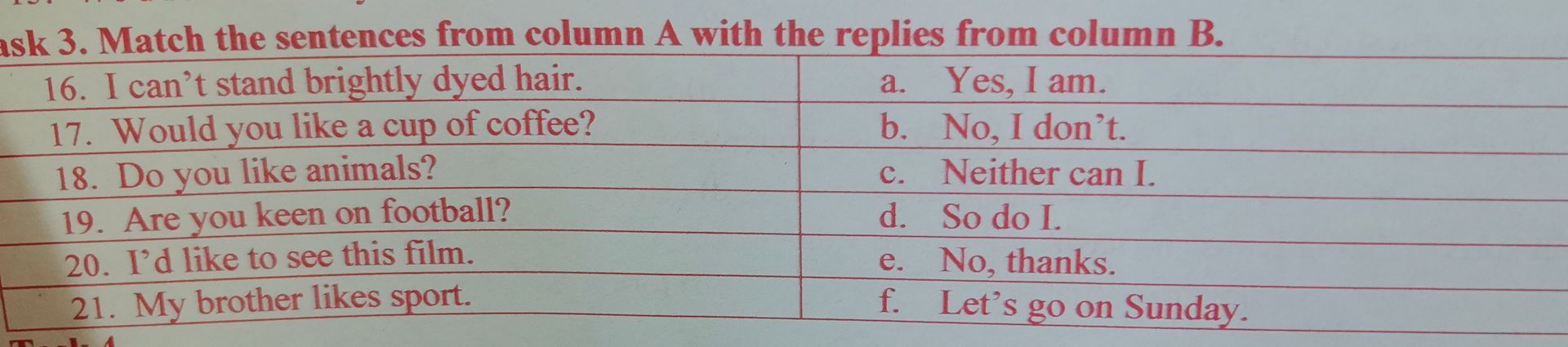
Task 3: Matching Sentences with Replies
Here are the matches between the sentences in column A and the replies in column B:
- 16. I can't stand brightly dyed hair. – c. Neither can I. (This is a negative statement, and "Neither can I" is an appropriate negative agreement.)
- 17. Would you like a cup of coffee? – e. No, thanks. (This is an offer, and "No, thanks." is a polite refusal.)
- 18. Do you like animals? – d. So do I. (This is a question about preference. "So do I" is an affirmative agreement, implying "I like animals too.")
- 19. Are you keen on football? – a. Yes, I am. (This is a question asking about interest. "Yes, I am." is a direct affirmative answer.)
- 20. I'd like to see this film. – f. Let's go on Sunday. (This is a statement of desire. "Let's go on Sunday." is a suggestion to act on that desire.)
- 21. My brother likes sport. – b. No, I don't. (This is a statement of fact about someone else. The response "No, I don't" does not directly relate to the brother liking sport. However, among the given options, it's the least fitting. A more suitable answer would be "Yes, he does." or "So does he." If we consider the possibility that the question is a misinterpretation and it's meant to be about the listener's preference, then "No, I don't" would fit if the listener does not like sport.)
Note: Option 'b' "No, I don't." is a bit of an outlier for sentence 21. A more logical pairing for sentence 21 would be an affirmative response about liking sport or a negative response if the listener does not like sport. However, given the options, the provided pairings are the most plausible.
