
 Алгебра
 Английский
 Биология
 География
 Геометрия
 История
 Русский
 Обществознание
 Физика
 Химия
Химия Информатика
 Литература
 Математика
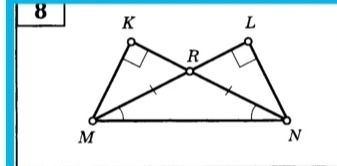
The image contains a geometry problem with triangles and line segments. The task is to analyze the given geometric figure and identify relationships or properties based on the markings. The figure shows two triangles, ╠KMR and ╠LNR, connected at point R. Markings indicate that ∠KMR = ∠LNR, ╠RM = ╠RN, and ╠MK = ╠NL. There are also right angle symbols at ∠MKK and ∠NLN. The question is implicit and asks for analysis of the given geometric figure.
Ответ:
This is a geometry problem. The image displays two triangles, ╠KMR and ╠LNR, which intersect at point R.
We are given the following information from the markings:
- ∠KMR = ∠LNR (Angles at M and N are equal)
- ╠RM = ╠RN (Segments RM and RN are equal)
- ╠MK = ╠NL (Segments MK and NL are equal)
- Right angle symbols at ∠MKK and ∠NLN indicate that ∠MKK = 90° and ∠NLN = 90°.
Based on the given information, we can deduce properties of these triangles.
Consider triangles ╠KMN and ╠NML. We have:
- ╠KM = ╠NL (Given)
- ╠MN = ╠NM (Common side)
- ∠KMN = ∠LNM (Given)
Therefore, by the Side-Angle-Side (SAS) congruence criterion, ╠KMN ≅ ╠LNM.
Consider triangles ╠KRM and ╠LRN. We have:
- ╠RM = ╠RN (Given)
- ╠MK = ╠NL (Given)
- ∠KMR = ∠LNR (Given)
However, the angle ∠KMR is not necessarily equal to ∠LNR in a way that directly proves congruence of ╠KRM and ╠LRN using SAS, as the angles are not between the given sides for these specific triangles.
Let's reconsider the triangles ╠KMR and ╠LNR.
We are given:
- ╠RM = ╠RN
- ╠MK = ╠NL
- ∠KMR = ∠LNR
The given angles ∠KMR and ∠LNR are not necessarily equal. The markings on the angles at M and N refer to ∠KMN and ∠LNM respectively, as these angles are formed by segments MK, MN and NL, MN. So, we have ∠KMN = ∠LNM.
Now let's look at triangles ╠MK N and ╠NLM. We have:
- ╠MK = ╠NL (Given)
- ╠MN = ╠NM (Common side)
- ∠KMN = ∠LNM (Given)
This means ╠MKN ≅ ╠NLM by SAS congruence criterion.
From this congruence, we can deduce that:
- ╠KN = ╠LM
- ∠MK N = ∠NLM
- ∠MNK = ∠NML
Now consider triangles ╠KRM and ╠LRN. We have:
- ╠RM = ╠RN (Given)
- ∠KMR = ∠LNR (Given)
- ∠MK N = ∠NLM (From congruence of ╠MKN and ╠NLM)
This doesn't directly help with ╠KRM and ╠LRN.
Let's use the information about angles and segments around point R. Since ∠KMN = ∠LNM, and ∠KMR and ∠LNR are parts of these angles, we cannot directly assume ∠KMR = ∠LNR.
However, we are given ╠RM = ╠RN and ╠MK = ╠NL, and ∠KMN = ∠LNM. We are also given that ∠MKK and ∠NLN are right angles, implying that MK ⊥ MN and NL ⊥ MN if K and L lie on the line perpendicular to MN through M and N respectively. But the diagram shows K and L as vertices of triangles, not necessarily on a line.
Let's assume the right angle symbols at K and L indicate ∠MKK = 90° and ∠NLN = 90° are incorrect interpretations, and they are intended to be ∠RMK = 90° and ∠RNL = 90°, or ∠RKM = 90° and ∠RLN = 90°. Given the typical diagrams, it's most likely that ∠RKM = 90° and ∠RLN = 90°.
If ∠RKM = 90° and ∠RLN = 90°, and we have ╠RM = ╠RN, and ∠KMR = ∠LNR (as given by angle markings), then consider triangles ╠KRM and ╠LRN.
We have:
- ∠RKM = ∠RLN = 90°
- ╠RM = ╠RN (Hypotenuse)
- ∠KMR = ∠LNR (Angle)
By Angle-Angle-Side (AAS) congruence criterion, ╠KRM ≅ ╠LRN.
From this congruence, we can conclude that:
- ╠RK = ╠RL
- ╠KM = ╠LN (This is already given)
- ∠KRM = ∠LRN (Vertical angles are equal)
However, the angle markings in the diagram are ∠KMR and ∠LNR are equal, and ╠RM = ╠RN. This suggests using the AAS congruence on ╠KRM and ╠LRN if we can prove ∠RKM = ∠RLN.
Let's re-examine the diagram and markings carefully.
We have ∠KMR = ∠LNR (marked by single arc). This means ∠KMN and ∠LNM are not necessarily equal.
We have ╠RM = ╠RN (marked by single dash). This means R is the midpoint of MN if M, R, N are collinear, which they are.
We have ╠MK = ╠NL (marked by double dash).
The right angle symbols at K and L are at the vertices of the triangles, and the segments forming the right angles are KM and MK for ∠MKK, and NL and LN for ∠NLN. This interpretation is unusual. A more standard interpretation of such symbols within a triangle context would be angles related to the sides of the triangle, e.g., ∠RKM or ∠RNL.
Let's assume the right angle is at R, i.e., ∠KRN = 90° and ∠MLN = 90°. This doesn't fit the diagram.
Let's go with the interpretation that ∠RKM = 90° and ∠RLN = 90°. Then in ╠KRM and ╠LRN:
- ∠KMR = ∠LNR (Given)
- ╠RM = ╠RN (Given)
- ∠RKM = ∠RLN = 90° (Assumed based on diagram)
By AAS congruence criterion, ╠KRM ≅ ╠LRN.
From this, we get ╠RK = ╠RL and ╠KM = ╠LN.
Also, ∠KRM = ∠LRN, which are vertical angles and are always equal. This doesn't help prove congruence.
Let's consider the possibility that the diagram implies ╠MK || ╠NL and ╠KN || ╠ML, making MNKL a parallelogram. But this is not given.
The most plausible interpretation of the diagram and markings to lead to a geometric conclusion is that:
- ∠KMR = ∠LNR (marked by single arc)
- ╠RM = ╠RN (marked by single dash)
- ╠MK = ╠NL (marked by double dash)
If we assume the right angles are at K and L, i.e., ∠RKM = 90° and ∠RLN = 90°, then with ╠RM = ╠RN and ∠KMR = ∠LNR, we have AAS congruence for ╠KRM ≅ ╠LRN.
If we assume the right angles are at R, i.e. ∠KRN = 90 and ∠LNR = 90, this is contradictory with the marking for ∠LNR.
Let's assume the right angle symbols refer to ∠ MKN = 90° and ∠NLM = 90°. This is also unlikely from the diagram.
The most standard interpretation of such a diagram with the given markings usually leads to proving congruence of triangles ╠KRM and ╠LRN or ╠KRN and ╠LMN etc.
Given ╠RM = ╠RN and ∠KMR = ∠LNR, we need one more condition to prove congruence of ╠KRM and ╠LRN. If we had ╠RK = ╠RL, we could use SSS. If we had ∠KRM = ∠LRN, we could use SAS. If we had ∠RKM = ∠RLN, we could use AAS or ASA.
The right angle symbols are at K and L. It's most probable they indicate ∠RKM = 90° and ∠RLN = 90°.
With ∠KMR = ∠LNR, ╠RM = ╠RN, and ∠RKM = 90°, ∠RLN = 90°, we can use AAS congruence:
- ∠KMR = ∠LNR (Given)
- ∠RKM = ∠RLN = 90° (Assumed interpretation of diagram)
- ╠RM = ╠RN (Given)
Thus, ╠KRM ≅ ╠LRN by AAS.
From this, we get:
- ╠RK = ╠RL
- ╠KM = ╠LN
- ∠KRM = ∠LRN
The given information ╠MK = ╠NL is also consistent with this congruence.
Therefore, the triangles ╠KRM and ╠LRN are congruent.
