
 Алгебра
 Английский
 Биология
 География
 Геометрия
 История
 Русский
 Обществознание
 Физика
 Химия
Химия Информатика
 Литература
 Математика
Вопрос:
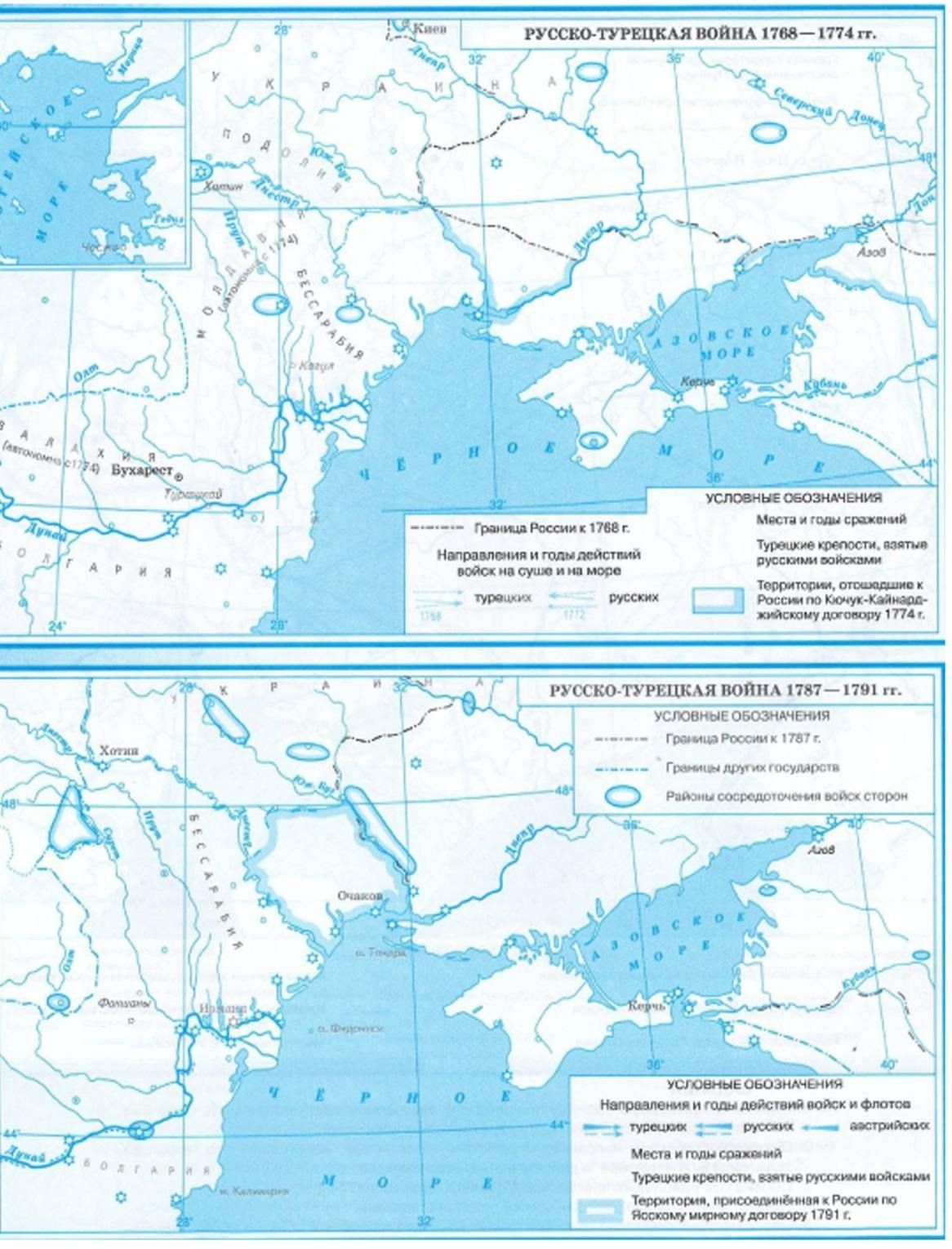
The image contains two maps showing different periods of the Russo-Turkish War. The top map illustrates the period 1768-1774, and the bottom map depicts the period 1787-1791. Both maps include legends with conventional signs for borders, locations and years of battles, Turkish fortresses taken by Russian troops, and territories that transferred to Russia according to peace treaties. The maps also show directions and years of military actions on land and sea for Turkish and Russian forces. What are the key conventional signs used in these maps?
Ответ:
The maps use several conventional signs to convey information:
- Borders: Different line styles represent borders, such as the border of Russia in 1768 and 1787, and borders of other states.
- Military Actions: Arrows indicate the directions of troop movements on land and sea, with corresponding years.
- Battles/Locations: Circles with stars or dots mark the locations and years of battles or significant events.
- Fortresses: Symbols (e.g., stars within circles) indicate Turkish fortresses, often with an indication if they were captured by Russian forces.
- Territorial Changes: Shaded areas or specific color fills (in this case, light blue) denote territories that transferred to Russia under peace treaties, such as the Treaty of Küçük Kaynarca (1774) and the Treaty of Iași (1791).
- Troop Concentration: Ovals are used to show areas where troops of opposing sides were concentrated.
These signs collectively provide a visual representation of the military campaigns, territorial shifts, and key engagements during the Russo-Turkish Wars.
Похожие
- Based on the map of the Russo-Turkish War 1768-1774, identify the year and the name of the peace treaty that led to the transfer of territories to Russia.
- The second map (1787-1791) shows a specific territory that was "присоединённая к России по Ясскому мирному договору 1791 г." (annexed to Russia by the Treaty of Iași of 1791). Based on the map, identify this territory.
- Examine the top map (1768-1774) and locate the year '1772' associated with Turkish troop movements. Which river is indicated as a route for these movements around that year?
