
 Алгебра
 Английский
 Биология
 География
 Геометрия
 История
 Русский
 Обществознание
 Физика
 Химия
Химия Информатика
 Литература
 Математика
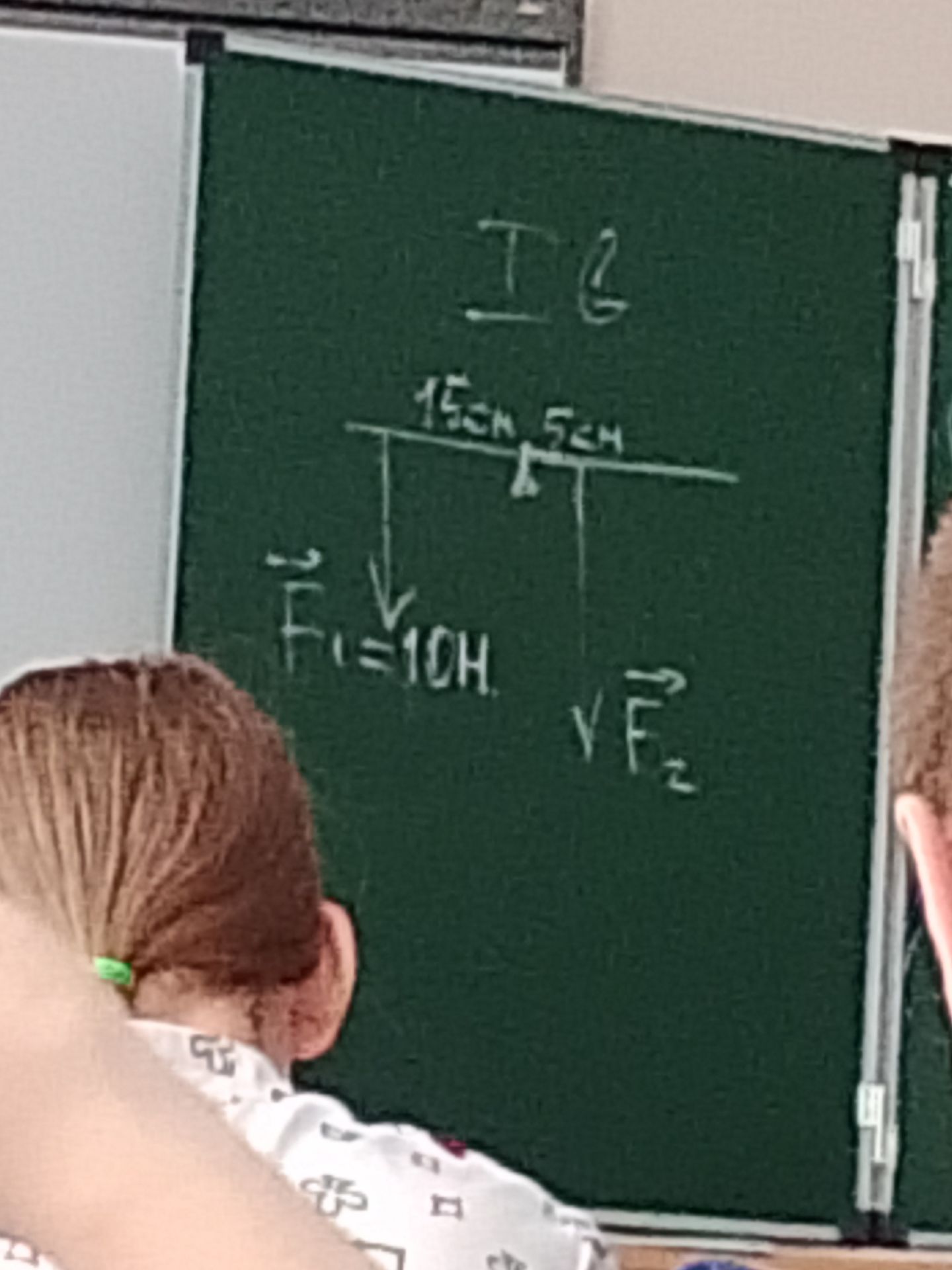
The image shows a physics problem on a chalkboard.
Ответ:
This image displays a physics problem written on a chalkboard. The problem involves a lever balanced on a fulcrum. On the left side, a force \( F_1 \) of 10N is shown acting downwards at a distance of 15cm from the fulcrum. On the right side, there is a force \( F_2 \) acting upwards (indicated by the arrow direction) at a distance of 5cm from the fulcrum. The text 'I L' is written at the top, likely indicating the topic or a label for the problem.
To solve this problem, one would typically use the principle of moments, which states that for a lever in equilibrium, the sum of the clockwise moments about the fulcrum must equal the sum of the counterclockwise moments.
The moment due to \( F_1 \) is \( M_1 = F_1 \times d_1 \), where \( F_1 = 10 \text{ N} \) and \( d_1 = 15 \text{ cm} = 0.15 \text{ m} \).
The moment due to \( F_2 \) is \( M_2 = F_2 \times d_2 \), where \( d_2 = 5 \text{ cm} = 0.05 \text{ m} \).
Assuming the lever is in equilibrium:
\[ M_1 = M_2 \]
\[ F_1 \times d_1 = F_2 \times d_2 \]
Substituting the known values:
\[ 10 \text{ N} \times 0.15 \text{ m} = F_2 \times 0.05 \text{ m} \]
\[ 1.5 \text{ Nm} = F_2 \times 0.05 \text{ m} \]
Solving for \( F_2 \):
\[ F_2 = \frac{1.5 \text{ Nm}}{0.05 \text{ m}} \]
\[ F_2 = 30 \text{ N} \]
Therefore, the force \( F_2 \) is 30 N.
Answer: $$F_2 = 30 \(\text{ N}\)
