
 Алгебра
 Английский
 Биология
 География
 Геометрия
 История
 Русский
 Обществознание
 Физика
 Химия
Химия Информатика
 Литература
 Математика
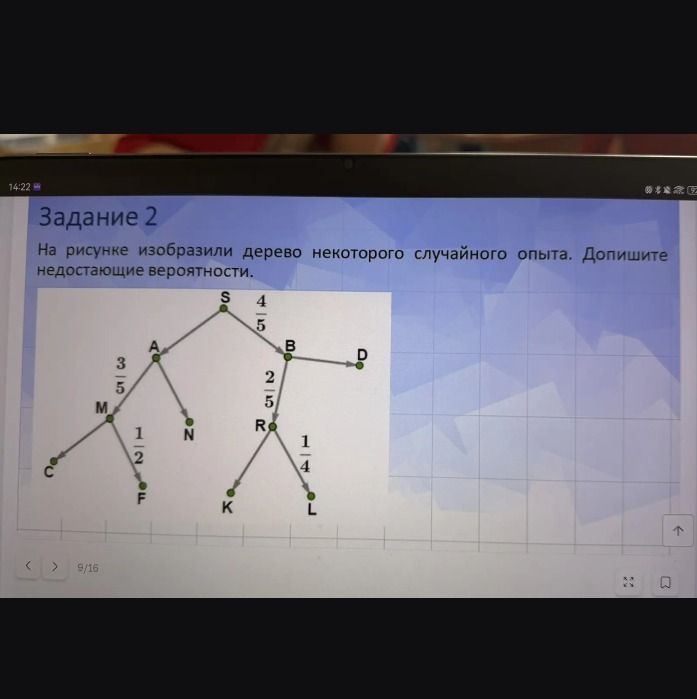
The image shows a probability tree diagram. Some probabilities are missing. Fill in the missing probabilities.
Ответ:
Привет! Давай разберёмся с этим деревом вероятностей. Чтобы найти недостающие вероятности, нам нужно вспомнить одно важное правило: сумма вероятностей на всех ветках, исходящих из одной точки, всегда равна 1.
1. Вероятность пути S → A
У нас есть вероятность S → B, которая равна \(\fcolorbox{white}{white}\){\(\frac{4}{5}\)}\(\fcolorbox{white}{white}\){\(\)}.
Значит, вероятность S → A будет:
\[ P(S \rightarrow A) = 1 - P(S \rightarrow B) = 1 - \frac{4}{5} = \frac{1}{5} \]
2. Вероятность пути A → M
У нас есть вероятность A → F, которая равна \(\fcolorbox{white}{white}\){\(\frac{1}{2}\)}\(\fcolorbox{white}{white}\){\(\)}.
Значит, вероятность A → M будет:
\[ P(A \rightarrow M) = 1 - P(A \rightarrow F) = 1 - \frac{1}{2} = \frac{1}{2} \]
3. Вероятность пути M → C
У нас есть вероятность M → F, которая равна \(\fcolorbox{white}{white}\){\(\frac{1}{2}\)}\(\fcolorbox{white}{white}\){\(\)}.
Значит, вероятность M → C будет:
\[ P(M \rightarrow C) = 1 - P(M \rightarrow F) = 1 - \frac{1}{2} = \frac{1}{2} \]
4. Вероятность пути B → D
У нас есть вероятность B → R, которая равна \(\fcolorbox{white}{white}\){\(\frac{2}{5}\)}\(\fcolorbox{white}{white}\){\(\)}.
Значит, вероятность B → D будет:
\[ P(B \rightarrow D) = 1 - P(B \rightarrow R) = 1 - \frac{2}{5} = \frac{3}{5} \]
5. Вероятность пути R → K
У нас есть вероятность R → L, которая равна \(\fcolorbox{white}{white}\){\(\frac{1}{4}\)}\(\fcolorbox{white}{white}\){\(\)}.
Значит, вероятность R → K будет:
\[ P(R \rightarrow K) = 1 - P(R \rightarrow L) = 1 - \frac{1}{4} = \frac{3}{4} \]
Теперь дерево выглядит так:
- S → A: \(\fcolorbox{white}{white}\){\(\frac{1}{5}\)}\(\fcolorbox{white}{white}\){\(\)}
- A → M: \(\fcolorbox{white}{white}\){\(\frac{1}{2}\)}\(\fcolorbox{white}{white}\){\(\)}
- M → C: \(\fcolorbox{white}{white}\){\(\frac{1}{2}\)}\(\fcolorbox{white}{white}\){\(\)}
- B → D: \(\fcolorbox{white}{white}\){\(\frac{3}{5}\)}\(\fcolorbox{white}{white}\){\(\)}
- R → K: \(\fcolorbox{white}{white}\){\(\frac{3}{4}\)}\(\fcolorbox{white}{white}\){\(\)}
Ответ:
Недостающие вероятности:
- P(S → A) = \(\fcolorbox{white}{white}\){\(\frac{1}{5}\)}\(\fcolorbox{white}{white}\){\(\)}
- P(A → M) = \(\fcolorbox{white}{white}\){\(\frac{1}{2}\)}\(\fcolorbox{white}{white}\){\(\)}
- P(M → C) = \(\fcolorbox{white}{white}\){\(\frac{1}{2}\)}\(\fcolorbox{white}{white}\){\(\)}
- P(B → D) = \(\fcolorbox{white}{white}\){\(\frac{3}{5}\)}\(\fcolorbox{white}{white}\){\(\)}
- P(R → K) = \(\fcolorbox{white}{white}\){\(\frac{3}{4}\)}\(\fcolorbox{white}{white}\){\(\)}
