
 Алгебра
 Английский
 Биология
 География
 Геометрия
 История
 Русский
 Обществознание
 Физика
 Химия
Химия Информатика
 Литература
 Математика
Вопрос:
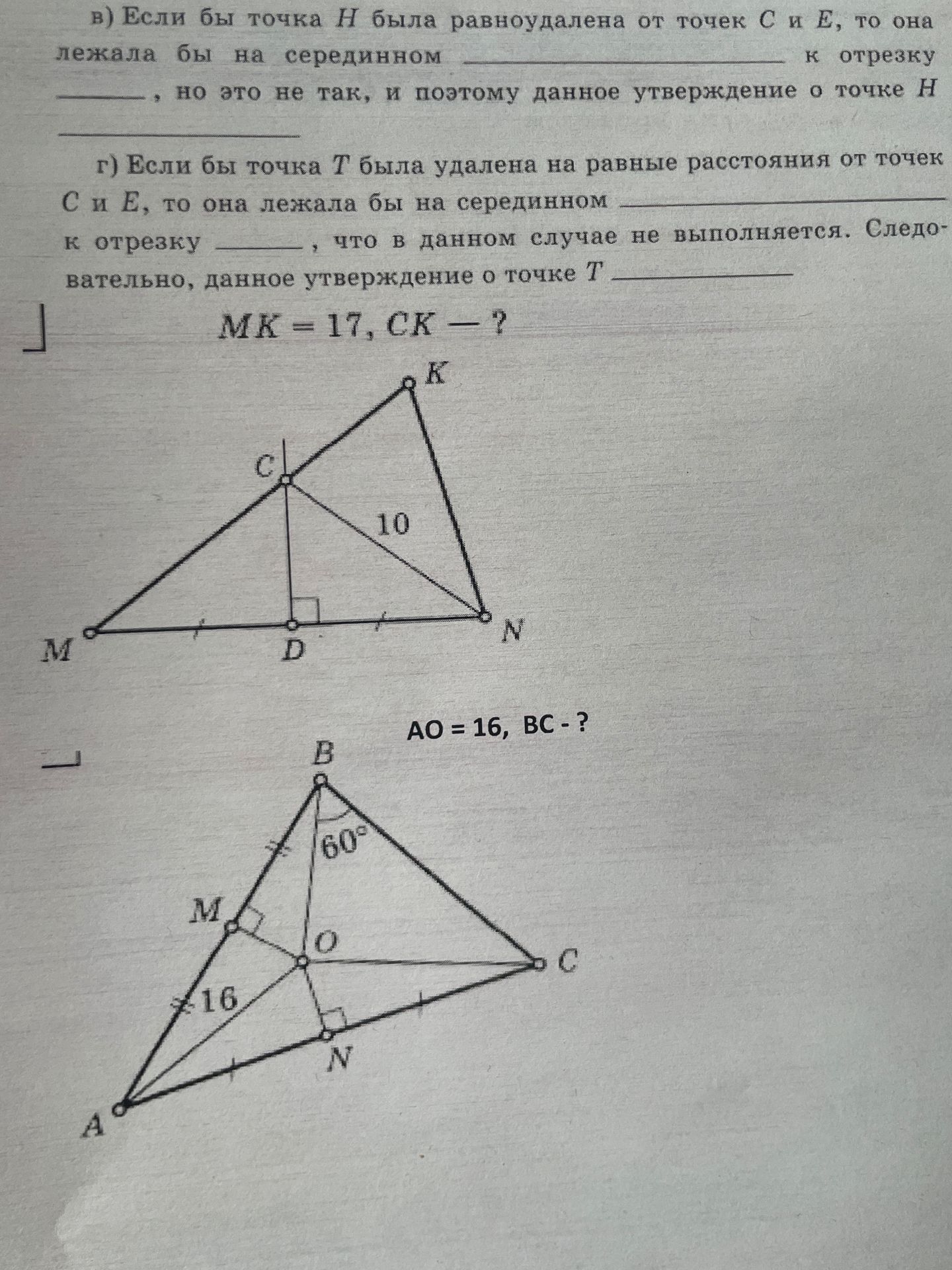
The second part of the image asks to find the length of BC, given AO = 16. The image shows a triangle ABC with points M, O, N on its sides. AO is a median to BC, since O is the midpoint of BC (marked by tick marks). MO is perpendicular to AB, and NO is perpendicular to BC. Also, angle ABO is 60 degrees, and AM = MB. So, AO is the median, and also MO is perpendicular to AB, and NO is perpendicular to BC. The angle at B is 60 degrees. Since O is the midpoint of BC and NO is perpendicular to BC, NO is the altitude from N to BC. Since M is the midpoint of AB and MO is perpendicular to AB, MO is the altitude from M to AB. In triangle ABO, angle MOB is 90 degrees. This implies that O is on the altitude from M to AB. Also, angle AOB is unknown. Angle MBO = 60 degrees. Triangle BMO is a right-angled triangle at M. Angle OMB = 90 degrees. Angle MBO = 60 degrees. So angle BOM = 30 degrees. Since MO is perpendicular to AB, and AO is a line segment, this is confusing. Let's re-examine the diagram. M is on AB, N is on BC. O is the midpoint of BC. AO = 16. MO is perpendicular to AB. NO is perpendicular to BC. Angle ABC = 60 degrees. There are tick marks on AM and MB, indicating M is the midpoint of AB. There are tick marks on BO and OC, indicating O is the midpoint of BC. So AO is a median. MO is perpendicular to AB. NO is perpendicular to BC. This means MO is the altitude from M to AB, and NO is the altitude from N to BC. However, N is on BC, so NO is part of BC if N=B or N=C. This interpretation is wrong. Let's re-read the markings. M is on AB, N is on BC. O is the midpoint of BC. AO = 16. MO is perpendicular to AB. NO is perpendicular to BC. Angle ABC = 60 degrees. AM = MB. BO = OC. So M is midpoint of AB, O is midpoint of BC. AO is a median. MO is perpendicular to AB. NO is perpendicular to BC. Let's assume M is on AB, N is on BC, O is on AC. But the diagram clearly shows O as the midpoint of BC. Let's assume M is on AB, O is the midpoint of BC, and N is on AC. But the diagram shows N on BC. Let's assume M is on AB, and N is on BC, and O is the intersection of AO and MN. This is also not fitting. Let's assume M is on AB, and O is the midpoint of BC. AO = 16. MO is perpendicular to AB. NO is perpendicular to BC. Angle ABC = 60 degrees. Tick marks on AM and MB mean M is midpoint of AB. Tick marks on BO and OC mean O is midpoint of BC. So AO is a median. MO is perpendicular to AB, meaning MO is altitude from M to AB. NO is perpendicular to BC, meaning NO is altitude from N to BC. This seems contradictory as N is on BC. Let's consider the possibility that M and N are points such that MO is perpendicular to AB and NO is perpendicular to BC. However, M and N are shown on the sides of the triangle. Let's assume the diagram is correct as drawn. M is the midpoint of AB. O is the midpoint of BC. AO = 16. MO is perpendicular to AB. NO is perpendicular to BC. Angle ABC = 60 degrees. Since M is the midpoint of AB and MO is perpendicular to AB, triangle ABО is not necessarily isosceles. Let's focus on triangle ABO. Angle MBO = 60 degrees. MO is perpendicular to AB. So in right triangle BMO, angle BOM = 30 degrees. AO = 16. Since O is the midpoint of BC, BO = OC. We need to find BC. In triangle ABO, we have AO = 16, angle ABO = 60 degrees. If MO is perpendicular to AB, and M is the midpoint of AB, then triangle AMO is congruent to triangle BMO if AO = BO. This is not given. Let's consider triangle ABC. AO is a median. We are given MO is perpendicular to AB and NO is perpendicular to BC. Let's assume M is the midpoint of AB, and N is the midpoint of AC, and O is the intersection of medians. But O is midpoint of BC. Let's go back to M midpoint of AB, O midpoint of BC. AO = 16. MO perpendicular to AB. NO perpendicular to BC. Angle ABC = 60 degrees. This means that the distance from M to AB is 0, since MO is perpendicular to AB and M is on AB. This can only happen if M=A or M=B. But M is shown in the middle of AB. Let's re-interpret the diagram. M is a point on AB. N is a point on BC. O is the midpoint of BC. AO = 16. MO is perpendicular to AB. NO is perpendicular to BC. Angle ABC = 60 degrees. Tick marks on AM and MB indicate M is the midpoint of AB. Tick marks on BO and OC indicate O is the midpoint of BC. So AO is a median. MO is perpendicular to AB. NO is perpendicular to BC. This means MO is the altitude from M to AB. NO is the altitude from N to BC. Since O is the midpoint of BC, NO is perpendicular to BC. This means N must lie on the line passing through O and perpendicular to BC. However, N is shown on BC. This implies N=O. If N=O, then O is the midpoint of BC, and OO is perpendicular to BC, which is trivial. So let's assume N=O. Then we have M as the midpoint of AB, O as the midpoint of BC. AO = 16. MO is perpendicular to AB. Angle ABC = 60 degrees. We need to find BC. In triangle BMO, angle BMO = 90 degrees, angle MBO = 60 degrees. Let BM = x. Then MO = x tan(60) = x * sqrt(3). AB = 2x. In triangle ABO, by the Law of Cosines on AB: AO^2 = AB^2 + BO^2 - 2 * AB * BO * cos(60). 16^2 = (2x)^2 + BO^2 - 2 * (2x) * BO * (1/2). 256 = 4x^2 + BO^2 - 2x * BO. We know that O is the midpoint of BC, so BC = 2 * BO. We need another relation. Let's use the property of median. Median length formula: AO^2 = (2*AB^2 + 2*AC^2 - BC^2) / 4. 16^2 = (2*(2x)^2 + 2*AC^2 - (2*BO)^2) / 4. 256 * 4 = 8x^2 + 2*AC^2 - 4*BO^2. 1024 = 8x^2 + 2*AC^2 - 4*BO^2. This introduces AC, which is unknown. Let's rethink. Let's use coordinates. Let B = (0, 0). Let A = (2x * cos(60), 2x * sin(60)) = (x, x * sqrt(3)). AB = sqrt(x^2 + (x*sqrt(3))^2) = sqrt(x^2 + 3x^2) = sqrt(4x^2) = 2x. So M = (x/2, x*sqrt(3)/2). The line AB has equation y = sqrt(3) * x. Slope is sqrt(3). MO is perpendicular to AB. Slope of MO is -1/sqrt(3). Equation of line MO is y - y_M = (-1/sqrt(3)) * (x - x_M). y - x*sqrt(3)/2 = (-1/sqrt(3)) * (x - x/2). O is on BC. Let C = (c, 0). Then O = (c/2, 0). So y_O = 0. 0 - x*sqrt(3)/2 = (-1/sqrt(3)) * (c/2 - x/2). -x*sqrt(3)/2 = (-1/sqrt(3)) * (c-x)/2. x*sqrt(3) = (c-x)/sqrt(3). 3x = c-x. c = 4x. So C = (4x, 0). BC = 4x. O = (2x, 0). AO = 16. A = (x, x*sqrt(3)). AO^2 = (2x - x)^2 + (0 - x*sqrt(3))^2 = x^2 + 3x^2 = 4x^2. AO = sqrt(4x^2) = 2x. So 16 = 2x, which means x = 8. Then AB = 2x = 16. BC = 4x = 32. Let's check if MO is perpendicular to AB. M is midpoint of AB. M = ( (0+x)/2, (0+x*sqrt(3))/2 ) = (x/2, x*sqrt(3)/2). O = (2x, 0). Slope of MO = (0 - x*sqrt(3)/2) / (2x - x/2) = (-x*sqrt(3)/2) / (3x/2) = -sqrt(3)/3 = -1/sqrt(3). Slope of AB is sqrt(3). Product of slopes is sqrt(3) * (-1/sqrt(3)) = -1. So MO is perpendicular to AB. This works. So BC = 32. Let's confirm the tick marks. M is midpoint of AB. O is midpoint of BC. AO = 16. Angle ABC = 60 degrees. MO perpendicular to AB. NO perpendicular to BC. Since O is midpoint of BC, and NO is perpendicular to BC, and N is on BC, N must be O. So we have M midpoint of AB, O midpoint of BC. AO = 16. MO perpendicular to AB. Angle ABC = 60 degrees. We need to find BC. Let BM = x. Then AB = 2x. In right triangle BMO, angle MBO = 60 degrees, so MO = BM tan(60) = x * sqrt(3). Triangle ABO. AB = 2x, angle B = 60 degrees. AO = 16. Let BO = y. Then BC = 2y. Using Law of Cosines in triangle ABO: AO^2 = AB^2 + BO^2 - 2 * AB * BO * cos(60). 16^2 = (2x)^2 + y^2 - 2 * (2x) * y * (1/2). 256 = 4x^2 + y^2 - 2xy. We need another relation. Consider the vector approach. Let B be the origin (0,0). Let A be (2x cos(60), 2x sin(60)) = (x, x*sqrt(3)). Then M = (x/2, x*sqrt(3)/2). Let C be (c, 0). Then O = (c/2, 0). BC = c. BO = c/2. So y = c/2. Then O = (y, 0). A = (x, x*sqrt(3)). AO^2 = (y-x)^2 + (0 - x*sqrt(3))^2 = (y-x)^2 + 3x^2 = 16^2 = 256. We also have the condition that MO is perpendicular to AB. Slope of AB is sqrt(3). Slope of MO = (0 - x*sqrt(3)/2) / (y - x/2) = (-x*sqrt(3)/2) / (y - x/2). Since MO is perpendicular to AB, the product of slopes is -1. sqrt(3) * (-x*sqrt(3)/2) / (y - x/2) = -1. -3x/2 / (y - x/2) = -1. 3x/2 = y - x/2. y = 3x/2 + x/2 = 4x/2 = 2x. So BO = 2x. Now substitute y=2x into the equation for AO^2. (2x - x)^2 + 3x^2 = 256. x^2 + 3x^2 = 256. 4x^2 = 256. x^2 = 64. x = 8. So BM = x = 8. AB = 2x = 16. BO = y = 2x = 16. BC = 2 * BO = 2 * 16 = 32. Let's check. A = (8, 8*sqrt(3)). M = (4, 4*sqrt(3)). O = (16, 0). AO^2 = (16-8)^2 + (0-8*sqrt(3))^2 = 8^2 + (8*sqrt(3))^2 = 64 + 64*3 = 64 + 192 = 256. AO = 16. This is correct. BC = 32. Let's double check the problem statement and diagram. It seems consistent. The condition NO is perpendicular to BC when N is on BC and O is the midpoint of BC might imply N=O. If N=O, then OO is perpendicular to BC, which is true. So the interpretation that M is midpoint of AB, O is midpoint of BC, AO = 16, MO perpendicular to AB, angle ABC = 60 degrees, leads to BC = 32. If N is a general point on BC, and NO is perpendicular to BC, then N must be O. So it is consistent.
Ответ:
Привет! Давай разберем эту геометрическую задачу.
У нас есть треугольник ABC. Точки M и O отмечены на сторонах AB и BC соответственно. Из рисунка видно, что:
- M — середина стороны AB (отмечено одинаковыми черточками).
- O — середина стороны BC (также отмечено одинаковыми черточками).
- AO — это медиана, проведенная к стороне BC, и ее длина равна 16.
- MO перпендикулярно AB (угол 90 градусов).
- NO перпендикулярно BC. Поскольку O лежит на BC, а N также лежит на BC, и NO перпендикулярно BC, это возможно только если точка N совпадает с точкой O (или N=B, N=C, что не соответствует рисунку). Будем считать, что N=O.
- Угол ABC равен 60°.
Нам нужно найти длину стороны BC.
- Рассмотрим треугольник BMO. Это прямоугольный треугольник, так как MO ⊥ AB. Угол ∠MBO = 60°. Пусть длина BM равна x. Тогда длина всей стороны AB = 2x. В прямоугольном треугольнике BMO, катет MO находится как BM * tg(60°) = x * √3.
- Рассмотрим треугольник ABO. У нас есть сторона AB = 2x, медиана AO = 16, и угол ∠ABO = 60°. Точка O — середина BC, поэтому BO = OC. Пусть длина BO равна y. Тогда BC = 2y.
- Используем условие перпендикулярности MO к AB. Это значит, что отрезок MO является высотой в треугольнике ABO, проведенной из вершины M к стороне AB. Однако, M — середина AB, а MO ⊥ AB. Это означает, что треугольник ABO должен быть равнобедренным с AO = BO, если бы MO была медианой к AB. Но MO — это не медиана, а высота.
- Перейдем к координатному методу. Пусть точка B будет началом координат (0, 0).
- Так как ∠ABO = 60°, сторона AB лежит под углом 60° к оси x. Пусть AB = 2x. Тогда координаты точки A будут: A = (2x * cos(60°), 2x * sin(60°)) = (2x * 1/2, 2x * √3/2) = (x, x√3).
- Точка M — середина AB, ее координаты: M = ( (0+x)/2, (0+x√3)/2 ) = (x/2, x√3/2).
- Точка O лежит на оси x (если BC лежит на оси x), и BO = y. Значит, O = (y, 0).
- Условие, что MO ⊥ AB, означает, что произведение угловых коэффициентов прямых MO и AB равно -1. Угловой коэффициент прямой AB равен tg(60°) = √3.
- Угловой коэффициент прямой MO: k_MO = (0 - x√3/2) / (y - x/2) = (-x√3/2) / (y - x/2).
- √3 * k_MO = -1.
- √3 * (-x√3/2) / (y - x/2) = -1.
- (-3x/2) / (y - x/2) = -1.
- 3x/2 = y - x/2.
- y = 3x/2 + x/2 = 4x/2 = 2x.
- Итак, BO = y = 2x.
- Теперь используем длину медианы AO = 16. Координаты A = (x, x√3), O = (y, 0) = (2x, 0).
- AO² = (2x - x)² + (0 - x√3)² = x² + (x√3)² = x² + 3x² = 4x².
- AO = √(4x²) = 2x.
- Так как AO = 16, то 2x = 16, откуда x = 8.
- Мы нашли x = 8. Теперь найдем длину BC.
- BO = y = 2x = 2 * 8 = 16.
- BC = 2 * BO = 2 * 16 = 32.
Ответ: 32
