
 Алгебра
 Английский
 Биология
 География
 Геометрия
 История
 Русский
 Обществознание
 Физика
 Химия
Химия Информатика
 Литература
 Математика
Вопрос:
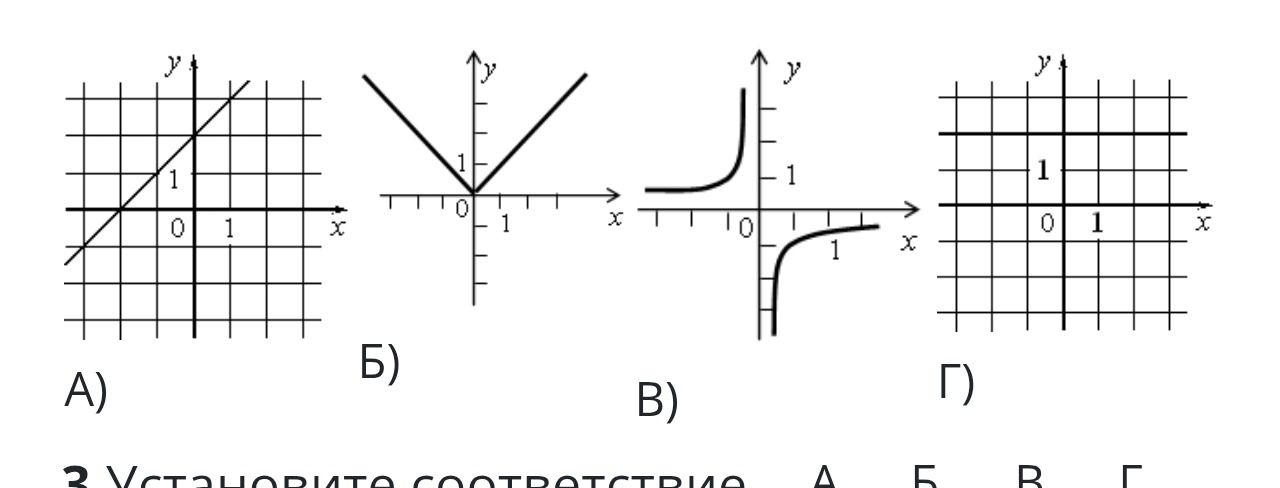
The user has provided an image containing four graphs labeled A, Б, B, and Г. The task is to determine the correspondence between these graphs and likely some implied mathematical functions or equations, although these are not explicitly stated. The prompt also includes Russian text that seems to be an instruction related to establishing correspondence. Since the instruction is not a question and the graphs are not accompanied by specific functions to match, I will describe each graph as a mathematical function it most likely represents based on its visual characteristics.
Ответ:
Analysis of Graphs:
The image displays four graphs, labeled A, Б, B, and Г, each plotted on a Cartesian coordinate system. We will analyze each graph to identify the type of function it represents.
- Graph A: This graph shows a straight line passing through the origin with a positive slope. It appears to have a y-intercept of 0 and an x-intercept of 0. A function represented by this graph is likely a linear function of the form
y = mx, wheremis a positive constant. For example, it could bey = xory = 2x. - Graph Б: This graph displays a V-shaped curve with its vertex at the origin (0,0). The two arms of the V extend upwards, indicating that the function has a minimum value at y=0. This shape is characteristic of an absolute value function. The most basic form of such a function is
y = |x|. - Graph B: This graph shows a hyperbola with two branches, one in the first quadrant and one in the third quadrant. The axes (x and y) appear to be asymptotes for both branches. This type of graph is typical of an inverse proportion function, such as
y = k/x, wherekis a positive constant. The branches are in the first and third quadrants, indicating thatk > 0. - Graph Г: This graph shows a horizontal line and a vertical line, forming a grid. There is no curve or specific function plotted on this graph. It appears to be a set of axes with grid lines, possibly intended as a reference or a base for plotting other functions, or it might represent constant functions, but without a plotted line, it's just a grid. If we were to consider a function, a horizontal line would represent a constant function
y = c, and a vertical line would representx = c. However, no such line is explicitly drawn as a function plot.
Conclusion: The graphs represent a linear function (A), an absolute value function (Б), and an inverse proportion function (B). Graph Г is a grid without a specific function plotted.
