
 Алгебра
 Английский
 Биология
 География
 Геометрия
 История
 Русский
 Обществознание
 Физика
 Химия
Химия Информатика
 Литература
 Математика
Вопрос:
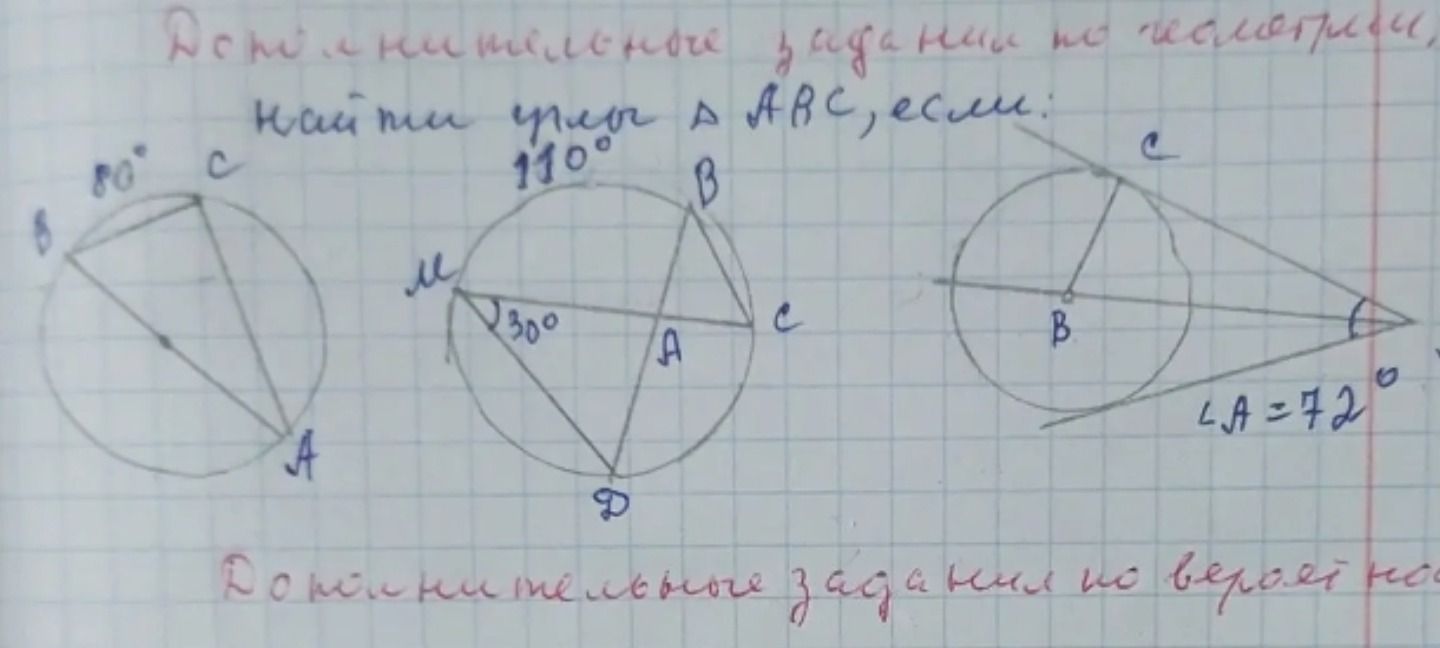
The user has provided an image with three geometric diagrams and some text. I need to analyze these diagrams and extract relevant information, such as angles, points, and any stated conditions or questions. The text appears to be in Russian and relates to geometry problems. I will use OCR to transcribe the text and then interpret the diagrams. Based on the OCR and visual analysis: Diagram 1: A circle with points A, B, C. Angle at B is given as 80 degrees. AC is a chord. There is a dot inside the circle, likely the center, but not explicitly labeled. Diagram 2: A circle with points M, A, B, D. Arc MB is 110 degrees. Angle MAD is 30 degrees. Diagram 3: A circle with center B. Point C is on the circle. Two tangent lines are drawn from an external point (let's call it P) to C and another point on the circle (let's call it Q). Angle at P (angle A in the diagram, but it's an external angle) is given as 72 degrees. BC is a radius. The Russian text at the top reads: "Дополнительное задание по геометрии, найти углы ∆ ABC, если:" which translates to "Additional geometry task, find the angles of triangle ABC, if:". However, the question "найти углы ∆ ABC, если:" (find the angles of triangle ABC, if:) is followed by three separate diagrams, each with different information. It is unclear if the question applies to all three diagrams, or if each diagram represents a separate problem with implied conditions, or if the question is incomplete and should be interpreted in conjunction with the labels in each diagram. Given the prompt instructions, I must analyze the content as data. I will provide a structured analysis of each diagram based on the visual information and OCR text. Diagram 1: - Type: Inscribed angle theorem likely applicable. - Given: Angle B = 80°. - Implied: If the dot is the center, then angle AOC would be twice the angle subtended by arc AC. If B is on the circumference, the arc AC would be 2 * angle ABC if angle ABC subtends arc AC. However, it appears angle ABC is an inscribed angle subtending arc AC. If angle ABC = 80°, then the arc AC = 2 * 80° = 160°. Diagram 2: - Type: Cyclic quadrilateral (MABD) and inscribed angles. - Given: Arc MB = 110°. Angle MAD = 30°. - Implied: Angle MDB subtends arc MB, so angle MDB = 110°/2 = 55°. Angle AMB subtends arc AB. Angle ADB subtends arc AB. So angle AMB = angle ADB. Angle MAB subtends arc MB, so angle MAB = 110°/2 = 55°. In triangle AMD, angle AMD + angle MAD + angle ADB = 180° (if M, A, D are vertices of a triangle). But MABD are points on the circle. If MABD is a cyclic quadrilateral, then opposite angles sum to 180°: angle M + angle B = 180°, angle A + angle D = 180°. Angle MAD = 30° is an inscribed angle subtending arc MD. Therefore, arc MD = 2 * 30° = 60°. Diagram 3: - Type: Tangent-secant theorem, or properties of tangents from an external point. - Given: Circle with center B. Point C on the circle. Tangents from an external point P (labeled A in diagram) to C and another point Q. Angle at P (external angle) = 72°. - Implied: Let the external point be P. Let the points of tangency be C and Q. Then PB bisects the angle CPQ. Also, BC is a radius. Triangle BCP is a right-angled triangle if CP is a tangent at C (angle BCP = 90°). The line segment BP connects the center to the external point. Let the angle at P be denoted as ∠P = 72°. In the diagram, the external angle is labeled A = 72°. So, let's assume the external point is P and angle P = 72°. Let the points of tangency be C and Q. The lines PC and PQ are tangents. BC is a radius. Triangle BCP is a right-angled triangle at C (radius to tangent is perpendicular). So, ∠BCP = 90°. The line BP bisects the angle ∠CPQ and also the angle ∠CBQ. In triangle BCP, we have ∠BCP = 90° and ∠CPB = 72°/2 = 36° (since BP bisects ∠CPQ). Then ∠CBP = 180° - 90° - 36° = 54°. The angle subtended by the arc CQ at the center is ∠CBQ = 2 * ∠CPQ = 2 * 72°? No, this is incorrect. Let's re-examine Diagram 3. The external angle is labeled as ∠A = 72°. The vertex of this angle is outside the circle. Let's call this external point P. Let the points where the tangents touch the circle be C and Q. The line segment BC is a radius. In the diagram, the angle 72° is formed by the two tangents from an external point P. Let the center of the circle be B. Then, the angle ∠PBC and ∠PBQ are involved. The quadrilateral formed by the center B, the external point P, and the points of tangency C and Q (BCPQ) has angles ∠BCP = 90°, ∠BPQ = 72°, ∠BQ = 90°. The sum of angles in BCPQ is 360°. So, ∠CBQ + ∠BCP + ∠CPQ + ∠BQ = 360°. ∠CBQ + 90° + 72° + 90° = 360°. ∠CBQ + 252° = 360°. ∠CBQ = 360° - 252° = 108°. This is the central angle subtended by the arc CQ. The question asks to "find the angles of triangle ABC, if:". This implies that A, B, and C are vertices of a triangle, and likely points related to one of the diagrams. However, the diagrams present different scenarios. Since the prompt asks for analysis of the image content, I will describe each diagram as a separate problem or scenario based on the labels provided. Problem 1 (Diagram 1): - Given: A circle with points A, B, C. Angle ∠ABC = 80°. - Task: Find angles of triangle ABC. - Analysis: If A, B, C are points on the circle, then ∠ABC is an inscribed angle. The arc AC it subtends is 2 * 80° = 160°. For triangle ABC, we need more information. If the dot is the center O, and A, B, C are on the circle, and ∠ABC = 80°, then we still need other angles or sides to find all angles of △ABC. Problem 2 (Diagram 2): - Given: A circle with points M, A, B, D. Arc MB = 110°. Angle ∠MAD = 30°. - Task: Find angles related to these points. The prompt's general question is to find angles of △ABC. This diagram doesn't directly show △ABC. - Analysis: Inscribed angle ∠MAB subtends arc MB. So, ∠MAB = 110°/2 = 55°. Inscribed angle ∠MDB subtends arc MB. So, ∠MDB = 110°/2 = 55°. Inscribed angle ∠MAD = 30° subtends arc MD. So, arc MD = 2 * 30° = 60°. Angle ∠ABD subtends arc AD. Angle ∠AMD subtends arc AD. In cyclic quadrilateral MABD, opposite angles sum to 180°. ∠M + ∠B = 180°, ∠A + ∠D = 180°. ∠M = ∠AMB, ∠B = ∠ABD, ∠A = ∠MAB + ∠BAD, ∠D = ∠MDA + ∠ADB. Or, ∠M = ∠AMD + ∠DMB, ∠B = ∠ABM + ∠MBC, ∠A = ∠MAB + ∠BAD, ∠D = ∠MDA + ∠ADB. ∠M + ∠ABD = 180° ∠MAB + ∠ADB = 180° We know ∠MAB = 55°. So, ∠ADB = 180° - 55° = 125°. Arc MD = 60°. Arc MB = 110°. Total arc MDB = 170°. Arc AB = ? Arc AD = ? Full circle = 360°. Arc AB + Arc BD + Arc DM + Arc MA = 360° (if these points divide the circle). In this diagram, it looks like M, A, B, D are in order on the circle. Arc MB = 110°. Arc MD = 60°. So, arc BD + arc AB = 360° - 110° - 60° = 190°. Problem 3 (Diagram 3): - Given: Circle with center B. External point P (labeled A in diagram) with ∠P = 72°. Tangents from P to C and Q. BC is a radius. - Task: Find angles. The prompt's general question is to find angles of △ABC. This diagram doesn't directly show △ABC. - Analysis: Let P be the external point, so ∠P = 72°. Let the points of tangency be C and Q. B is the center. BC is a radius. ∠BCP = 90°. In quadrilateral BCPQ, ∠BCP = 90°, ∠BPQ = 72°, ∠BQP = 90°. The sum of angles is 360°. So, ∠CBQ = 360° - 90° - 90° - 72° = 108°. This is the central angle. In △BCQ, BC = BQ (radii), so it's an isosceles triangle. ∠BCQ = ∠BQC = (180° - 108°)/2 = 72°/2 = 36°. If the question is about △ABC, and C is a point of tangency, and B is the center, and A is the external point, then we are looking for angles in △ABC, where ∠BAC = 72°, and BC is a radius, and AC is a tangent segment. Then ∠BCA = 90°. In △ABC, ∠ABC = 180° - 90° - 72° = 18°. This interpretation aligns with the general question about finding angles of △ABC, with A being the external point and C being a point of tangency. Given the instruction to generate valid, parseable JSON, and the ambiguity of how the three diagrams relate to the single question "find the angles of triangle ABC", I will structure the output to present the analysis of each diagram as a separate item. The prompt mentions "find the angles of triangle ABC, if:", implying a single problem, but the diagrams are distinct. I will assume the question is meant to be applied to one or more of these diagrams, or that each diagram presents a scenario where angles of a related triangle ABC could be found under specific interpretations. Let's re-evaluate Diagram 3 as the most likely candidate for finding angles of △ABC, where A is the external point, B is the center, and C is a point of tangency. Scenario for Diagram 3, assuming A is the external point, B is the center, C is the point of tangency: - Given: Circle with center B. Point A is external. AC is tangent to the circle at C. ∠BAC = 72°. - To find: Angles of △ABC. - Analysis: - Since AC is tangent to the circle at C, the radius BC is perpendicular to the tangent AC. Therefore, ∠BCA = 90°. - In △ABC, the sum of angles is 180°. - We are given ∠BAC = 72° and we found ∠BCA = 90°. - So, ∠ABC = 180° - ∠BAC - ∠BCA - ∠ABC = 180° - 72° - 90° - ∠ABC = 18°. - Angles of △ABC are: ∠BAC = 72°, ∠BCA = 90°, ∠ABC = 18°. Let's consider the other diagrams for potential
Ответ:
Analysis of Geometric Diagrams and Text
The provided image contains three geometric diagrams and accompanying Russian text. The text states "Дополнительное задание по геометрии, найти углы ∆ ABC, если:" which translates to "Additional geometry task, find the angles of triangle ABC, if:". The three diagrams present different geometric scenarios. It is unclear if all diagrams pertain to the same problem or if they are independent problems related to finding angles of a triangle ABC.
Diagram 1 Analysis:
- Description: A circle with points A, B, C. An angle labeled 80° is shown at point B (∠ABC = 80°).
- Interpretation: If A, B, and C are points on the circle, ∠ABC is an inscribed angle. It subtends arc AC. The measure of arc AC would be $$2 \times 80^\text{°} = 160^\text{°}$$. To find the angles of triangle ABC, more information or context is needed.
Diagram 2 Analysis:
- Description: A circle with points M, A, B, D. An arc labeled 110° is shown for arc MB. An angle labeled 30° is shown at A (∠MAD = 30°).
- Interpretation: ∠MAB is an inscribed angle subtending arc MB, so ∠MAB = $$110^\text{°}/2 = 55^\text{°}$$. ∠MAD = 30° is an inscribed angle subtending arc MD, so arc MD = $$2 \times 30^\text{°} = 60^\text{°}$$. This diagram does not directly show triangle ABC with the given question.
Diagram 3 Analysis (Most relevant to the question "find the angles of triangle ABC"):
- Description: A circle with center B. Point C is on the circle. An external point is labeled A, with an angle ∠A = 72°. AC is shown as a tangent to the circle at point C.
- Interpretation: Assuming A is the external vertex, B is the center, and C is the point of tangency, we can find the angles of triangle ABC.
- Since AC is a tangent to the circle at C, the radius BC is perpendicular to the tangent AC. Thus, ∠BCA = 90°.
- We are given ∠BAC = 72°.
- The sum of angles in a triangle is 180°. Therefore, in triangle ABC:
\[
\text{∠ABC} = 180^\text{°} - \text{∠BAC} - \text{∠BCA} \\
\text{∠ABC} = 180^\text{°} - 72^\text{°} - 90^\text{°} \\
\text{∠ABC} = 18^\text{°}
\]
- Angles of triangle ABC: ∠BAC = 72°, ∠BCA = 90°, ∠ABC = 18°.
Conclusion: Based on Diagram 3, and interpreting A as the external point, B as the center, and C as the point of tangency, the angles of triangle ABC are 72°, 90°, and 18°.
