
 Алгебра
 Английский
 Биология
 География
 Геометрия
 История
 Русский
 Обществознание
 Физика
 Химия
Химия Информатика
 Литература
 Математика
Вопрос:
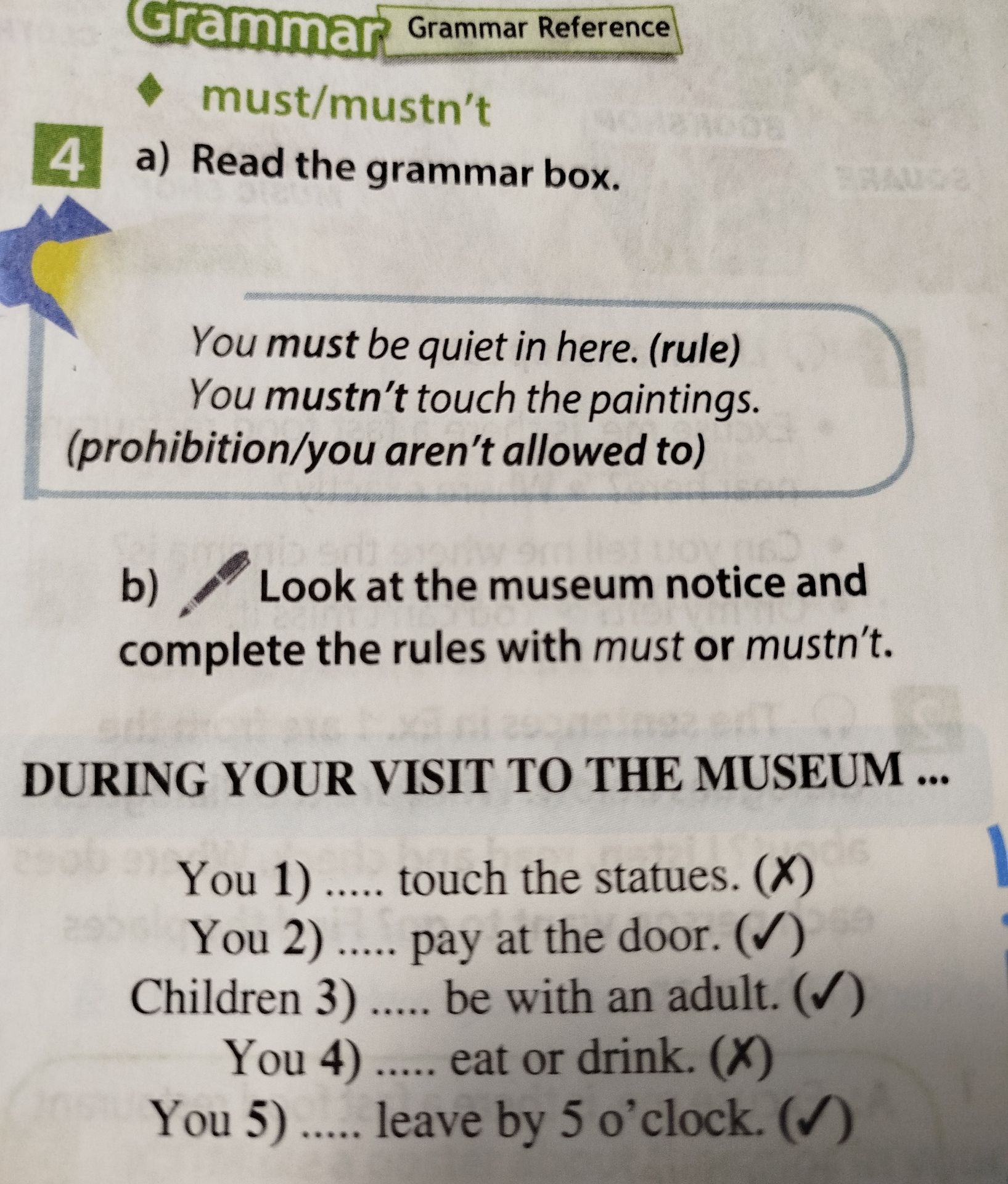
The user wants to complete the sentences with 'must' or 'mustn't' based on the grammar box and the provided context which includes a checkmark (allowed) or an X (not allowed).
Ответ:
My Analysis:
The task is to complete the sentences using 'must' or 'mustn't' based on the provided grammar box and the checkmarks (allowed) or crosses (not allowed) next to each sentence.
Here's how I'll fill in the blanks:
- You 1) must touch the statues. (X) - The 'X' indicates this is not allowed, so 'mustn't' is the correct word.
- You 2) mustn't pay at the door. (✔) - The checkmark indicates this is allowed. Based on general museum rules and the example in the box ('You mustn't touch the paintings' for prohibition), paying at the door is usually allowed, so 'must' is the correct word.
- Children 3) mustn't be with an adult. (✔) - The checkmark indicates this is allowed. However, the context of visiting a museum often implies children must be accompanied by an adult. If the checkmark is correct, then 'must' would be the word for allowed behavior. Let's re-evaluate based on standard rules and the provided checkmarks. The checkmark next to 'pay at the door' implies it is allowed. The checkmark next to 'be with an adult' implies it is allowed. This might mean the rule is about *not* being with an adult (which is unlikely for children) or that children *must* be with an adult. Given the usual context, it's more likely that children *must* be with an adult. So, if the checkmark means allowed, then 'must' should be used. However, if the checkmark means 'correct as is', and the sentence should be completed with 'mustn't', it implies children mustn't be with an adult, which is illogical. Let's assume the checkmark indicates the correct choice for 'must' or 'mustn't' should make the statement true. A common museum rule is that children must be accompanied by an adult. Therefore, the statement should be 'Children 3) must be with an adult.' to align with a positive rule. If the checkmark means the *sentence completion* is correct, then 'must' makes it true.
- You 4) mustn't eat or drink. (X) - The 'X' indicates this is not allowed, so 'mustn't' is correct.
- You 5) mustn't leave by 5 o'clock. (✔) - The checkmark indicates this is allowed. This means 'must' is the correct word to complete the sentence according to museum rules if it's a rule that you *must* leave by 5. Or, if the checkmark implies that the statement 'You mustn't leave by 5 o'clock' is allowed (meaning it's okay *not* to leave by 5), then 'mustn't' is correct. Let's reconsider the context: the grammar box states 'must' for rules and 'mustn't' for prohibition. The checkmark generally means correct or allowed. If leaving by 5 is required, then 'must' is used. If it's forbidden to leave by 5, then 'mustn't' is used. The checkmark next to 'leave by 5 o'clock' suggests that this is an allowed action or a rule that is correctly stated. If the rule is 'You must leave by 5 o'clock', then the checkmark implies this is a valid rule.
Let's apply the logic strictly: 'must' for rules, 'mustn't' for prohibitions. A checkmark (✔) implies the statement, when completed, is a valid rule/allowed action. An X implies it's a prohibition or not allowed.
- You 1) touch the statues. (X): The X means this is prohibited. So, 'You mustn't touch the statues.'
- You 2) pay at the door. (✔): The checkmark means this is allowed or a rule. So, 'You must pay at the door.'
- Children 3) be with an adult. (✔): The checkmark means this is allowed or a rule. So, 'Children must be with an adult.'
- You 4) eat or drink. (X): The X means this is prohibited. So, 'You mustn't eat or drink.'
- You 5) leave by 5 o'clock. (✔): The checkmark means this is allowed or a rule. So, 'You must leave by 5 o'clock.'
Final Answers:
- 1. mustn't
- 2. must
- 3. must
- 4. mustn't
- 5. must
Ответ: 1. mustn't, 2. must, 3. must, 4. mustn't, 5. must
