
 Алгебра
 Английский
 Биология
 География
 Геометрия
 История
 Русский
 Обществознание
 Физика
 Химия
Химия Информатика
 Литература
 Математика
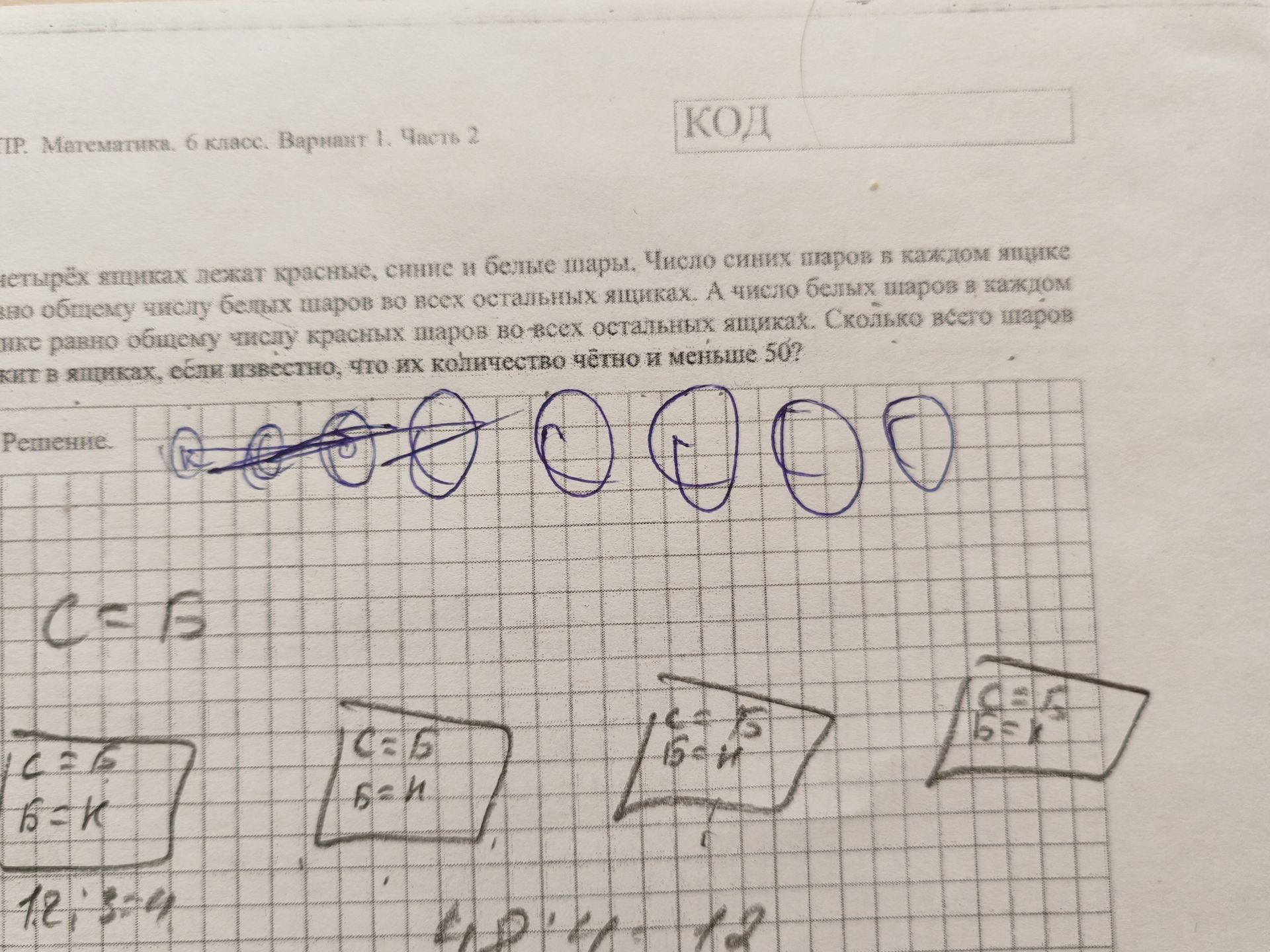
There are red, blue, and white balls in four boxes. The number of blue balls in each box is equal to the total number of white balls in all other boxes. The number of white balls in each box is equal to the total number of red balls in all other boxes. How many balls are in the boxes in total, if it is known that the total number is even and less than 50?
Ответ:
Let's denote:
- \[ r_i \] - the number of red balls in box \(i\)
- \[ b_i \] - the number of blue balls in box \(i\)
- \[ w_i \] - the number of white balls in box \(i\)
The problem states:
For each box \(i\), the number of blue balls is equal to the total number of white balls in all other boxes:
\[ b_i = \sum_{j \neq i} w_j \]
For each box \(i\), the number of white balls is equal to the total number of red balls in all other boxes:
\[ w_i = \sum_{j \neq i} r_j \]
Let \(R\), \(B\), and \(W\) be the total number of red, blue, and white balls, respectively.
\[ R = \sum_{i=1}^4 r_i \]
\[ B = \sum_{i=1}^4 b_i \]
\[ W = \sum_{i=1}^4 w_i \]
The total number of balls is \(T = R + B + W\).
From the first condition:
\[ b_i = W - w_i \]
Summing over all \(i\):
\[ B = \sum_{i=1}^4 (W - w_i) = 4W - \sum_{i=1}^4 w_i = 4W - W = 3W \]
From the second condition:
\[ w_i = R - r_i \]
Summing over all \(i\):
\[ W = \sum_{i=1}^4 (R - r_i) = 4R - \sum_{i=1}^4 r_i = 4R - R = 3R \]
So, we have the relationships:
\[ B = 3W \]
\[ W = 3R \]
Substituting the second equation into the first:
\[ B = 3(3R) = 9R \]
The total number of balls is:
\[ T = R + B + W = R + 9R + 3R = 13R \]
We are given that the total number of balls \(T\) is even and less than 50.
\[ T = 13R < 50 \]
Since \(R\) must be a positive integer (number of balls), the possible values for \(R\) are:
If \(R = 1\), then \(T = 13 \times 1 = 13\) (odd, not valid).
If \(R = 2\), then \(T = 13 \times 2 = 26\) (even, and < 50, valid).
If \(R = 3\), then \(T = 13 \times 3 = 39\) (odd, not valid).
If \(R = 4\), then \(T = 13 \times 4 = 52\) (even, but > 50, not valid).
The only valid case is \(R = 2\), which gives \(T = 26\).
Let's check if we can find a distribution of balls for \(R=2\).
If \(R=2\), then \(W = 3R = 3 \times 2 = 6\).
And \(B = 3W = 3 \times 6 = 18\).
Total balls \(T = R + B + W = 2 + 18 + 6 = 26\).
Now we need to distribute these balls into 4 boxes such that the conditions are met.
Let's try to set \(r_1 = 2, r_2 = 0, r_3 = 0, r_4 = 0\). So \(R=2\).
Then for box 1: \(w_1 = R - r_1 = 2 - 2 = 0\).
For boxes 2, 3, 4: \(w_2 = R - r_2 = 2 - 0 = 2\), \(w_3 = R - r_3 = 2 - 0 = 2\), \(w_4 = R - r_4 = 2 - 0 = 2\).
Total white balls \(W = w_1 + w_2 + w_3 + w_4 = 0 + 2 + 2 + 2 = 6\). This matches \(W=6\).
Now let's check the blue balls.
For box 1: \(b_1 = W - w_1 = 6 - 0 = 6\).
For box 2: \(b_2 = W - w_2 = 6 - 2 = 4\).
For box 3: \(b_3 = W - w_3 = 6 - 2 = 4\).
For box 4: \(b_4 = W - w_4 = 6 - 2 = 4\).
Total blue balls \(B = b_1 + b_2 + b_3 + b_4 = 6 + 4 + 4 + 4 = 18\). This matches \(B=18\).
So, one possible distribution is:
- Box 1: 2 red, 6 blue, 0 white
- Box 2: 0 red, 4 blue, 2 white
- Box 3: 0 red, 4 blue, 2 white
- Box 4: 0 red, 4 blue, 2 white
Let's verify the conditions for Box 1:
Blue balls in Box 1 = 6.
White balls in other boxes = \(w_2 + w_3 + w_4 = 2 + 2 + 2 = 6\). (Condition met)
White balls in Box 1 = 0.
Red balls in other boxes = \(r_2 + r_3 + r_4 = 0 + 0 + 0 = 0\). (Condition met)
Let's verify the conditions for Box 2:
Blue balls in Box 2 = 4.
White balls in other boxes = \(w_1 + w_3 + w_4 = 0 + 2 + 2 = 4\). (Condition met)
White balls in Box 2 = 2.
Red balls in other boxes = \(r_1 + r_3 + r_4 = 2 + 0 + 0 = 2\). (Condition met)
The total number of balls is 26, which is even and less than 50.
Ответ: 26
