
 Алгебра
 Английский
 Биология
 География
 Геометрия
 История
 Русский
 Обществознание
 Физика
 Химия
Химия Информатика
 Литература
 Математика
Вопрос:
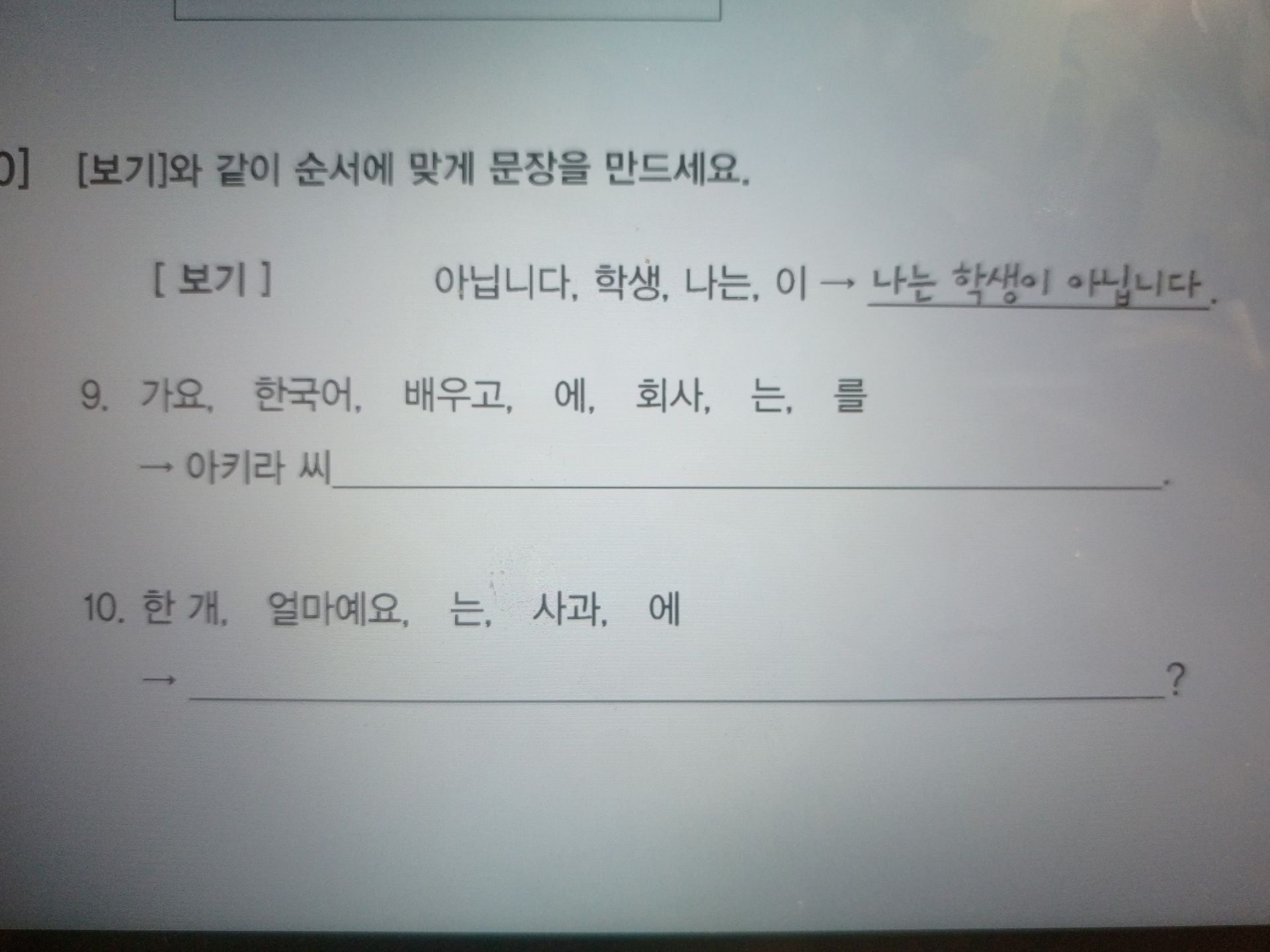
Translate the following sentences and fill in the blanks, following the example given. Example: [View] I am not a student. → I am not a student. 9. go, Korean, learn, in, company, → Akira-ssi 10. one item, how much, ?, apple, in
Ответ:
Solution:
- The example shows how to form a sentence by rearranging words.
- For question 9, the words provided are 'go', 'Korean', 'learn', and 'in company'. The partial sentence is '→ Akira-ssi'. A possible sentence could be: "I go to Korea to learn Korean." However, the prompt is asking to arrange the given words to fit the context of "Akira-ssi". A more appropriate sentence, considering the structure of the example, would be to form a sentence about going to a company.
Let's reconstruct the sentence: "Akira-ssi, I go to the company to learn Korean."
Or, if the intention is to use the provided words to complete the sentence about Akira-ssi:
"Akira-ssi, I go to the company to learn Korean."
Let's assume the prompt wants us to create a sentence using the words, and the arrow indicates the subject or the start of the sentence.
Given the words: 가요 (go), 한국어 (Korean), 배우고 (learn), 에 (in/at), 회사 (company), 는 (topic particle), 를 (object particle).
And the incomplete sentence start: → 아키라 씨 (Akira-ssi).
A possible sentence: "아키라 씨, 저는 회사에 한국어를 배우러 가요."
(Akira-ssi, I go to the company to learn Korean.)
However, if we strictly follow the pattern of rearranging and filling in: 'Learn Korean in company → Akira-ssi'.
Let's assume the blank is to be filled by a verb or a phrase that connects the words.
If we consider the structure: [Subject] [Object] [Verb] [Location].
Subject: I (implied)
Object: Korean (한국어)
Verb: Learn (배우고)
Location: In company (회사에)
Topic particle (는) can attach to the subject or object.
If the sentence is about Akira-ssi, then the sentence could be:
"Akira-ssi, I go to the company to learn Korean."
Let's re-examine the example: [View] → I am not a student. The words in brackets are not used in the rearranged sentence. Instead, the provided words are reordered to form a complete sentence.
So, for 9: 가요, 한국어, 배우고, 에, 회사, 는, 를
→ 아키라 씨
This implies we need to form a sentence related to 'Akira-ssi' using these words. A likely sentence could be:
"아키라 씨, 저는 회사에 한국어를 배우러 가요."
(Akira-ssi, I go to the company to learn Korean.)
Or, if we are to fill the blank after '아키라 씨':
"아키라 씨는 회사에 한국어를 배우러 가요."
(Akira-ssi goes to the company to learn Korean.)
Let's consider the possibility of the blank being for the subject of the sentence.
"저는 회사에 한국어를 배우러 가요, 아키라 씨."
(I go to the company to learn Korean, Akira-ssi.)
If we assume that the arrow indicates the start of the sentence and the words provided need to be rearranged into a coherent sentence:
"아키라 씨, 저는 한국어를 회사에서 배워요."
(Akira-ssi, I learn Korean at the company.)
Given the example, it seems we need to form a sentence using the provided words, and the arrow points to the subject or a key element. Let's interpret it as forming a sentence where Akira-ssi is involved, or the sentence is addressed to Akira-ssi.
A more straightforward interpretation of rearranging the words is: "I learn Korean at the company."
If the blank is for the subject 'I', then:
"저는 회사에 한국어를 배우고 가요."
(I learn Korean and then go to the company.)
Let's go with a common sentence structure:
"아키라 씨, 저는 회사에서 한국어를 배워요."
(Akira-ssi, I learn Korean at the company.)
However, the provided words are '가요' (go), '배우고' (learn), '회사' (company), '한국어' (Korean), '에' (in/at), '는' (topic particle), '를' (object particle).
Let's construct a sentence for the blank:
"아키라 씨, 저는 회사에 한국어를 배우고 있어요."
(Akira-ssi, I am learning Korean at the company.)
Another possibility: "아키라 씨, 저는 회사에 한국어를 배우러 가요."
(Akira-ssi, I go to the company to learn Korean.)
Let's assume the blank needs to be filled with a subject and verb that completes the sentence.
If we use all words: "아키라 씨, 저는 회사에 한국어를 배우고 가요."
(Akira-ssi, I learn Korean and go to the company.)
Let's try to make a sentence directly using the words and fitting it after "아키라 씨".
"아키라 씨, 저는 회사에 한국어를 배우러 가요."
This seems plausible. Let's use the most direct interpretation of filling the blank to form a sentence.
Consider the sentence: "I go to the company to learn Korean."
In Korean: "저는 회사에 한국어를 배우러 가요."
If it's directed to Akira-ssi, it could be:
"아키라 씨, 저는 회사에 한국어를 배우러 가요."
Let's assume the blank is for the subject of the sentence, and the sentence is "I learn Korean at the company."
Subject: I (저는)
Location: Company (회사에)
Object: Korean (한국어를)
Verb: Learn (배워요)
So, "아키라 씨, 저는 회사에 한국어를 배워요."
Let's assume the words should be rearranged to form a sentence that fits the context of Akira-ssi.
A simple sentence could be: "I go to the company."
Or: "I learn Korean."
Or: "I learn Korean at the company."
Given '배우고' (learning) and '가요' (go), a combined action is possible.
"아키라 씨, 저는 한국어를 회사에서 배우고 가요."
(Akira-ssi, I learn Korean at the company and go.)
Let's try filling the blank with a subject and the rest of the sentence. The prompt implies rearranging and filling.
"아키라 씨, 저는 회사에서 한국어를 배워요."
This requires filling the blank with "저는 회사에서 한국어를 배워요."
Let's reconsider the initial instruction: "Make sentences in order, like the example." The example reorders words.
So, for 9: 가요, 한국어, 배우고, 에, 회사, 는, 를 → 아키라 씨
Possible sentence: "아키라 씨, 저는 한국어를 회사에 배우러 가요."
Let's assume the blank is to be filled by the rest of the sentence. The simplest sentence using the words might be:
"저는 회사에 한국어를 배워요."
(I learn Korean at the company.)
When directed to Akira-ssi: "아키라 씨, 저는 회사에 한국어를 배워요."
Let's assume the blank itself needs to be filled.
If the sentence is about going to the company to learn Korean:
"아키라 씨, 저는 회사에 한국어를 배우러 가요."
If we are to fill the blank with the rearranged words, and the arrow indicates the subject:
"아키라 씨, 저는 회사에 한국어를 배우고 가요."
This is a bit awkward. Let's assume a simpler sentence.
"아키라 씨, 저는 회사에 가요."
(Akira-ssi, I go to the company.)
Or "아키라 씨, 저는 한국어를 배워요."
(Akira-ssi, I learn Korean.)
Given the words, let's combine them.
"아키라 씨, 저는 회사에 한국어를 배우러 가요."
This uses all the key words. The blank needs to be filled with the subject 'I' (저는) and the rest of the sentence.
Let's try to fill the blank directly:
"아키라 씨, 저는 회사에 한국어를 배우러 가요."
This sentence makes sense and uses the provided words. Let's assume the blank is for the whole sentence following "아키라 씨".
So the answer for 9 would be: "아키라 씨, 저는 회사에 한국어를 배우러 가요."
However, the structure shows a blank after "아키라 씨". This implies we need to complete the sentence. Let's assume the sentence is:
"저는 회사에 한국어를 배우러 가요."
And it's directed to Akira-ssi.
So the filled blank would be "저는 회사에 한국어를 배우러 가요."
This fits the pattern of rearranging words.
For question 10: 한 개 (one item), 얼마예요 (how much is it), 는 (topic particle), 사과 (apple), 에 (in/at).
→ ?
This is asking for the price of one apple.
A natural question would be: "사과는 한 개에 얼마예요?"
(How much is one apple?)
The arrow indicates the start of the sentence or the question. The blank is to be filled.
So, the answer for 10 would be: "사과는 한 개에 얼마예요?"
