
 Алгебра
 Английский
 Биология
 География
 Геометрия
 История
 Русский
 Обществознание
 Физика
 Химия
Химия Информатика
 Литература
 Математика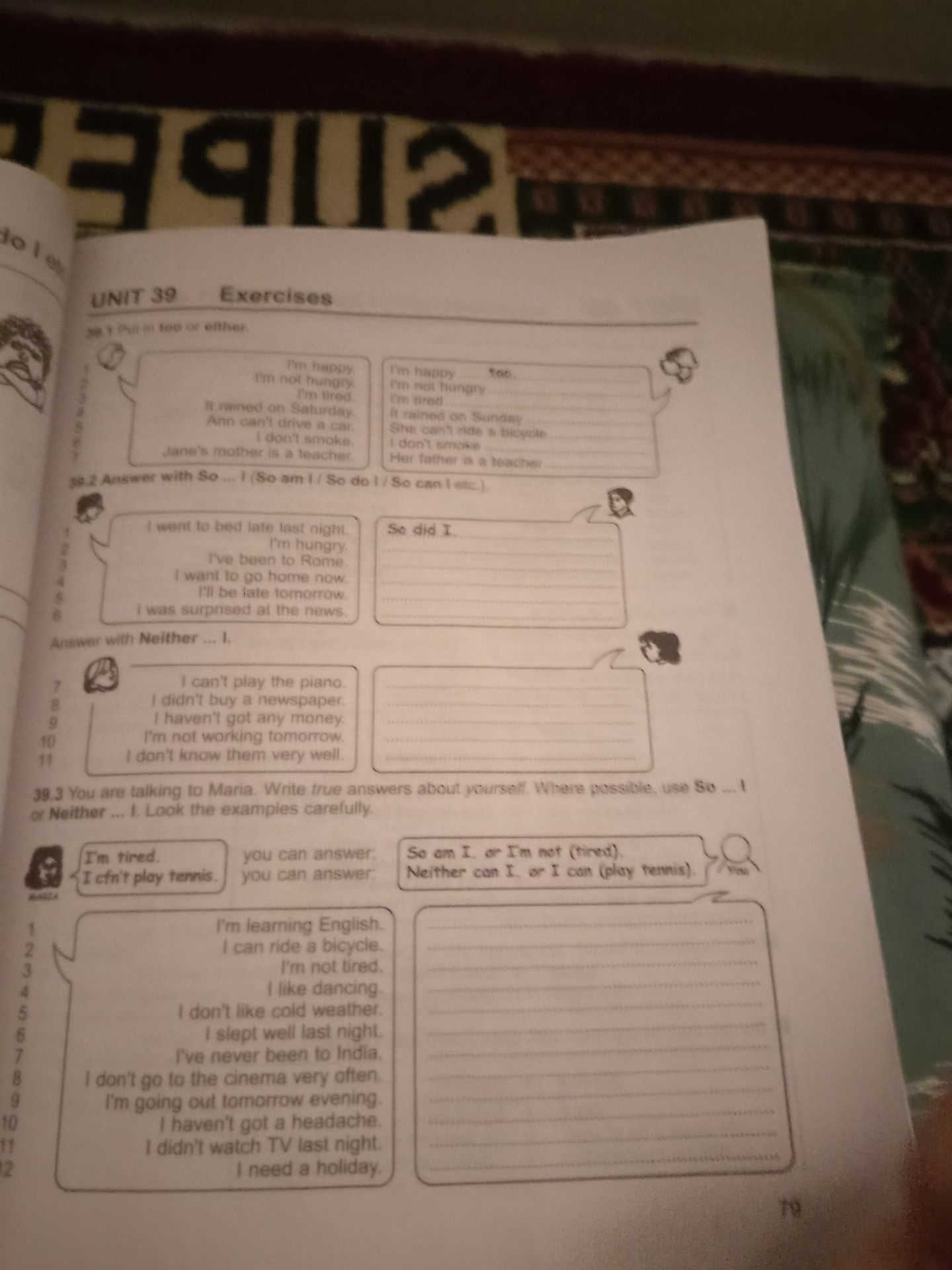
Ответ:
39.1
Too is used for positive statements, and either is used for negative statements.
39.2
Examples:
I'm happy. So am I.
I'm hungry. So am I.
I'm tired. So am I.
It rained on Saturday. So did I.
Ann can't drive a car. Neither can I.
I don't smoke. Neither do I.
Jane's mother is a teacher. So am I.
Her father is a teacher. So am I.
I went to bed late last night. So did I.
I'm hungry. So am I.
I've been to Rome. So have I.
I want to go home now. So do I.
I'll be late tomorrow. So will I.
I was surprised at the news. So was I.
39.3
Examples:
Maria: I'm tired.
You: I'm tired, too. / I'm not tired. / Neither am I.
Maria: I can't play tennis.
You: I can't play tennis, either. / I can play tennis. / So can I.
Maria: I'm learning English.
You: I'm learning English, too. / I'm not learning English. / Neither am I.
Maria: I can ride a bicycle.
You: I can ride a bicycle, too. / I can't ride a bicycle. / Neither can I.
Maria: I'm not tired.
You: I'm not tired, either. / I'm tired. / So am I.
Maria: I like dancing.
You: I like dancing, too. / I don't like dancing. / Neither do I.
Maria: I don't like cold weather.
You: I don't like cold weather, either. / I like cold weather. / So do I.
Maria: I slept well last night.
You: I slept well last night, too. / I didn't sleep well last night. / Neither did I.
Maria: I've never been to India.
You: I've never been to India, either. / I have been to India. / So have I.
Maria: I don't go to the cinema very often.
You: I don't go to the cinema very often, either. / I go to the cinema very often. / So do I.
Maria: I'm going out tomorrow evening.
You: I'm going out tomorrow evening, too. / I'm not going out tomorrow evening. / Neither am I.
Maria: I haven't got a headache.
You: I haven't got a headache, either. / I have got a headache. / So have I.
Maria: I didn't watch TV last night.
You: I didn't watch TV last night, either. / I watched TV last night. / So did I.
Maria: I need a holiday.
You: I need a holiday, too. / I don't need a holiday. / Neither do I.
