
 Алгебра
 Английский
 Биология
 География
 Геометрия
 История
 Русский
 Обществознание
 Физика
 Химия
Химия Информатика
 Литература
 Математика
Вопрос:
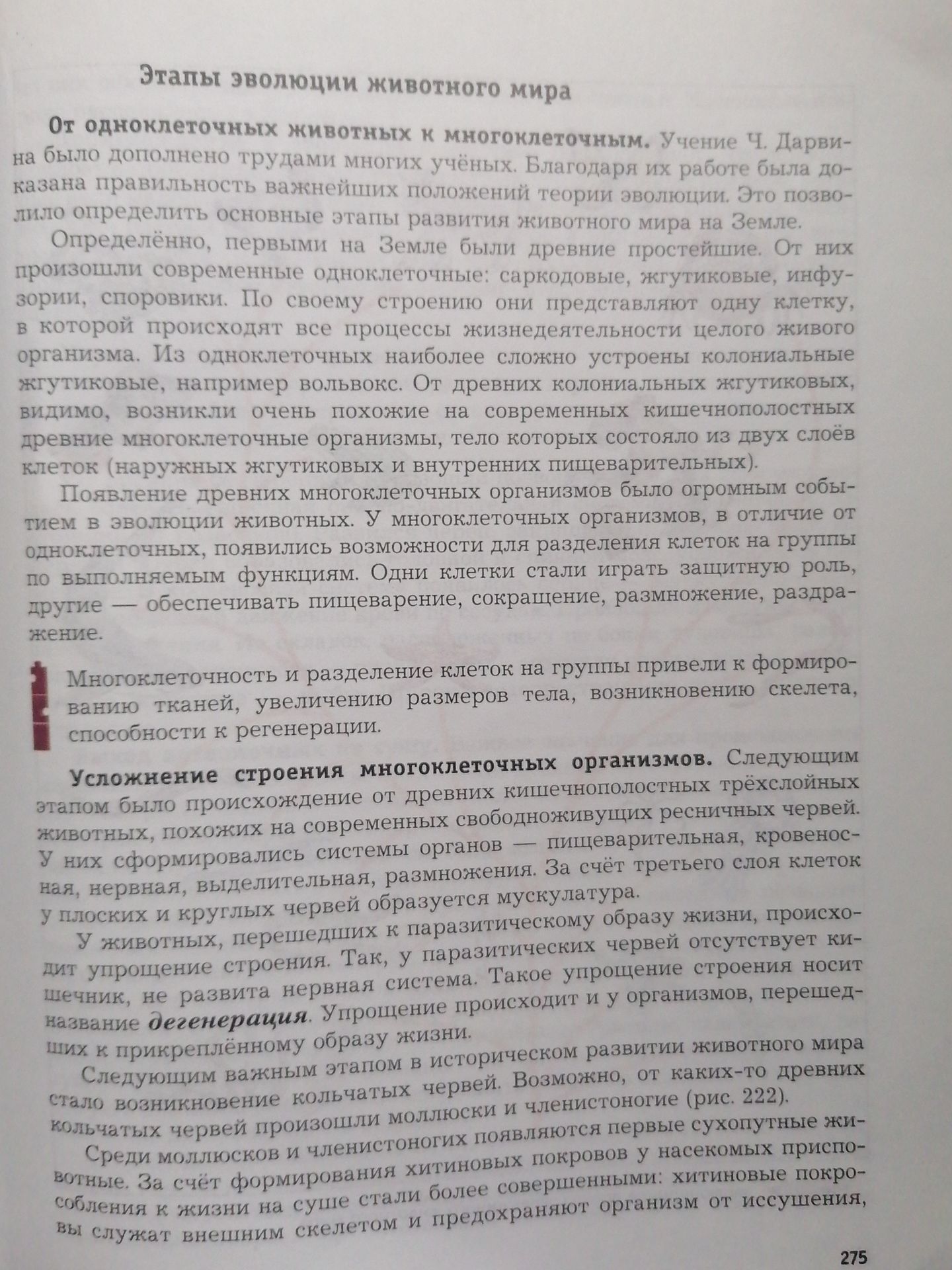
What are the main stages of animal world evolution mentioned in the text?
Ответ:
The text describes the stages of animal world evolution as follows:
- Origin of unicellular animals: The earliest life forms on Earth were unicellular organisms (protists like sarcodines, flagellates, infusoria, and sporozoans).
- Multicellularity: The evolution of multicellular organisms from ancient colonial flagellates. This allowed for cell specialization and differentiation of functions, leading to tissues, organ systems, and increased complexity.
- Simplification in parasitic/sessile forms: Some multicellular organisms simplified their structure, like parasitic worms lacking a complete digestive system or developed nervous system, a process called degeneration. Organisms that became sessile also experienced simplification.
- Origin of segmented worms: This stage led to the appearance of more complex body plans and eventually to the evolution of mollusks and arthropods.
- First terrestrial animals: The emergence of land-dwelling animals, particularly among mollusks and arthropods, facilitated by adaptations like chitinous exoskeletons.
The main stages are: Unicellular organisms -> Multicellular organisms -> Simplification in some forms -> Segmented worms -> Terrestrial animals.
Похожие
