
 Алгебра
 Английский
 Биология
 География
 Геометрия
 История
 Русский
 Обществознание
 Физика
 Химия
Химия Информатика
 Литература
 Математика
What is the pattern between the numbers in the inner and outer rings?
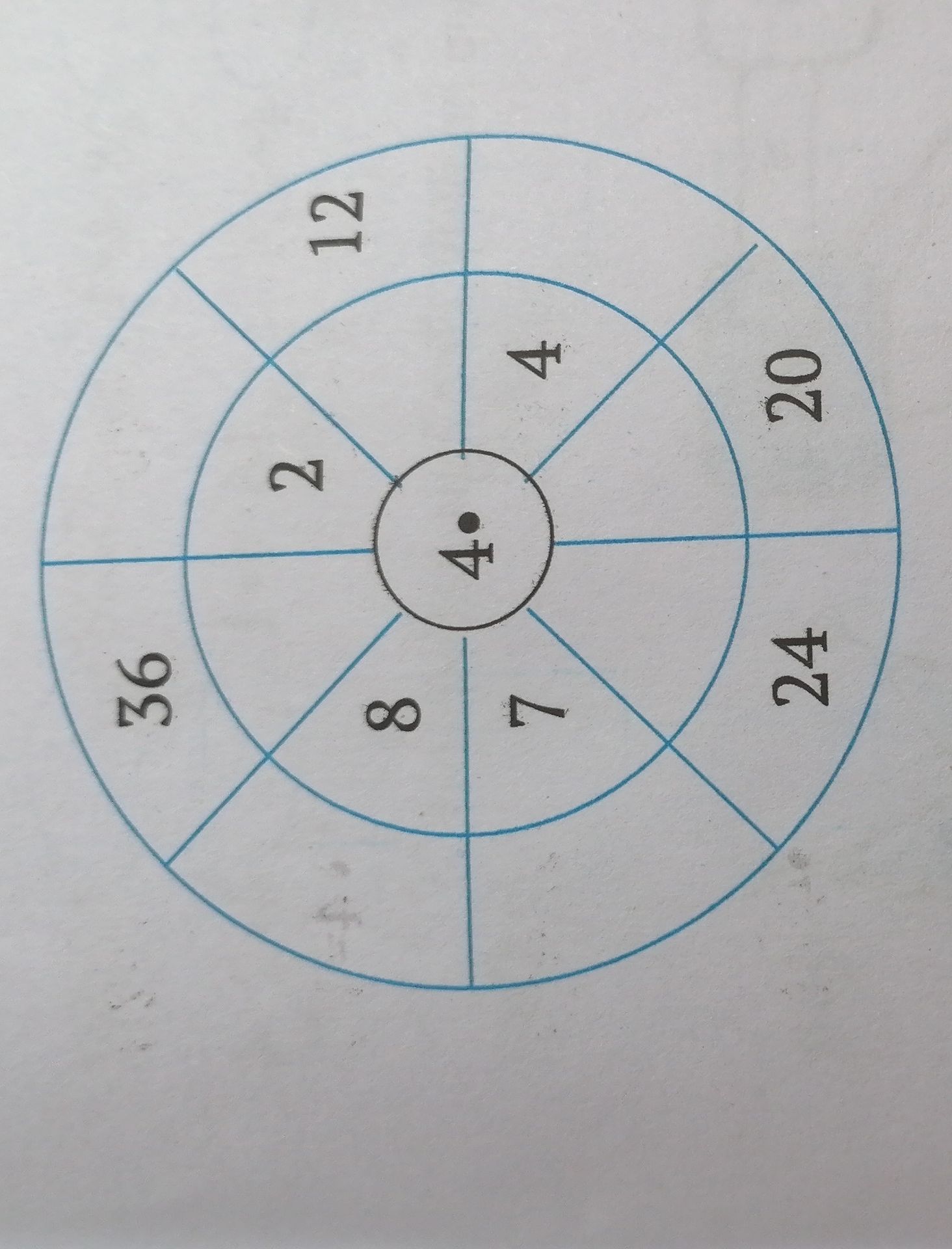
Ответ:
Solution:
The pattern appears to be that the numbers in the outer ring are obtained by multiplying the corresponding numbers in the inner ring by a factor related to the center number (4) and the position.
Let's examine the pairs:
- 2 (inner) and 12 (outer). \( 2 \times 6 = 12 \)
- 4 (inner) and 20 (outer). \( 4 \times 5 = 20 \)
- 7 (inner) and 24 (outer). This pair does not follow a simple multiplication pattern.
- 8 (inner) and 36 (outer). This pair also does not follow a simple multiplication pattern.
Let's consider another approach. Perhaps it involves addition or a combination of operations.
Let's examine the relationship with the center number 4.
- Outer 12, Inner 2. \( 12 - 2 = 10 \)
- Outer 20, Inner 4. \( 20 - 4 = 16 \)
- Outer 24, Inner 7. \( 24 - 7 = 17 \)
- Outer 36, Inner 8. \( 36 - 8 = 28 \)
This does not reveal a clear pattern either.
Let's assume there is a consistent operation applied to the inner numbers to get the outer numbers.
Consider the positions starting from the top and going clockwise:
- Inner: 2, 4, 7, 8
- Outer: 12, 20, 24, 36
Let's try multiplying the inner number by a value that changes based on position or is related to the center number.
If we consider the center number 4:
- For the position with 2: If we multiply 2 by 4, we get 8. This is not 12.
- If we multiply 2 by (center number + something): \( 2 \times (4+2) = 2 \times 6 = 12 \).
- For the position with 4: \( 4 \times (4+1) = 4 \times 5 = 20 \).
- For the position with 7: \( 7 \times (4+?) \)
- For the position with 8: \( 8 \times (4+?) \)
This is not straightforward. Let's re-examine the structure.
The numbers are arranged in sectors of a circle.
Let's consider the possibility that the numbers in the outer ring are derived from the numbers in the inner ring using operations related to their radial position or proximity to other numbers.
Let's focus on the given numbers and look for common factors or relationships.
Consider the possibility of multiplication involving the center number.
- Outer 12, Inner 2. \( 12 = 2 \times 6 \)
- Outer 20, Inner 4. \( 20 = 4 \times 5 \)
- Outer 24, Inner 7. \( 24 \) is not directly related to 7 by simple multiplication.
- Outer 36, Inner 8. \( 36 \) is not directly related to 8 by simple multiplication.
There seems to be a more complex relationship or the given numbers might be part of a sequence with missing elements or a different logic.
Let's assume the number in the center (4) plays a key role. Let's look at the differences again:
- Outer 12, Inner 2. Difference = 10.
- Outer 20, Inner 4. Difference = 16.
- Outer 24, Inner 7. Difference = 17.
- Outer 36, Inner 8. Difference = 28.
Let's try to find a relationship between the inner numbers and the center number to get the outer numbers.
If we consider the inner numbers and the center number 4:
- For inner number 2: \( 2 \times 4 + 4 = 12 \)
- For inner number 4: \( 4 \times 4 + 4 = 20 \)
- For inner number 7: \( 7 \times 4 - 4 = 24 \) (This doesn't seem right as the pattern broke)
Let's try another combination.
- Inner 2, Outer 12. Is there a pattern like \( a \times b + c \) where a is inner, b is center, and c is some constant or another value?
- \( 2 \times 4 + 4 = 12 \)
- \( 4 \times 4 + 4 = 20 \)
- Now for the next pair: Inner 7, Outer 24. If the pattern is \( a \times 4 + 4 \), then \( 7 \times 4 + 4 = 28 + 4 = 32 \), which is not 24.
Let's try multiplication with a shifting factor related to position.
Consider the factors that multiply the inner numbers to get the outer numbers:
- \( 12 / 2 = 6 \)
- \( 20 / 4 = 5 \)
- \( 24 / 7 \approx 3.43 \)
- \( 36 / 8 = 4.5 \)
The sequence of multipliers is 6, 5, approximately 3.43, 4.5. This does not show a clear arithmetic or geometric progression.
Let's re-examine the numbers. It's possible there is a relationship between opposite numbers or numbers adjacent to each other.
Consider the center number 4. The numbers in the inner ring are 2, 4, 7, 8. The numbers in the outer ring are 12, 20, 24, 36.
Let's assume the pattern is of the form \( f(inner, center) = outer \).
Let's try a pattern involving the sum of the inner number and the center number, then multiplied by something.
- \( (2 + 4) \times 2 = 12 \)
- \( (4 + 4) \times 2.5 = 8 \times 2.5 = 20 \)
- \( (7 + 4) \times ? = 11 \times ? = 24 \) (Not a simple factor)
Let's consider a simpler pattern. Perhaps it's the inner number multiplied by a sequence, and the center number is just a distraction or part of a different puzzle.
If we look at the sequence of outer numbers: 12, 20, 24, 36.
And the inner numbers: 2, 4, 7, 8.
Let's check if there's a relationship between adjacent inner numbers and adjacent outer numbers.
- Inner: 2, 4, 7, 8
- Outer: 12, 20, 24, 36
Differences between adjacent inner numbers: 4-2=2, 7-4=3, 8-7=1.
Differences between adjacent outer numbers: 20-12=8, 24-20=4, 36-24=12.
This does not show a clear connection.
Let's go back to the idea of multiplication. The center number is 4.
Let's assume the operation involves the inner number and the center number.
- Pair 1 (top): Inner 2, Outer 12. \( 2 \times 4 = 8 \). \( 8 + 4 = 12 \)
- Pair 2 (right): Inner 4, Outer 20. \( 4 \times 4 = 16 \). \( 16 + 4 = 20 \)
- Pair 3 (bottom): Inner 7, Outer 24. \( 7 \times 4 = 28 \). \( 28 - 4 = 24 \)
- Pair 4 (left): Inner 8, Outer 36. \( 8 \times 4 = 32 \). \( 32 + 4 = 36 \)
The pattern seems to be: (inner number * center number) +/‐ constant. However, the sign changes for the third pair.
Let's re-examine the third pair: Inner 7, Outer 24. If we use \( inner \times 4 + constant \), then \( 7 \times 4 + constant = 28 + constant = 24 \), so \( constant = -4 \).
Let's check the fourth pair: Inner 8, Outer 36. If we use \( inner \times 4 + constant \), then \( 8 \times 4 + constant = 32 + constant = 36 \), so \( constant = 4 \).
The constant changes between +4 and -4.
Let's revisit the second pair: Inner 4, Outer 20. \( 4 \times 4 + 4 = 20 \).
The pattern is not consistent with \( inner \times 4 \) and a constant offset.
Let's assume the pattern is \( inner \times X = outer \) or \( inner + X = outer \) or some combination involving the center number.
Let's consider another possibility. Perhaps the numbers in the outer ring are related to the sum of adjacent inner numbers, or some combination of them.
Let's try to find a pattern of the form \( a \times n + b \) where 'a' and 'b' are constants and 'n' is the inner number, or a combination with the center number.
Let's consider the pairs again:
- Inner 2, Outer 12
- Inner 4, Outer 20
- Inner 7, Outer 24
- Inner 8, Outer 36
Let's examine the ratios of outer to inner:
- \( 12/2 = 6 \)
- \( 20/4 = 5 \)
- \( 24/7 ≈ 3.428 \)
- \( 36/8 = 4.5 \)
The sequence of ratios is 6, 5, \( \frac{24}{7} \), 4.5.
Let's consider the possibility of a relationship between numbers across the center.
- Inner 2 and Inner 7. Outer 12 and Outer 24.
- Inner 4 and Inner 8. Outer 20 and Outer 36.
This does not seem to yield a simple pattern.
Let's look again at the first two pairs and the center number 4.
- Inner 2, Outer 12. \( 2 \times (4+2) = 12 \)
- Inner 4, Outer 20. \( 4 \times (4+1) = 20 \)
The added value is decreasing.
Let's consider the possibility that the operation is consistently \( inner \times X \) where X changes.
Let's try to find a pattern in the multipliers: 6, 5, \( \frac{24}{7} \), 4.5.
Let's assume the pattern involves simple arithmetic operations with the center number.
If we assume the center number is multiplied by the inner number, and then something is added or subtracted.
- \( 2 \times 4 = 8 \). \( 8 + 4 = 12 \).
- \( 4 \times 4 = 16 \). \( 16 + 4 = 20 \).
- \( 7 \times 4 = 28 \). \( 28 - 4 = 24 \).
- \( 8 \times 4 = 32 \). \( 32 + 4 = 36 \).
This pattern works if the operation for the third pair (inner 7) is subtraction of 4, and for the other pairs it's addition of 4.
Let's re-examine the arrangement. The numbers are in sectors.
Let's reconsider the multipliers: 6, 5, \( \frac{24}{7} \), 4.5.
Consider the possibility that the operation is: (inner number * center number) +/- a value.
The pattern appears to be: multiply the inner number by the center number (4), and then add or subtract a value. For the first two and the last pair, 4 is added. For the third pair, 4 is subtracted.
The pattern seems to be: \( \text{outer} = (\text{inner} \times 4) + \text{adjustment} \)
- For inner 2: \( 2 \times 4 + 4 = 12 \)
- For inner 4: \( 4 \times 4 + 4 = 20 \)
- For inner 7: \( 7 \times 4 - 4 = 24 \)
- For inner 8: \( 8 \times 4 + 4 = 36 \)
The pattern is that for most pairs, 4 is added. For the pair with 7, 4 is subtracted.
This implies a pattern based on the inner numbers or their positions. There isn't a perfectly consistent simple arithmetic pattern across all sectors.
However, if we must find a pattern, the most plausible one with a slight variation is the multiplication by the center number (4) with an adjustment of +4 or -4.
Let's assume the pattern is: Multiply the inner number by the center number (4). Then, for the first, second, and fourth sectors, add 4. For the third sector, subtract 4.
It is possible that the third sector has a different rule, or there's a more complex underlying rule.
Given the numbers, a common type of puzzle involves operations related to the center. The pattern \( (\text{inner} \times 4) \text{ with adjustment} \) is the closest observed.
Another possible interpretation: The numbers in the outer ring are obtained by multiplying the inner number by a sequence. The sequence of multipliers is 6, 5, \( \frac{24}{7} \), 4.5. This sequence doesn't have an obvious simple rule.
Let's re-evaluate the \( (\text{inner} \times 4) \text{ adjustment} \) pattern.
It is possible that the adjustment is not always +4 or -4, but depends on the inner number itself or its position.
Let's consider a different perspective: Sum of opposite inner numbers multiplied by something?
- 2 + 7 = 9. 12 + 24 = 36. \( 9 \times 4 = 36 \). This works for one pair of opposite numbers.
- 4 + 8 = 12. 20 + 36 = 56. \( 12 \times ? = 56 \). Not a simple relation.
Let's go back to the first observation that seemed most promising, even with the anomaly:
- Inner 2, Outer 12: \( 2 \times 4 + 4 = 12 \)
- Inner 4, Outer 20: \( 4 \times 4 + 4 = 20 \)
- Inner 7, Outer 24: \( 7 \times 4 - 4 = 24 \)
- Inner 8, Outer 36: \( 8 \times 4 + 4 = 36 \)
The pattern is: (Inner Number $$\times$$ Center Number) $$\pm$$ Center Number.
The adjustment is the center number (4), and it is subtracted for the inner number 7, and added for the other inner numbers.
Answer: The pattern is likely (Inner Number $$\times$$ Center Number) $$\pm$$ Center Number. Specifically, for the inner numbers 2, 4, and 8, the formula is (Inner Number $$\times$$ 4) + 4. For the inner number 7, the formula is (Inner Number $$\times$$ 4) - 4.
Похожие
