
 Алгебра
 Английский
 Биология
 География
 Геометрия
 История
 Русский
 Обществознание
 Физика
 Химия
Химия Информатика
 Литература
 Математика
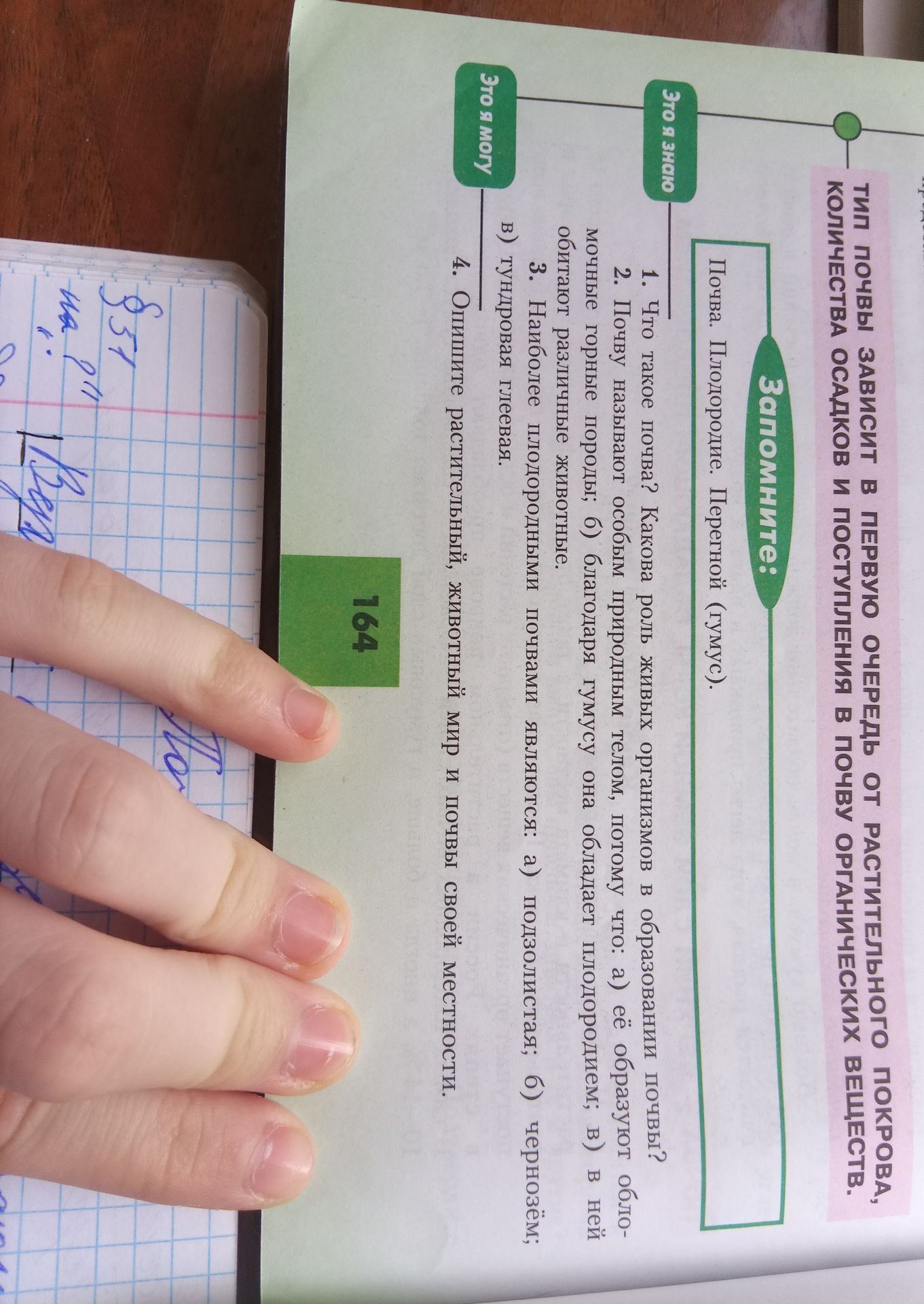
What is the type of soil? What is the role of living organisms in soil formation? 2. Soil is called a special natural body because: a) it is formed by loose rocks; b) thanks to humus, it has fertility; c) various animals live in it. 3. The most fertile soils are: a) podzolic; b) chernozem; c) tundra gley. 4. Describe the plant and animal world and soils of your area.
Ответ:
Analysis of the questions:
The provided image contains questions related to soil science, likely from a geography or biology textbook. The questions cover the definition of soil, the role of living organisms, characteristics of fertile soils, and a descriptive task about local soil conditions.
- Question 1 asks for the definition of soil and the role of living organisms in its formation.
- Question 2 presents a multiple-choice question about why soil is considered a special natural body.
- Question 3 is a multiple-choice question asking to identify the most fertile soil type.
- Question 4 is an open-ended question requiring a description of the local environment's flora, fauna, and soil.
The text also includes a heading "Запомните:" (Remember:) followed by "Почва. Плодородие. Перегной (гумус)." (Soil. Fertility. Humus (humus).), which provides key terms relevant to the questions.
Additionally, there's a statement "ТИП ПОЧВЫ ЗАВИСИТ В ПЕРВУЮ ОЧЕРЕДЬ ОТ РАСТИТЕЛЬНОГО ПОКРОВА, КОЛИЧЕСТВА ОСАДКОВ И ПОСТУПЛЕНИЯ В ПОЧВУ ОРГАНИЧЕСКИХ ВЕЩЕСТВ." (The type of soil depends primarily on the vegetation cover, the amount of precipitation, and the input of organic matter into the soil.) This provides context for factors influencing soil types.
The numbers "164" and "§51" appear to be page or section numbers.
Answering the questions based on the provided text and general knowledge:
- What is soil? What is the role of living organisms in soil formation?
Based on the "Remember" section, soil is a crucial natural resource characterized by its fertility and the presence of humus. Living organisms play a vital role in its formation through decomposition of organic matter, creating humus, and mixing soil layers.
- Soil is called a special natural body because:
The text states that soil's fertility is due to humus. Therefore, option б) благодаря гумусу она обладает плодородием is the most fitting answer based on the provided hints.
- The most fertile soils are:
General knowledge in geography indicates that б) чернозём (chernozem) soils are known for their high fertility due to their rich humus content.
- Describe the plant and animal world and soils of your area.
This question requires local knowledge and cannot be answered from the provided image alone. It asks for a description of the specific environment the student is in.
Summary of answers derived from the image context:
- Soil is a natural body characterized by fertility and humus.
- Living organisms contribute to soil formation and fertility.
- Soil is considered special because of its fertility, which is attributed to humus.
- Chernozem is identified as a highly fertile soil type.
