
 Алгебра
 Английский
 Биология
 География
 Геометрия
 История
 Русский
 Обществознание
 Физика
 Химия
Химия Информатика
 Литература
 Математика
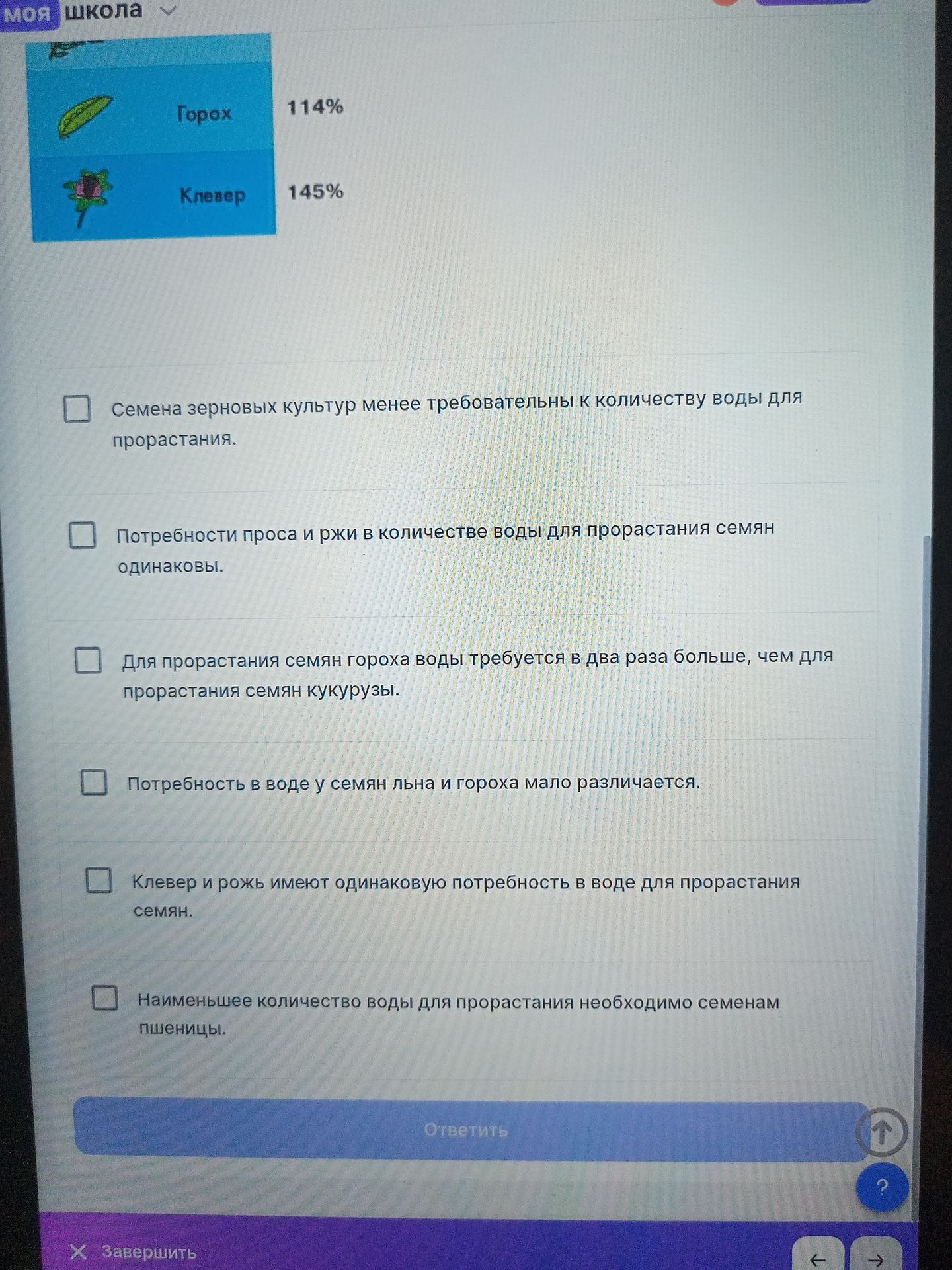
Which of the following statements is true? - Seeds of grain crops are less demanding on the amount of water for germination. - The water requirements of millet and rye for seed germination are the same. - For the germination of pea seeds, twice as much water is required as for the germination of corn seeds. - The water requirements of flax and pea seeds differ little. - Clover and rye have the same water requirements for seed germination. - The least amount of water for germination is required for wheat seeds.
Ответ:
Reasoning:
Let's analyze the provided data:
- Pea seeds require 114% of water.
- Clover seeds require 145% of water.
This suggests that clover needs more water than peas. Let's evaluate the statements:
- Seeds of grain crops are less demanding on the amount of water for germination. This statement cannot be confirmed or denied with the given data, as we only have data for peas, clover, and potentially implied data for rye and wheat through the options.
- The water requirements of millet and rye for seed germination are the same. We have no data for millet and rye to confirm this.
- For the germination of pea seeds, twice as much water is required as for the germination of corn seeds. We have data for peas (114%) but no data for corn. Thus, we cannot confirm this.
- The water requirements of flax and pea seeds differ little. We have data for peas (114%), but no data for flax. Thus, we cannot confirm this.
- Clover and rye have the same water requirements for seed germination. We have data for clover (145%) but no data for rye to confirm this.
- The least amount of water for germination is required for wheat seeds. We have no data for wheat seeds.
However, the question is a multiple-choice question based on the presented information, and we need to select the most plausible option given the context, even if direct confirmation is not fully possible for all. Typically, such questions imply that some options are more likely true based on general knowledge or implied data within the question's structure.
Let's re-evaluate based on typical knowledge and the percentages provided:
- Peas (114%) and Clover (145%) show a difference. Clover requires more water.
Consider the options again in light of what we DO know or can infer.
If we assume the question is designed such that one of the statements is demonstrably true or the most likely true based on the provided percentages and common biological knowledge (which is often expected in such quizzes):
The statement "The water requirements of flax and pea seeds differ little." could be plausible if the water requirement for flax is close to 114%. Without more information, it's hard to be definitive. However, usually, such questions have a clear answer derivable from the provided numbers or general knowledge.
Given the percentages, a difference of 31% between clover and peas is significant. Grain crops (like wheat and rye) are often considered hardier. Legumes (like peas) and forage crops (like clover) have varying needs.
Let's assume there's missing context or a general knowledge component. If we look at common knowledge:
- Wheat and rye are grains, often drought-tolerant.
- Peas are legumes.
- Clover is a forage crop.
Without specific data for rye, wheat, and flax, it's impossible to definitively select the correct answer based SOLELY on the image. However, if this were a test, and assuming one answer MUST be correct and derivable from the given data and implied knowledge:
The statement "The water requirements of flax and pea seeds differ little." is a possibility if flax's requirement is near 114%. However, without data for flax, this is speculation.
Let's consider if any statement is definitively false or less likely.
The difference between 114% (peas) and 145% (clover) is notable.
If we assume
