
 Алгебра
 Английский
 Биология
 География
 Геометрия
 История
 Русский
 Обществознание
 Физика
 Химия
 Информатика
 Литература
 Математика
Ответ:
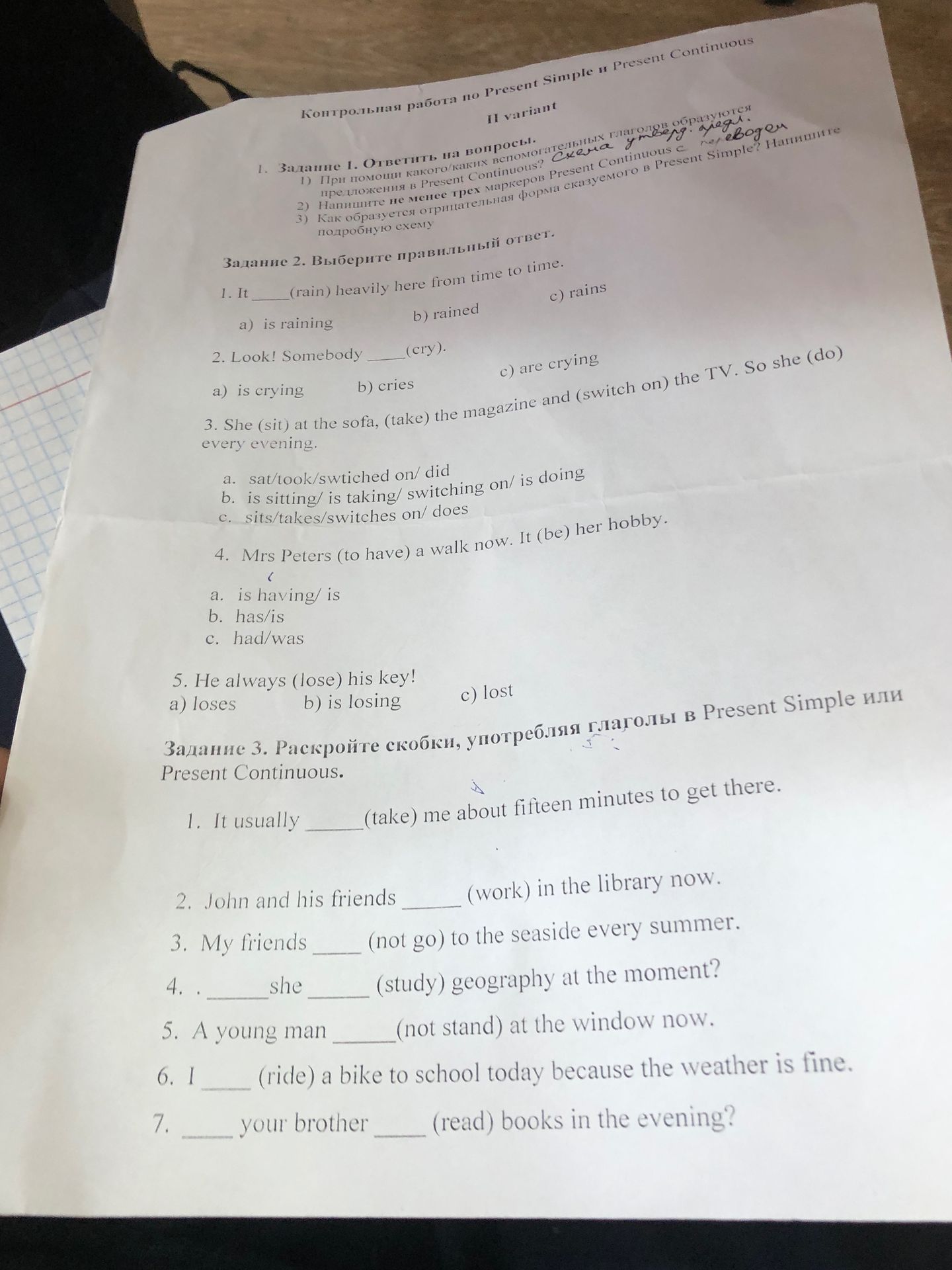
Перевод задания: Answer the questions: 1) Which auxiliary verbs are used to form sentences in the Present Continuous? 2) Write at least three markers of the Present Continuous. 3) How is the negative form of the predicate formed in the Present Simple? Write a detailed pattern.
В Present Continuous используются вспомогательные глаголы am, is, are — формы глагола to be.
The Present Continuous uses the auxiliary verbs am, is, are—forms of the verb to be.
Маркеры Present Continuous: now (сейчас), at the moment (в данный момент), Look! (Посмотри!).
Markers of the Present Continuous: now, at the moment, Look!
Отрицательная форма Present Simple: подлежащее + do not (don’t) или does not (doesn’t) + глагол в начальной форме без to. С I/you/we/they употребляется do not; с he/she/it — does not. После doesn’t окончание -s у смыслового глагола не ставится.
Present Simple negative: subject + do not (don’t) or does not (doesn’t) + base form of the verb. Use do not with I/you/we/they and does not with he/she/it. After doesn’t, the main verb has no -s ending.
