
 Алгебра
 Английский
 Биология
 География
 Геометрия
 История
 Русский
 Обществознание
 Физика
 Химия
Химия Информатика
 Литература
 Математика
Вопрос:
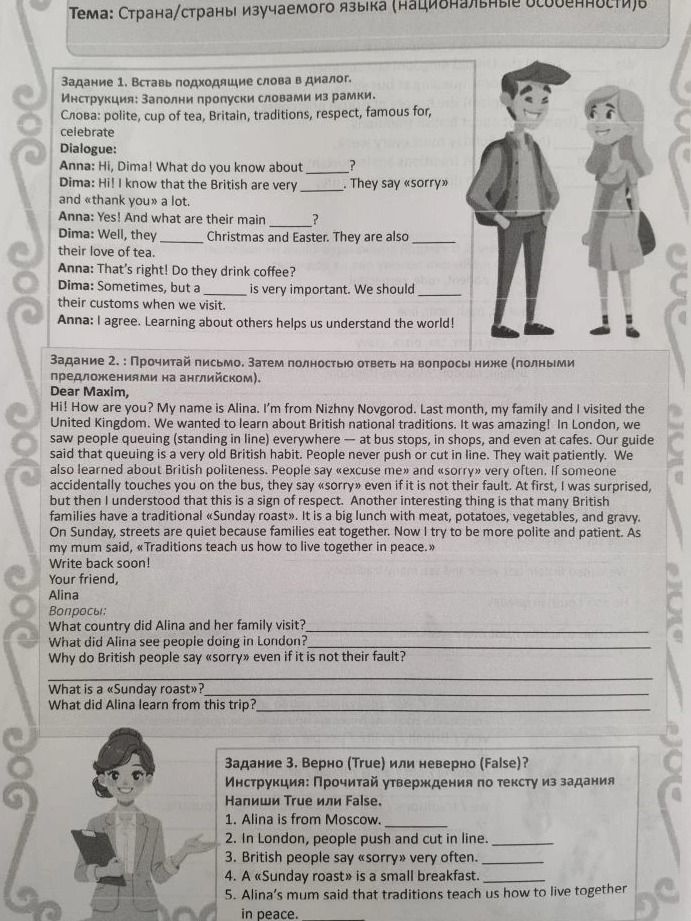
Задание 2.: Прочитай письмо. Затем полностью ответь на вопросы ниже (полными предложениями на английском). Dear Maxim, Hi! How are you? My name is Alina. I'm from Nizhny Novgorod. Last month, my family and I visited the United Kingdom. We wanted to learn about British national traditions. It was amazing! In London, we saw people queuing (standing in line) everywhere - at bus stops, in shops, and even at cafes. Our guide said that queuing is a very old British habit. People never push or cut in line. They wait patiently. We also learned about British politeness. People say «excuse me» and «sorry» very often. If someone accidentally touches you on the bus, they say «sorry» even if it is not their fault. At first, I was surprised, but then I understood that this is a sign of respect. Another interesting thing is that many British families have a traditional «Sunday roast». It is a big lunch with meat, potatoes, vegetables, and gravy. On Sunday, streets are quiet because families eat together. Now I try to be more polite and patient. As my mum said, «Traditions teach us how to live together in peace.» Write back soon! Your friend, Alina Вопросы: What country did Alina and her family visit? What did Alina see people doing in London? Why do British people say «sorry» even if it is not their fault? What is a «Sunday roast»? What did Alina learn from this trip?
Ответ:
Ответ (EN)
- Alina and her family visited the United Kingdom.
- Alina saw people queuing (standing in line) everywhere in London.
- British people say "sorry" even if it is not their fault because it is a sign of respect.
- A "Sunday roast" is a big traditional lunch with meat, potatoes, vegetables, and gravy.
- Alina learned about British traditions, politeness, and how traditions teach us to live together in peace.
Перевод (RU)
- Алина и ее семья посетили Соединенное Королевство.
- Алина видела, как люди стоят в очереди (встают в очередь) повсюду в Лондоне.
- Британцы говорят «извините», даже если это не их вина, потому что это знак уважения.
- «Воскресное жаркое» — это большой традиционный обед с мясом, картофелем, овощами и подливкой.
- Алина узнала о британских традициях, вежливости и о том, как традиции учат нас жить в мире.
Похожие
- Задание 1. Вставь подходящие слова в диалог. Инструкция: Заполни пропуски словами из рамки. Слова: polite, cup of tea, Britain, traditions, respect, famous for, celebrate Dialogue: Anna: Hi, Dima! What do you know about _______? Dima: Hi! I know that the British are very _______. They say «sorry» and «thank you» a lot. Anna: Yes! And what are their main _______? Dima: Well, they _______ Christmas and Easter. They are also _______ their love of tea. Anna: That's right! Do they drink coffee? Dima: Sometimes, but a _______ is very important. We should _______ their customs when we visit. Anna: I agree. Learning about others helps us understand the world!
- Задание 3. Верно (True) или неверно (False)? Инструкция: Прочитай утверждения по тексту из задания Напиши True или False. 1. Alina is from Moscow. 2. In London, people push and cut in line. 3. British people say «sorry» very often. 4. A «Sunday roast» is a small breakfast. 5. Alina's mum said that traditions teach us how to live together in peace.
