
 Алгебра
 Английский
 Биология
 География
 Геометрия
 История
 Русский
 Обществознание
 Физика
 Химия
 Информатика
 Литература
 Математика
Ответ:
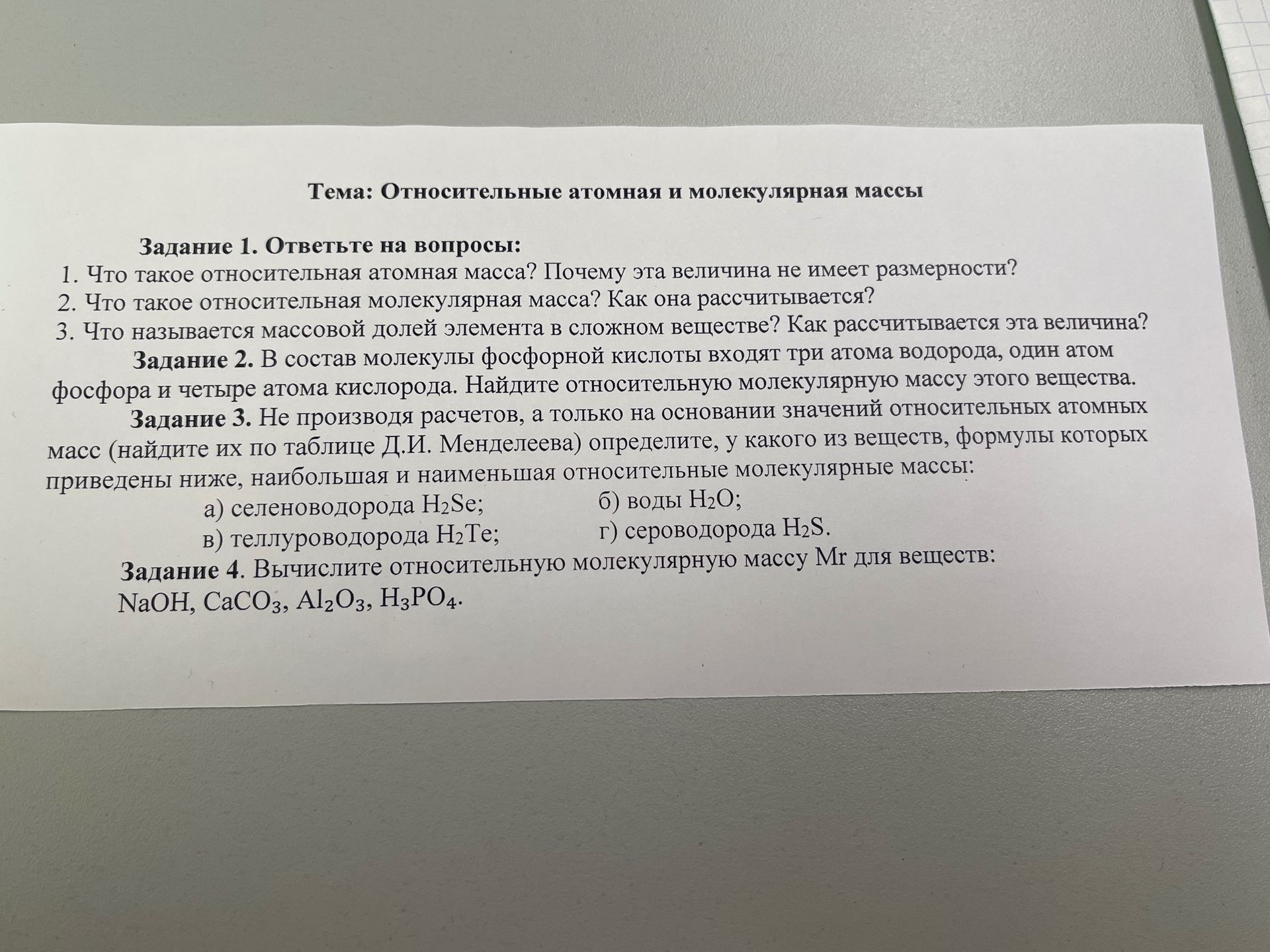
Используем значения относительных атомных масс: \(A_r(\mathrm{Na})=23\), \(A_r(\mathrm{O})=16\), \(A_r(\mathrm{H})=1\), \(A_r(\mathrm{Ca})=40\), \(A_r(\mathrm{C})=12\), \(A_r(\mathrm{Al})=27\), \(A_r(\mathrm{P})=31\).
\(M_r(\mathrm{NaOH})=23+16+1=40\).
\(M_r(\mathrm{CaCO_3})=40+12+3\cdot16=100\).
\(M_r(\mathrm{Al_2O_3})=2\cdot27+3\cdot16=102\).
\(M_r(\mathrm{H_3PO_4})=3\cdot1+31+4\cdot16=98\).
Ответ: \(M_r(\mathrm{NaOH})=40\); \(M_r(\mathrm{CaCO_3})=100\); \(M_r(\mathrm{Al_2O_3})=102\); \(M_r(\mathrm{H_3PO_4})=98\).
