
 Алгебра
 Английский
 Биология
 География
 Геометрия
 История
 Русский
 Обществознание
 Физика
 Химия
Химия Информатика
 Литература
 Математика
Вопрос:
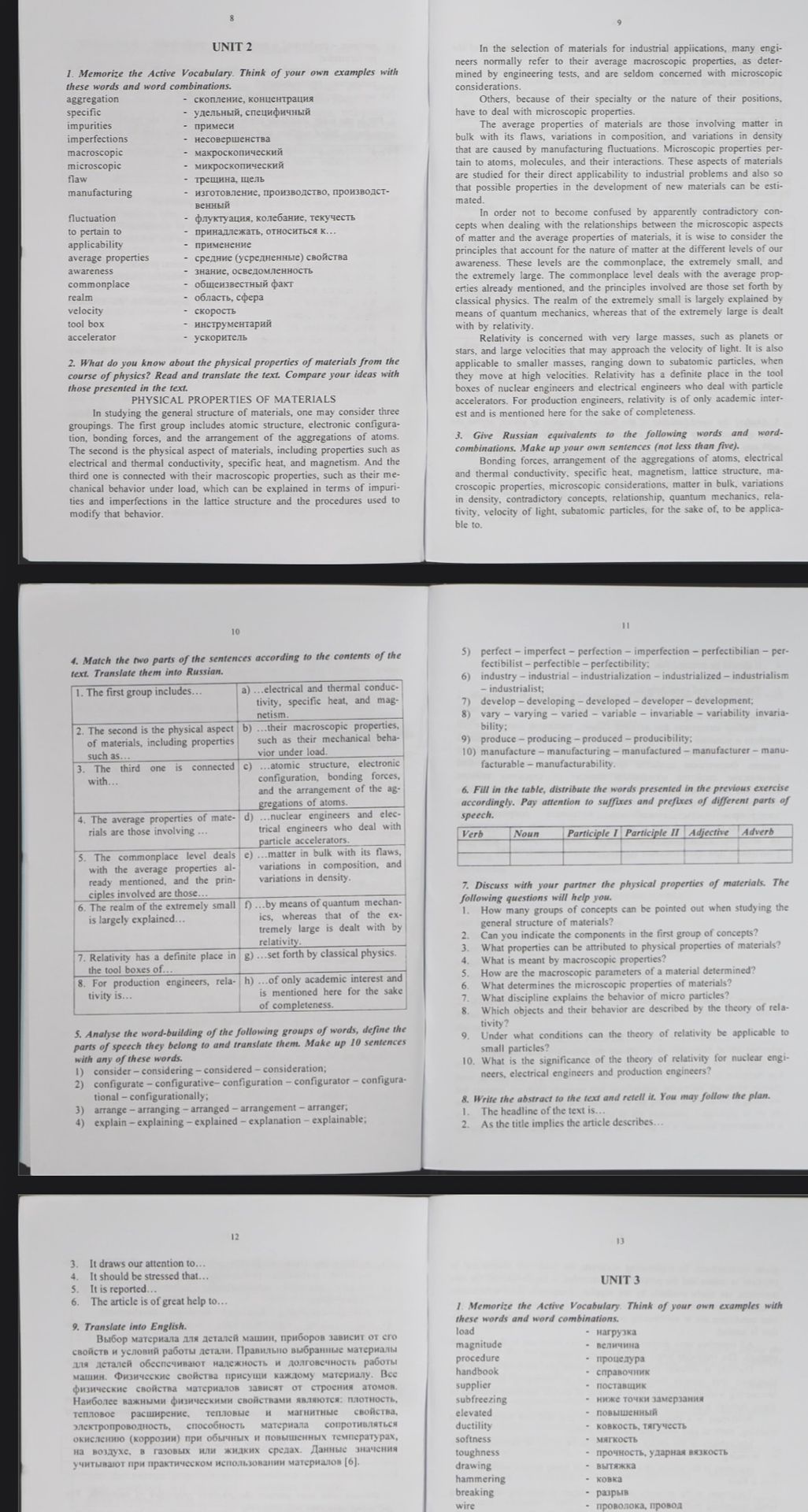
3. Give Russian equivalents to the following words and word-combinations. Make up your own sentences (not less than five).
Ответ:
Russian Equivalents and Sentences:
- Bonding forces - силы связи; Примером сил связи является водородная связь.
- arrangement of the aggregations of atoms - расположение агрегатов атомов; От расположения агрегатов атомов зависит структура кристалла.
- electrical and thermal conductivity - электрическая и тепловая проводимость; Металлы обладают высокой электрической и тепловой проводимостью.
- specific heat - удельная теплоемкость; Удельная теплоемкость воды очень высока.
- magnetism - магнетизм; Магнетизм является важным свойством некоторых материалов.
- lattice structure - кристаллическая решетка; Кристаллическая решетка алмаза очень прочная.
- macroscopic properties - макроскопические свойства; Макроскопические свойства материала можно измерить.
- microscopic considerations - микроскопические соображения; Микроскопические соображения важны для понимания поведения веществ.
- matter in bulk - вещество в массе; Свойства вещества в массе могут отличаться от свойств отдельных молекул.
- variations in density - вариации плотности; Вариации плотности могут влиять на характеристики материала.
- contradictory concepts - противоречивые концепции; Противоречивые концепции могут вызывать споры.
- relationship - взаимосвязь; Существует взаимосвязь между структурой и свойствами.
- quantum mechanics - квантовая механика; Квантовая механика объясняет поведение микрочастиц.
- relativity - теория относительности; Теория относительности имеет большое значение в физике.
- velocity of light - скорость света; Скорость света в вакууме является константой.
- subatomic particles - субатомные частицы; Изучение субатомных частиц ведется в ускорителях.
- for the sake of - ради, во имя; Он сделал это ради спасения друга.
- to be applicable to - быть применимым к; Эта теория применима к большинству случаев.
Похожие
- 1. Memorize the Active Vocabulary. Think of your own examples with these words and word combinations. aggregation specific impurities imperfections macroscopic microscopic flaw manufacturing fluctuation to pertain to applicability average properties awareness commonplace realm velocity tool box accelerator
- 2. What do you know about the physical properties of materials from the course of physics? Read and translate the text. Compare your ideas with those presented in the text.
- 4. Match the two parts of the sentences according to the contents of the text. Translate them into Russian.
- 5. Analyse the word-building of the following groups of words, define the parts of speech they belong to and translate them. Make up 10 sentences with any of these words.
- 6. Fill in the table, distribute the words presented in the previous exercise accordingly. Pay attention to suffixes and prefixes of different parts of speech.
- 7. Discuss with your partner the physical properties of materials. The following questions will help you. 1. How many groups of concepts can be pointed out when studying the general structure of materials? 2. Can you indicate the components in the first group of concepts? 3. What properties can be attributed to physical properties of materials? 4. What is meant by macroscopic properties? 5. How are the macroscopic parameters of a material determined? 6. What determines the microscopic properties of materials? 7. What discipline explains the behavior of micro particles? 8. Which objects and their behavior are described by the theory of relativity? 9. Under what conditions can the theory of relativity be applicable to small particles? 10. What is the significance of the theory of relativity for nuclear engineers, electrical engineers and production engineers?
- 8. Write the abstract to the text and retell it. You may follow the plan. 1. The headline of the text is... 2. As the title implies the article describes...
- 9. Translate into English. Выбор материала для деталей машин, приборов зависит от его свойств и условий работы детали. Правильно выбранные материалы для деталей обеспечивают надежность и долговечность работы машин. Физические свойства присущи каждому материалу. Все физические свойства материалов зависят от строения атомов. Наиболее важными физическими свойствами являются: плотность, тепловое расширение, тепловые и магнитные свойства, электропроводность, способность материала сопротивляться окислению (коррозии) при обычных и повышенных температурах, на воздухе, в газовых или жидких средах. Данные значения учитывают при практическом использовании материалов [6].
