
 Алгебра
 Английский
 Биология
 География
 Геометрия
 История
 Русский
 Обществознание
 Физика
 Химия
 Информатика
 Литература
 Математика
Ответ:
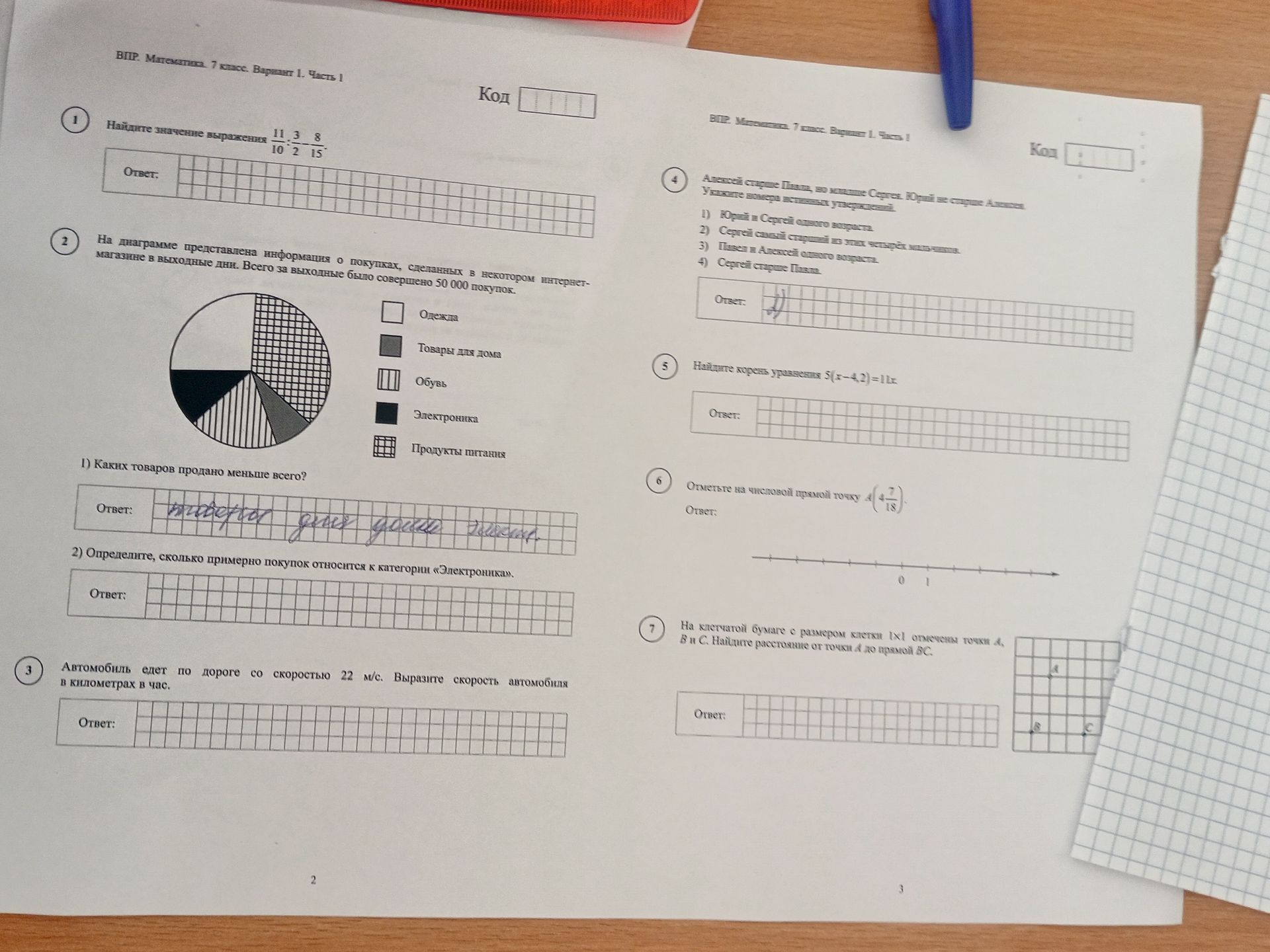
The problem describes the age relationships between four boys: Alexey, Pavel, Sergey, and Yuri.
Let's denote their ages as A (Alexey), P (Pavel), S (Sergey), and Y (Yuri).
From the given information:
- Alexey is older than Pavel: A > P
- Alexey is younger than Sergey: S > A
- Yuri is not older than Alexey: Y ≤ A
Combining these inequalities:
S > A > P
and Y ≤ A
This means Sergey is definitely the oldest among S, A, and P.
Alexey is older than Pavel.
Yuri is either younger than Alexey or the same age as Alexey.
Let's analyze the statements:
1) Yuri and Sergey are the same age.
We know S > A and Y ≤ A. There is no information to suggest Y = S. In fact, since S > A, it's unlikely that Y = S unless A is older than S, which is contradicted. So, this statement is likely false.
2) Sergey is the oldest of these four boys.
We know S > A, A > P, and Y ≤ A.
Since S > A, and A is greater than or equal to Y, and A is greater than P, Sergey (S) is older than A, P, and Y (unless Y=A, in which case S is still older than A=Y). Therefore, Sergey is indeed the oldest.
This statement is true.
3) Pavel and Alexey are the same age.
We are given A > P. So, this statement is false.
4) Sergey is older than Pavel.
We know S > A and A > P. By the transitive property, S > P. So, this statement is true.
Let's summarize:
Statement 1: False
Statement 2: True
Statement 3: False
Statement 4: True
The true statements are 2 and 4.
Краткое пояснение: Необходимо сопоставить информацию о возрасте мальчиков, представив ее в виде неравенств, а затем проверить истинность каждого утверждения.
Пошаговое решение:
Обозначим возраст мальчиков первыми буквами их имен:
- Алексей (А), Павел (П), Сергей (С), Юрий (Ю).
Из условия задачи следует:
- Алексей старше Павла: \( A > P \)
- Алексей младше Сергея: \( S > A \)
- Юрий не старше Алексея: \( Ю \le A \)
Объединяя эти неравенства, получаем:
- \( S > A > P \)
- \( Ю \le A \)
Это означает, что Сергей старше Алексея, который старше Павла. Юрий либо младше Алексея, либо одного возраста с ним.
Проверим утверждения:
- Юрий и Сергей одного возраста. \( Ю = С \)? Так как \( S > A \) и \( Ю \le A \), то \( S > Ю \). Утверждение ложное.
- Сергей самый старший из этих четырёх мальчиков. \( S \) - самый старший? Из \( S > A \), \( A > P \) и \( Ю \le A \) следует, что \( S \) старше всех. Утверждение истинное.
- Павел и Алексей одного возраста. \( П = A \)? Из условия \( A > P \) следует, что это ложно.
- Сергей старше Павла. \( S > P \)? Поскольку \( S > A \) и \( A > P \), то по свойству транзитивности \( S > P \). Утверждение истинное.
Истинные утверждения: 2 и 4.
Ответ: 2, 4
