
 Алгебра
 Английский
 Биология
 География
 Геометрия
 История
 Русский
 Обществознание
 Физика
 Химия
 Информатика
 Литература
 Математика
Ответ:
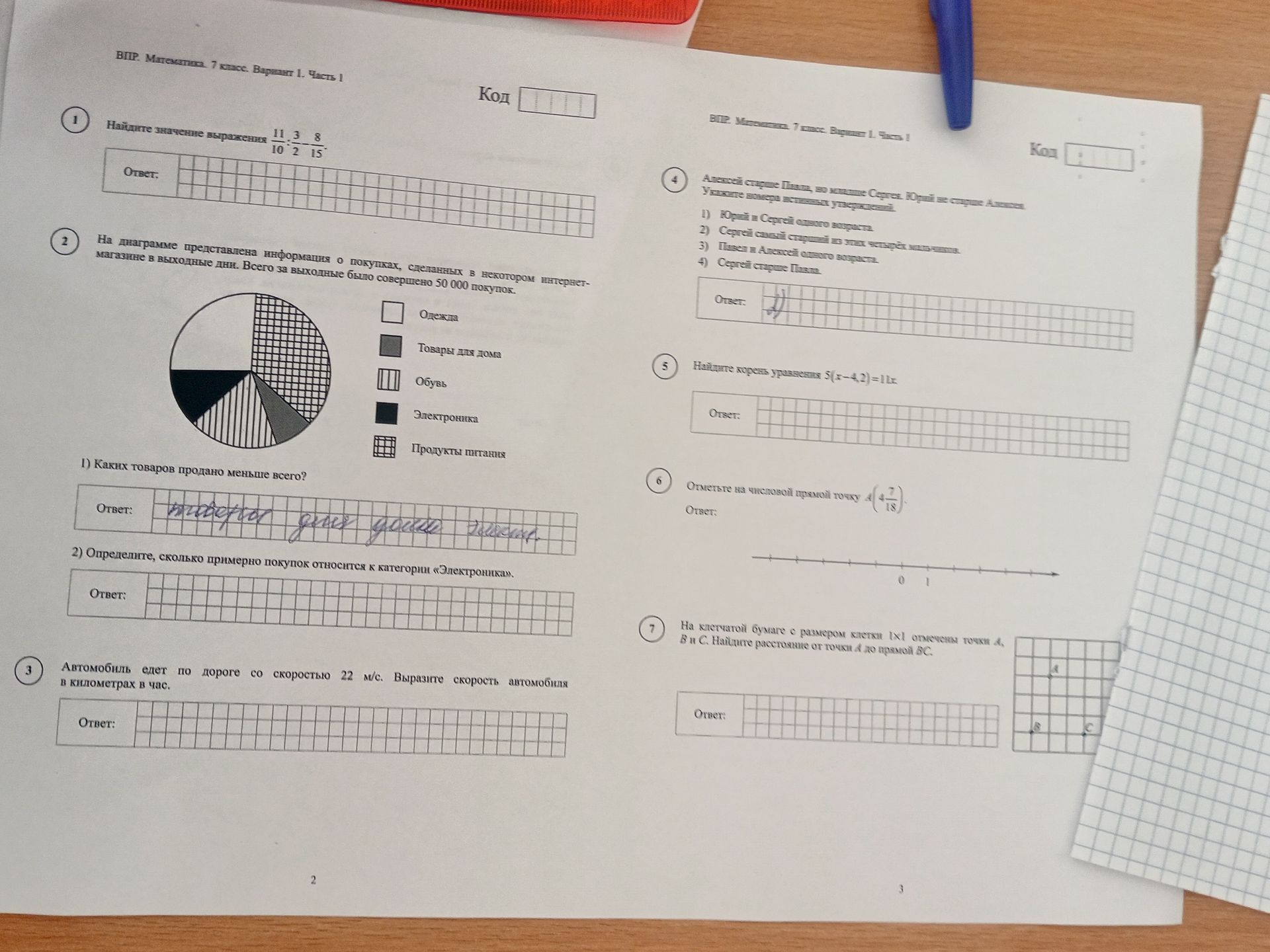
The question asks to mark the point A (4 and 7/18) on the number line.
The number line is shown with markings for 0 and 1. This means each unit on the number line represents 1.
The number we need to mark is \( 4\frac{7}{18} \). This is a mixed number, which means it is 4 whole units plus a fraction of the next unit.
1. Identify the whole number part: The whole number part is 4. This means the point will be located to the right of the number 4 on the number line.
2. Identify the fractional part: The fractional part is \( \frac{7}{18} \). This fraction is between 0 and 1, representing a portion of the segment between two consecutive integers.
3. Locate the position on the number line:
Since the number is \( 4\frac{7}{18} \), it will be located between the integer 4 and the integer 5.
To be more precise, \( \frac{7}{18} \) is slightly less than \( \frac{9}{18} = \frac{1}{2} \). So, the point will be slightly to the left of the midpoint between 4 and 5.
To mark this on the given number line, we need to assume the number line extends to at least 5. Since the number line shown only goes up to 1, we can infer that the task is to conceptually place the point based on its value. If we were to draw a number line that extends, we would:
- Find the position for the integer 4.
- Divide the segment between 4 and 5 into 18 equal parts.
- Count 7 parts from the number 4 towards the number 5.
Since the provided image shows the number line from 0 to 1, and the question asks to mark \( 4\frac{7}{18} \), it's likely a conceptual task or the provided number line is an example of how to mark fractions, and the actual marking should be done on an imagined number line. However, if we have to interpret the image literally, it's not possible to mark \( 4\frac{7}{18} \) on the given segment [0, 1].
Assuming the question implies marking it on a number line where the unit is represented and extended:
- The point \( 4\frac{7}{18} \) is greater than 4 and less than 5.
- The fraction \( \frac{7}{18} \) is approximately 0.389.
- So, the number is approximately 4.389.
To show this conceptually on the provided number line segment [0, 1], one would first understand that \( 4\frac{7}{18} \) lies far to the right of this segment. If the question implies to mark it on a number line that *would* contain it, the position relative to 4 and 5 would be important.
Given the grid below for question 7, it's possible that question 6 is meant to be answered by drawing on a physical copy or by indicating the general location.
Since I cannot draw on the image, I will describe the location conceptually.
The point \( 4\frac{7}{18} \) is located on the number line to the right of 4 and to the left of 5. The fractional part \( \frac{7}{18} \) means it is \( 7/18 \) of the way from 4 to 5. Since \( 7/18 \) is less than \( 1/2 \) (which is \( 9/18 \)), the point is closer to 4 than to 5.
If the task requires placing a marker on the visual representation provided, it's impossible as the number is outside the [0, 1] range. However, I will provide the conceptual answer.
Краткое пояснение: Для отметки числа на числовой прямой необходимо определить его целую и дробную части. Целая часть указывает на ближайшее целое число, а дробная — на положение между двумя соседними целыми числами.
Пошаговое решение:
Число для отметки: \( 4\frac{7}{18} \). Это смешанное число, состоящее из целой части 4 и дробной части \( \frac{7}{18} \).
- Целая часть: 4. Это означает, что точка будет находиться правее числа 4 на числовой прямой.
- Дробная часть: \( \frac{7}{18} \). Эта дробь меньше 1, значит, точка будет находиться между целыми числами 4 и 5.
- Положение точки: \( \frac{7}{18} \) — это примерно 0.389. Точка \( 4\frac{7}{18} \) находится на расстоянии 0.389 от числа 4 в направлении числа 5. Так как \( \frac{7}{18} < \frac{9}{18} = \frac{1}{2} \), точка будет ближе к 4, чем к 5.
- Отметка на числовой прямой: На числовой прямой, где отмечены 0 и 1, точка \( 4\frac{7}{18} \) будет находиться далеко справа, между отметками 4 и 5.
Ответ: Точка A (4 7/18) отмечается на числовой прямой правее числа 4, на расстоянии 7/18 единичного отрезка между 4 и 5.
