
 Алгебра
 Английский
 Биология
 География
 Геометрия
 История
 Русский
 Обществознание
 Физика
 Химия
Химия Информатика
 Литература
 Математика
Вопрос:
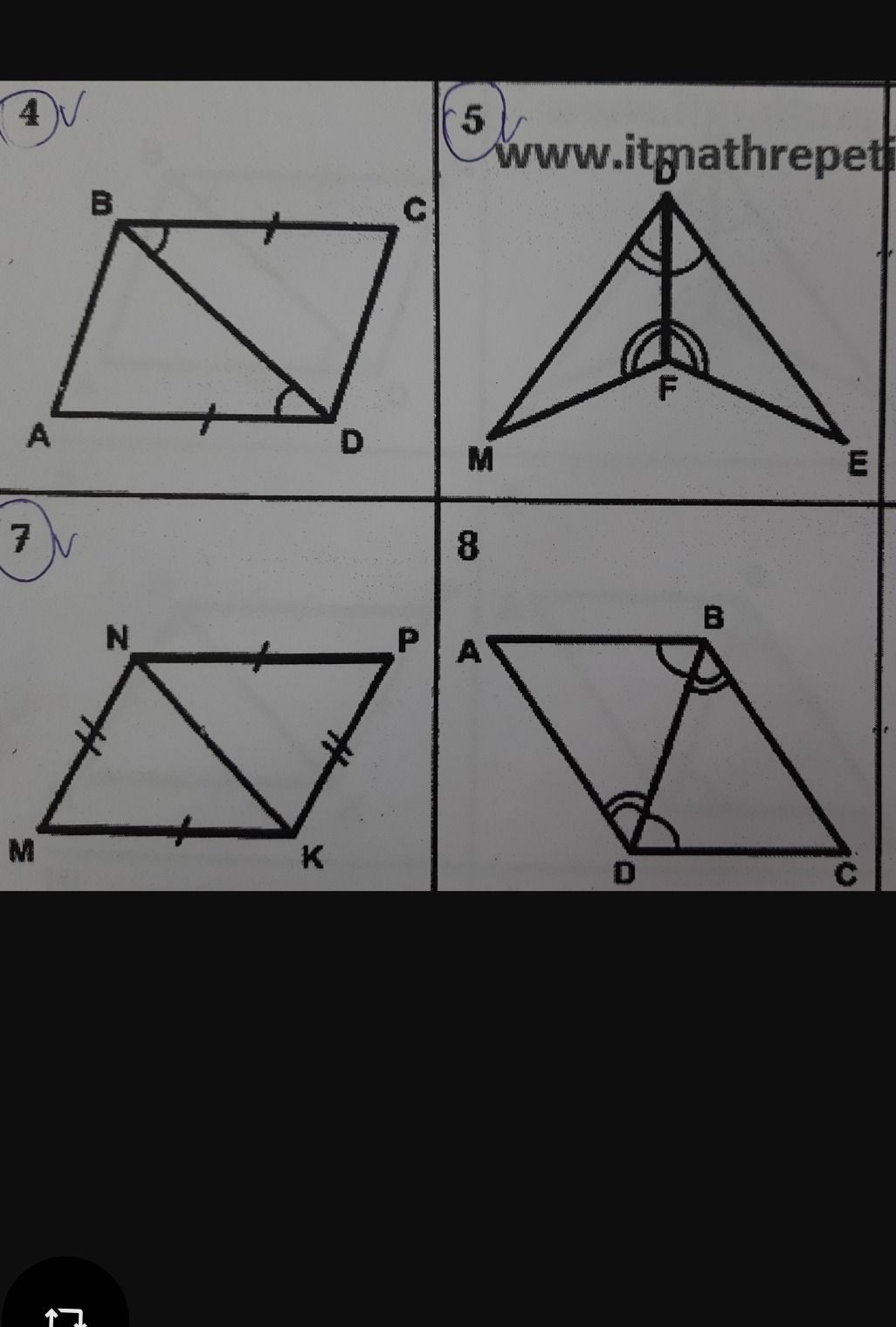
Analyze image 5, identifying the type of triangle and the geometric properties suggested by the markings.
Ответ:
Image 5 Analysis:
The image shows a triangle MDE with a point F inside. A line segment DF is drawn, which appears to be an altitude or angle bisector.
Observations from markings:
- The angle at vertex D is divided into two equal angles by the line segment DF (indicated by single arcs on ∡MDF and ∡EDF). This means DF is the angle bisector of ∡MDE.
- The line segment DF is marked with tick marks, suggesting it is equal in length to a portion of the base or another segment. However, there are no other segments marked with the same tick marks to establish equality.
- The angles at point F on the segment ME are marked with double arcs, suggesting they are equal. Since these are angles on a straight line, they must be supplementary (add up to 180 degrees). If they are equal, each must be 90 degrees. This indicates that DF is perpendicular to ME, making DF an altitude.
Conclusion:
The markings suggest that DF is both the angle bisector of ∡MDE and the altitude to side ME.
In a triangle, if an angle bisector from a vertex is also the altitude to the opposite side, then the triangle must be an isosceles triangle, with the sides adjacent to the bisected angle being equal (MD = ED).
Answer: The triangle MDE is likely an isosceles triangle, with DF acting as both an angle bisector and an altitude. This implies that MD = ED.
Похожие
- Identify the type of quadrilateral shown in image 4 and explain why, based on the markings.
- Describe the properties of the quadrilateral in image 7 based on the given markings.
- Analyze image 8. What geometric properties can be inferred from the markings on triangle ABC and its internal line segment BD?
