
 Алгебра
 Английский
 Биология
 География
 Геометрия
 История
 Русский
 Обществознание
 Физика
 Химия
Химия Информатика
 Литература
 Математика
Вопрос:
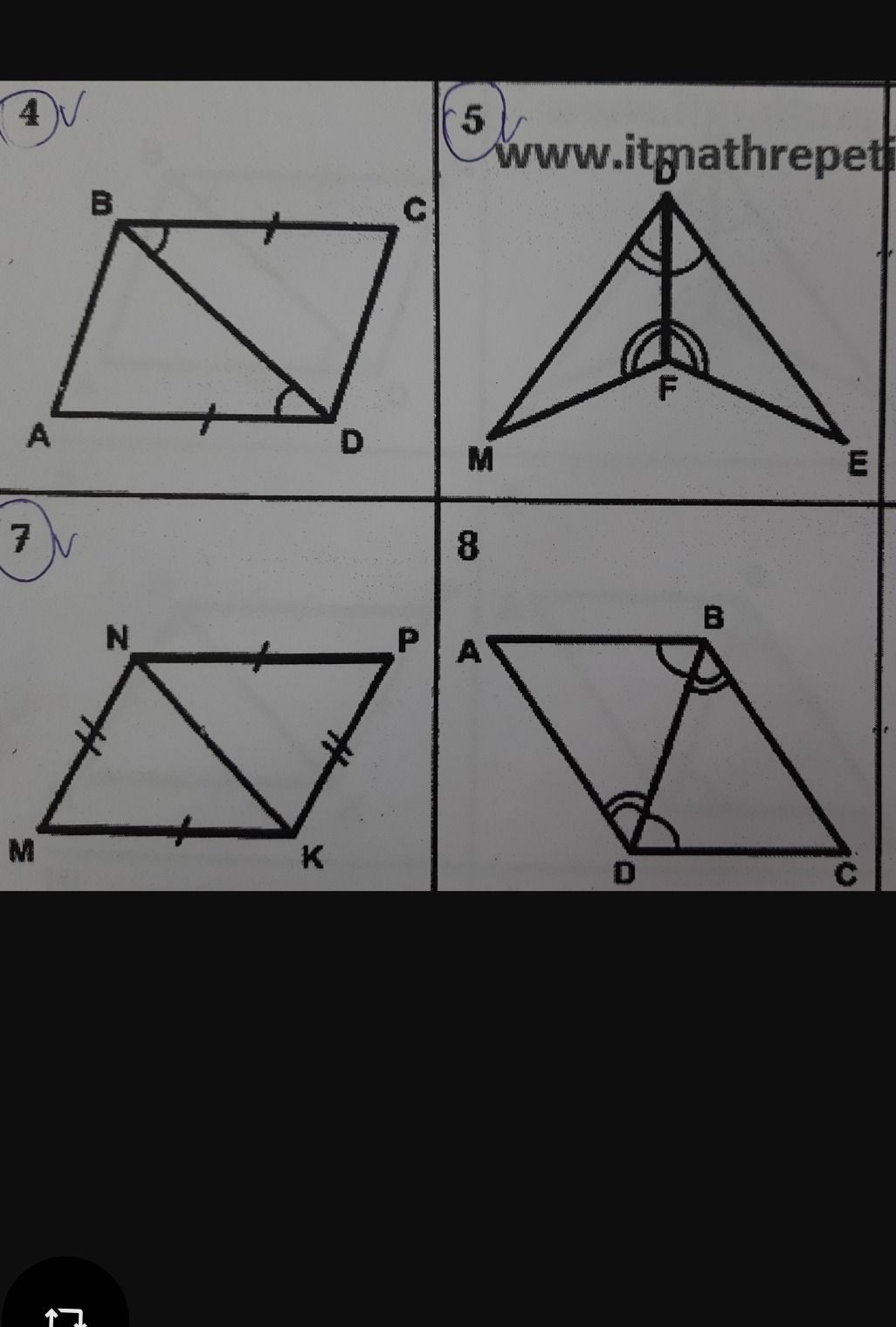
Analyze image 8. What geometric properties can be inferred from the markings on triangle ABC and its internal line segment BD?
Ответ:
Image 8 Analysis:
The image shows a triangle ABC with a line segment BD drawn from vertex B to side AC.
Observations from markings:
- Angle ∡ABD is marked with a single arc.
- Angle ∡CBD is marked with a single arc. This indicates that BD is the angle bisector of ∡ABC, meaning ∡ABD = ∡CBD.
- Angle ∡BAC is marked with a double arc.
- Angle ∡BCA is marked with a double arc. This indicates that ∡BAC = ∡BCA.
Conclusion:
Based on the markings:
- The equal angles at vertices A and C (∡BAC = ∡BCA) imply that the sides opposite these angles are equal in length, i.e., BC = AB. Therefore, triangle ABC is an isosceles triangle.
- The line segment BD bisects the angle ∡ABC. In an isosceles triangle, the angle bisector from the vertex angle (the angle between the two equal sides) is also the altitude and the median to the base. While BD is shown as an angle bisector, it's not explicitly marked as an altitude or median. However, the equality of base angles is a strong indicator of an isosceles triangle.
Answer: Triangle ABC is an isosceles triangle because the base angles ∡BAC and ∡BCA are marked as equal. BD is the angle bisector of ∡ABC.
Похожие
