
 Алгебра
 Английский
 Биология
 География
 Геометрия
 История
 Русский
 Обществознание
 Физика
 Химия
Химия Информатика
 Литература
 Математика
Вопрос:
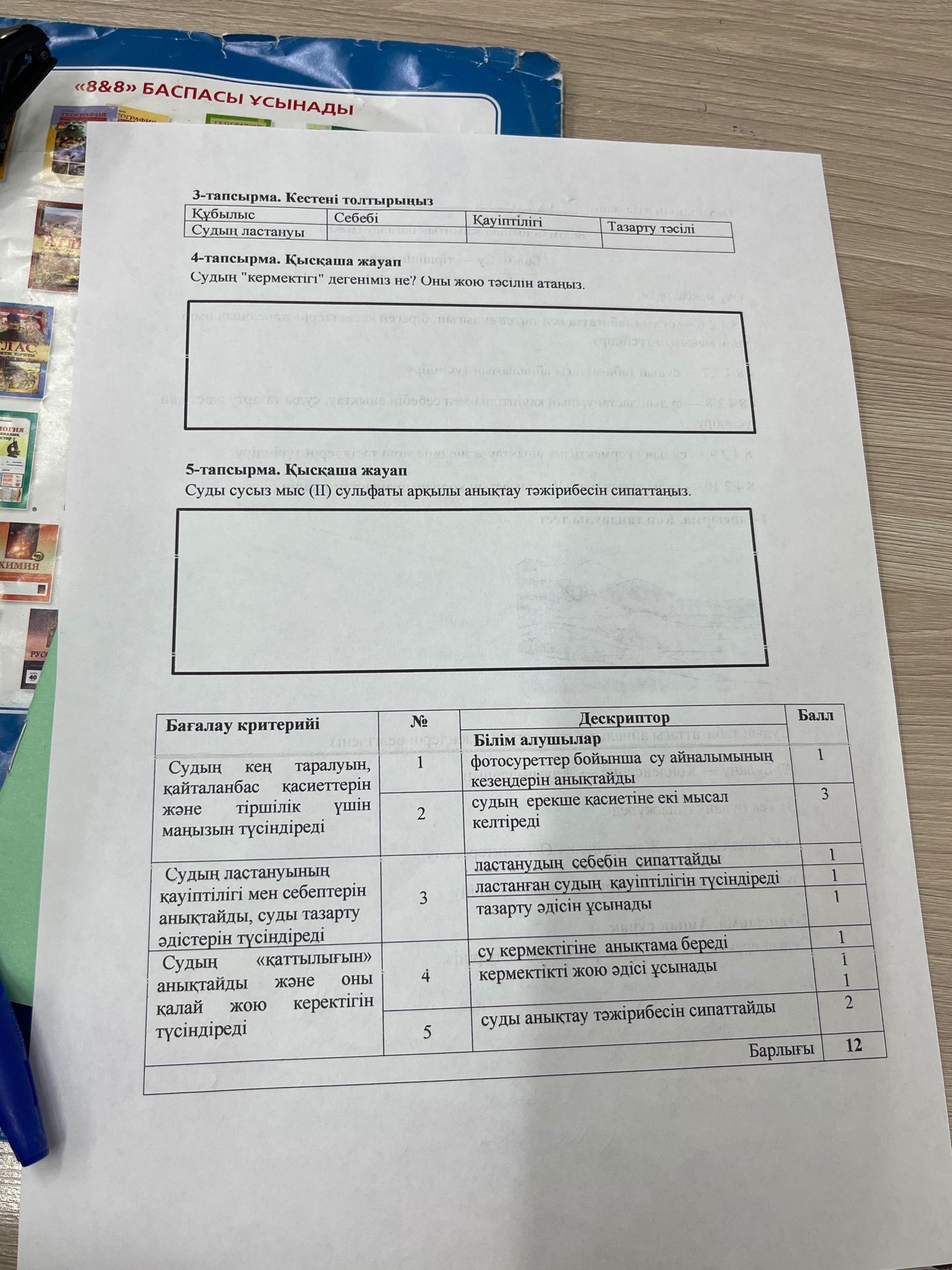
Describe the experiment to determine water by copper (II) sulfate (Task 5. Short answer).
Ответ:
Experiment to Determine Water using Copper (II) Sulfate:
This experiment relies on the property of anhydrous copper (II) sulfate (CuSO₄) to react with water and form copper (II) sulfate pentahydrate (CuSO₄·5H₂O), which is blue in color. Anhydrous copper (II) sulfate is a white crystalline solid.
- Procedure: Take a small amount of anhydrous copper (II) sulfate powder in a clean, dry test tube or dish.
- Observation: Observe the color of the anhydrous copper (II) sulfate. It should be white.
- Exposure to Water: Introduce a small amount of the substance suspected to contain water (e.g., a liquid or a moist solid) to the anhydrous copper (II) sulfate. If water is present, a reaction will occur.
- Result: If water is present, the white anhydrous copper (II) sulfate will turn blue, indicating the formation of copper (II) sulfate pentahydrate. The intensity of the blue color may give an indication of the amount of water present.
Explanation: The chemical reaction is:
- \[ \text{CuSO}_4\text{(s, white)} + 5\text{H}_2\text{O(l)} \rightarrow \text{CuSO}_4 \cdot 5\text{H}_2\text{O(s, blue)} \]
This experiment is a qualitative test for the presence of water.
Похожие
