
 Алгебра
 Английский
 Биология
 География
 Геометрия
 История
 Русский
 Обществознание
 Физика
 Химия
Химия Информатика
 Литература
 Математика
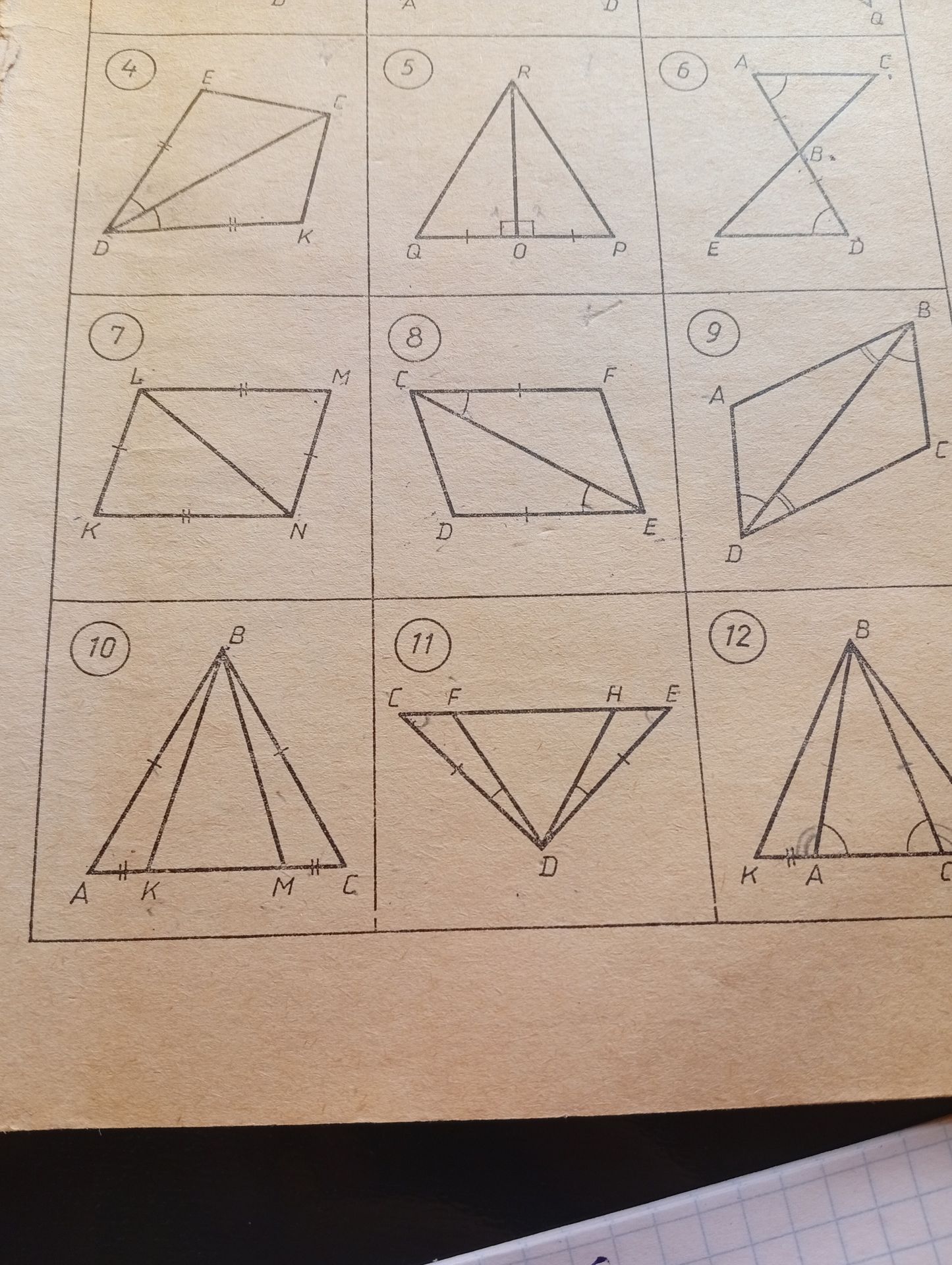
Figure 8. Given △CDF, CD = CF, and ∠CDF = ∠CFD. Point E is on CD and point F is on DF. Line segment CE is drawn. If △CDE ≅ △CFE, prove that △CDF is an isosceles triangle.
Ответ:
Proof:
We are given a triangle △CDF and points E on CD and F on DF. We are also given that △CDE ≅ △CFE.
The problem statement seems to have a typo. Point F is a vertex of △CDF, so it cannot be on DF as a separate point. Assuming E is on CD and another point, let's call it G, is on DF, and we have CE and CG drawn. Or, perhaps E is on CD and some point H is on DF, and we are given △CEH ≅ △CFH.
Let's re-interpret based on the figure. The figure shows △CDF. Point E is on CD, and a line segment FE is drawn. The congruence given is △CDE ≅ △CFE. This means that triangle CDE (with vertices C, D, E) is congruent to triangle CFE (with vertices C, F, E).
Let's list the corresponding parts from the congruence △CDE ≅ △CFE:
- CD corresponds to CF. Therefore, CD = CF.
- DE corresponds to FE. Therefore, DE = FE.
- CE corresponds to CE. (This is a common side).
- ∠CDE corresponds to ∠CFE. Therefore, ∠CDE = ∠CFE.
- ∠CED corresponds to ∠CEF. Therefore, ∠CED = ∠CEF.
- ∠DCE corresponds to ∠FCE. Therefore, ∠DCE = ∠FCE.
We are given that in △CDF, CD = CF (from the congruence statement).
A triangle is defined as isosceles if it has at least two sides of equal length.
Since we have shown that CD = CF from the given congruence △CDE ≅ △CFE, the triangle △CDF has two equal sides (CD and CF).
Therefore, △CDF is an isosceles triangle.
Additionally, from the congruence, we have ∠CDE = ∠CFE. Since E lies on CD and F is a vertex, ∠CDE is actually ∠CDF, and ∠CFE is an angle within △CFE.
If we consider the angles of △CDF:
- ∠CDF (which is ∠CDE from the congruence)
- ∠CFD
- ∠DCF (which is ∠DCE from the congruence)
From the congruence, we know ∠CDE = ∠CFE. This implies ∠CDF = ∠CFE. However, ∠CFE is not necessarily equal to ∠CFD.
Let's focus on the side equality.
Given: △CDE ≅ △CFE.
From the congruence: CD = CF (corresponding sides).
Definition of isosceles triangle: A triangle with at least two sides of equal length.
Conclusion: Since CD = CF, △CDF is an isosceles triangle.
Похожие
- Figure 4. The given figure shows a quadrilateral DECK, where DE = EK and ∠EDC = ∠KDC. Prove that △DEC is an isosceles triangle.
- Figure 5. Given △ROP, RO = OP, and RO ⊥ OP. What is the measure of ∠ORP?
- Figure 6. Given △ABC and △EDB, ∠BAC = ∠BED, AB = ED, and AC = EB. Prove that △ABC ≅ △EDB.
- Figure 7. Given parallelogram LMCF, with LM = MF and ∠MLF = 90°. Prove that LMCF is a square.
- Figure 9. Given quadrilateral ABCD, with AB || DC and AD || BC. Also, ∠ADC = ∠BCD. Prove that ABCD is a square.
